RP Woodworks

  • Home
  • Reviews
  • Projects
  • Tools
  • Woodworking Techniques
  • About

Grain Filling & Sealing

Grain fillers, sanding sealers and knot sealing before the topcoat.

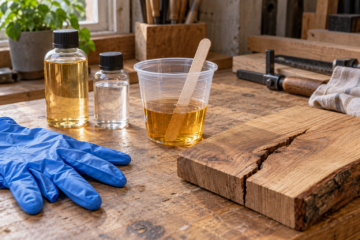
AI-generated editorial illustration of wood epoxy
Grain Filling & Sealing

How to Use Epoxy Filler in Deep Wood Voids

Deep voids in wood—large knots, insect damage, cracks, and missing edges—need more than ordinary wood filler. Most ready-mixed fillers shrink, crack, or fall out when packed into a cavity deeper than about 1/4 inch. Two-part epoxy filler is a better choice because it cures into a hard, bonded mass and Read more
By , 1 weekSeptember 25, 2026 ago
AI-generated editorial illustration of wood epoxy
Grain Filling & Sealing

Best Epoxy for Filling Knots and Voids in Wood

Knots and voids are where wood projects often fail. A loose knot can fall out during machining, while a crack or bark pocket can swallow finish and collect dirt. Epoxy is usually the most reliable filler because it bonds to the surrounding wood, seals the defect, and can be tinted Read more

By , 1 weekSeptember 25, 2026 ago
AI-generated editorial illustration of wood epoxy
Grain Filling & Sealing

Epoxy vs Wood Glue for Filling Gaps in Timber Joints

Gap filling is not the same as gluing. A glue joint works best when two pieces of timber fit closely, while a gap leaves the adhesive unsupported across part of its width. That distinction is why epoxy usually outperforms wood glue in a genuinely open joint—but it is not automatically Read more

By , 1 weekSeptember 25, 2026 ago
AI-generated editorial illustration of wood epoxy
Grain Filling & Sealing

How to Prepare a Wood Surface Before Using Epoxy Filler

Epoxy filler can repair knots, cracks, voids, chipped edges, and deep dents, but it will not hide poor surface preparation. Epoxy bonds best to clean, solid, slightly rough wood. Dust, oil, loose fibers, and excess moisture can cause weak adhesion, bubbles, staining, or a repair that breaks away when the Read more

By , 2 weeksSeptember 25, 2026 ago
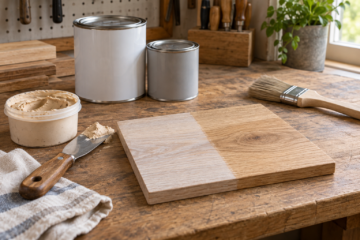
AI-generated editorial illustration of wood fillers and finishing prep
Grain Filling & Sealing

How to Match Wood Filler Color to a Clear-Finished Surface

Matching filler to a clear-finished surface is harder than matching it to stained wood. Clear finish leaves the wood’s natural color visible, and the color varies between boards, grain lines, end grain, and even areas of the same board. Filler also reflects light differently from wood. A patch that looks Read more

By , 2 weeksSeptember 25, 2026 ago
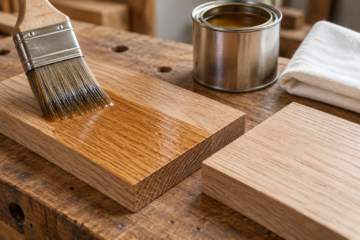
AI-generated editorial illustration: brush applying a clear wood finish to a board beside an unfinished offcut.
Grain Filling & Sealing

How to Fill Open Grain Before Lacquering Walnut

Why fill walnut before lacquering Walnut is a ring-porous hardwood with open pores that can show as small pits and dark lines beneath a clear finish. Lacquer builds a film on the surface; it does not reliably fill those pores. If you want a smooth, level top, fill them first. Read more

By , 2 weeksSeptember 25, 2026 ago
AI-generated editorial illustration of wood epoxy
Grain Filling & Sealing

How to Use Epoxy Adhesive to Fill Knots in Wood

Filling a knot with epoxy can stop a void from collecting dirt, stabilize loose wood, and create a smooth surface for finishing. It is a practical repair for a tabletop, shelf, or trim piece, but it takes more care than pouring resin into a hole. The knot must be sound, Read more

By , 2 weeksSeptember 24, 2026 ago
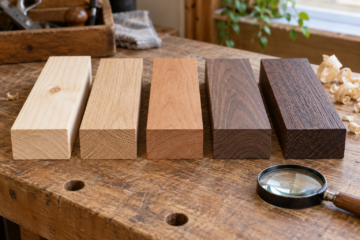
AI-generated editorial illustration: five wooden board samples showing different grain textures and colors.
Grain Filling & Sealing

How to Prepare Oak for a Pore-Filled, Glass-Smooth Finish

Why oak needs filling Oak’s open pores are part of its look, but they make a clear, glass-smooth finish harder to achieve. A finish can bridge the pores briefly, then shrink as it dries and leave tiny depressions visible under reflected light. Filling the grain creates a flatter surface before Read more

By , 2 weeksSeptember 24, 2026 ago

Posts pagination

Previous 1 2
Recent Posts
  • Best Woodworking Clamps: Which Types to Buy and How Many You Need
  • Best Pocket Hole Jigs in 2026: Kreg, Massca and Milescraft Compared
  • Best Dovetail Jigs: Fixed, Multi-Template and Variable-Spacing Options Explained
  • Best Compact Wood Routers: Corded vs Cordless Picks for Edge Work and Trimming
  • How to Repair a Wood Split Caused by a Screw (Even in Thin Teak)
Recent Comments
No comments to show.
Archives
  • October 2026
  • September 2026
Categories
  • Clear Coats & Topcoats
  • Finish Problems & Fixes
  • Gift Guides
  • Grain Filling & Sealing
  • Guides
  • Oils & Waxes
  • Painting & Priming
  • Sanding & Surface Prep
  • Shop Setup & Safety
  • Staining & Dyes
  • Tool Troubleshooting
  • Tools
  • Wood Finishing
  • Wood Species & Lumber
  • Woodworking Techniques
Hestia | Developed by ThemeIsle