As an Amazon Associate I earn from qualifying purchases. This post may contain affiliate links at no extra cost to you.
Here is the problem almost every hobby woodworker runs into. You buy a decent dust collector, hook it to the table saw and the planer, sweep up at the end of the day, and the shop still smells like sanded maple three days later. You wipe a finger across the tool chest and it comes back gray. That leftover haze is exactly what a workshop air filtration system is built to handle, and it is a different job from what your dust collector does.
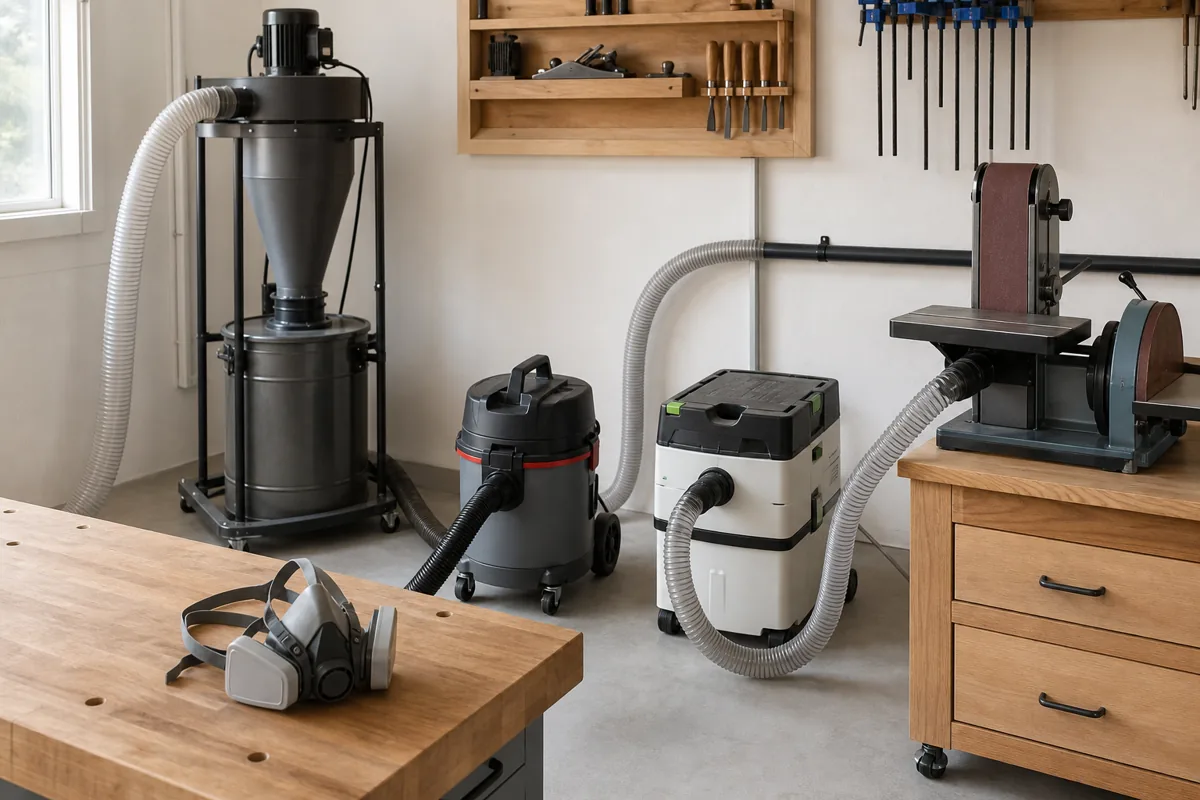
The confusion is understandable, because both machines move air through a filter. The difference is where they grab the dust. A dust collector is a capture device: it sits at the source, at the tool port, and pulls chips and dust into a duct before they ever get loose in the room. An air filtration unit is a scrubber: it hangs from the ceiling or sits on a bench and slowly recirculates the entire volume of the shop, catching the fine particles that escaped capture and are now floating around. Neither one replaces the other.
The misconception: “my dust collector already filters the air”
This is the single most common misunderstanding, and it comes from a real fact that gets misapplied. Yes, a 1.5 HP dust collector with a good pleated cartridge may move 600 to 900 CFM and filter down to a fine rating. But it only moves air through one four-inch or six-inch port at a time, and that port is bolted to a machine. The moment dust escapes the shroud, that CFM does you no good, because the air the collector is pulling on is not the air in the middle of the room.
Think of it like a kitchen. The range hood over your stove is a capture device. It is great at pulling steam off a boiling pot and useless at clearing smoke that already drifted into the dining room. For that you open a window or run a fan. Dust collection is the range hood. Air filtration is the fan that clears the room afterward.
There is a second reason this matters more than people expect. The particles a dust collector misses are the small ones. Big chips have mass and fall out of the air in seconds. Particles in the single-digit micron range and below can stay airborne for hours, and those are the ones small enough to travel deep into your lungs. Sanding, especially with a random orbit sander or a drum sander, is a fine-particle factory. So is routing MDF. You can run a spotless shop by appearance and still be breathing a heavy load.
How a workshop air filtration system actually works
Mechanically these units are simple. A blower wheel driven by a small motor pulls room air through an outer pre-filter, then through a finer inner filter, and pushes it back out. There are no tricks. What determines whether it does anything useful is the relationship between three numbers: airflow, filter rating, and room volume.
Airflow (CFM). Cubic feet per minute of air the unit moves. Ratings are usually given at multiple speeds, and the highest number is the marketing number.
Filter rating (MERV, sometimes stated in microns). MERV runs from roughly 1 to 16 in the range you will see on shop equipment. Higher catches smaller particles. A MERV 8 pre-filter grabs the coarse stuff so the expensive inner filter lasts longer; the inner filter is where you want MERV 11 or better if fine dust is your concern.
Air changes per hour (ACH). This is the number that actually tells you if a unit fits your shop. Divide your shop volume in cubic feet by the unit’s CFM, and you get minutes per air change. Most guidance for a woodworking shop lands around six to eight air changes per hour, which means roughly one full turnover every eight to ten minutes.
Run the math on your own space before you shop. A 20 by 24 foot garage shop with 8 foot ceilings is 3,840 cubic feet. At six air changes per hour you need about 384 CFM. At eight you need about 512. That tells you a small 400 CFM unit is genuinely adequate for that room, and a 1,000 CFM unit is comfortable headroom rather than a requirement.
| Shop size (8 ft ceiling) | Approx. volume | Target CFM for ~6-8 ACH | Typical unit class |
|---|---|---|---|
| 10 x 12 ft (small spare room) | 960 cu ft | 100-130 CFM | Small benchtop or box-fan-style unit |
| 12 x 20 ft (one-car garage) | 1,920 cu ft | 190-260 CFM | Compact ceiling-hung unit |
| 20 x 24 ft (two-car garage) | 3,840 cu ft | 385-515 CFM | Mid-size ceiling-hung, 3-speed |
| 24 x 36 ft (dedicated shop) | 6,912 cu ft | 690-920 CFM | Large ceiling unit or two mid-size units |
Placement matters more than horsepower
Here is where most installs go wrong. People hang the unit in a corner because that is where the joists were convenient, then wonder why the haze near the miter saw never clears. Air filtration works by setting up a circulation loop through the room. If the intake and the outlet are both stuck in a dead corner, the unit will happily filter the same eight cubic feet of clean air all afternoon. That is called short-circuiting, and it is the ceiling-fan equivalent of leaving your dust collector running with the blast gate closed.
Three rules that make a real difference:
Hang it off the wall, not against it. Give the intake side at least a couple of feet of clearance so it can draw from open room air. Aiming the discharge down the long axis of the shop sets up a lazy oval of moving air that eventually sweeps the whole room.
Mount it at working height for dust, not at the peak. Fine dust does eventually settle, but while it is airborne it is distributed through the room. Hanging the unit around seven to eight feet keeps it in the zone where you actually breathe, rather than scrubbing the air near the rafters.
Run it before, during, and after. Turn it on when you walk in, and leave it running for at least thirty minutes to an hour after you stop cutting. This is the single highest-value habit change, and it costs nothing. The dust that is still floating when you shut the door is the dust that settles on every surface overnight.
Ceiling-hung 3-speed shop air cleaner
For most one and two-car garage shops, a mid-size ceiling-hung unit in the 400 to 1,000 CFM class is the sensible buy. Look for three speeds, a remote or timer, and a replaceable pleated inner filter you can actually source in a few years. Skip units where the filter is a proprietary shape with no aftermarket, since that is where the long-term cost hides.
Filters, timers, and the features worth paying for
Filter access is the feature people underrate. You will pull the pre-filter every month or two, hit it with compressed air outside, and put it back. If that requires unbolting the unit from the ceiling, you will stop doing it, and a clogged pre-filter chokes airflow, which means the CFM you paid for quietly disappears. Front-loading or side-loading filter trays are worth a small premium.
A timer is the second real feature, not a gimmick. The value of running the unit for an hour after you leave is entirely dependent on remembering to come back and turn it off. A two, four, and eight hour timer with a remote means the shop is scrubbed while you eat dinner.
Noise is worth thinking about honestly. These units run for hours, and a loud one is a unit you will not run. If your shop is attached to the house or shares a wall with a bedroom, the low speed rating matters more than the high speed rating, since low is where you will leave it.
What you can skip: ionizers and UV add-ons on shop units are solving a problem woodworkers do not have. Mechanical filtration is what removes sawdust. Also be skeptical of any unit advertising a very high CFM with a very fine filter and a small motor, because those three things fight each other. Fine filters create resistance, and resistance eats airflow.
- ✔ Clears the fine airborne dust your collector never captured
- ✔ Cheap to run and easy to leave on unattended
- ✔ Dramatically less settled dust on tools and finished surfaces
- ✔ Filters are washable or inexpensive to replace
- ✘ Does nothing at the source, so it is an addition to dust collection, not a substitute
- ✘ Not respirator-grade protection while you are actively sanding
- ✘ Needs correct placement or it just recirculates clean air
- ✘ Cheap units overstate CFM at the fine-filter stage
The DIY box fan question
A box fan with a furnace filter bungee-corded to the back is a legitimate starter setup, and it is worth understanding why it works and where it stops working. It works because a box fan moves a lot of air at very low pressure, and a large-area filter presents low resistance. That combination is exactly what air scrubbing needs.
Where it falls short is pressure. Box fan motors are not designed to pull against resistance. Strap a MERV 13 filter to one and airflow drops sharply, and the motor runs hotter than it was designed to. Purpose-built units use a squirrel-cage blower, which handles filter resistance far better, and they enclose the motor away from the dust stream. If you want a step up from the box fan without buying a hanging unit, a multi-filter cube-style build using four filters spreads the resistance across much more surface area and holds airflow far better than a single flat filter.
Compact benchtop air cleaner for small shops
If you work in a spare bedroom, basement corner, or single-bay garage, a compact portable unit is often the better answer than a ceiling-hung one. You can move it next to the sander, which puts it where the dust is instead of hoping room circulation brings the dust to it. Check the filter replacement cost before buying, since small units sometimes use pricier cartridges.
Where filtration fits in a complete dust strategy
Think of shop dust control as three layers, in order of importance. Source capture comes first: a dust collector or shop vac connected to the tool, with as short and straight a duct run as you can manage. Air filtration is second, cleaning up what capture missed. A respirator is third, and it is the only one that actually protects your lungs while you are standing in a cloud.
That order matters because people tend to buy in reverse. Skipping capture and hoping the ceiling unit handles it is the expensive way to stay dusty, because you are asking one machine to clean 4,000 cubic feet of air instead of stopping the dust in the two cubic feet where it was created. And no ceiling unit clears the air fast enough to protect you during the sanding itself, which is why an N95 or a half-mask respirator stays on your bench regardless of what else you own.
FAQ
How long should I run my air filtration unit after I finish working? At minimum thirty minutes, and an hour or more is better. Use your ACH math: if your unit turns the room over every ten minutes, an hour gives you six full changes, which is enough to drop the airborne load substantially. A built-in timer makes this effortless.
Do I still need a respirator if I have both dust collection and air filtration? Yes, for any heavy sanding or extended machining. Filtration cleans the room over minutes; a respirator protects you in the moment. The two do different jobs, and no combination of machines removes dust from the air instantly around your face.
Is one large unit better than two smaller ones? For an open rectangular shop, one properly placed unit is simpler and usually cheaper. For an L-shaped space, a shop divided by a partition, or anything with a separate finishing area, two smaller units in the 200 to 400 CFM class often outperform one big one, because circulation cannot easily reach around corners.
Get the three numbers right, room volume, CFM, and filter rating, put the unit where air can actually loop through the room, and build the habit of running it past quitting time. That combination does more for shop air quality than upgrading to a bigger motor ever will.
Check prices on Amazon →
0 Comments