What's inside
- Quick picks by beginner situation
- Choose the cello size before comparing brands
- Solid wood versus laminate construction
- Setup quality matters more than a long accessory list
- Bow performance and included accessories
- Repairability and ownership costs
- Named beginner options worth investigating
- Final buying checklist
- Quick picks by beginner situation
- Choose the cello size before comparing brands
- Solid wood versus laminate construction
- Setup quality matters more than a long accessory list
- Bow performance and included accessories
- Repairability and ownership costs
- Named beginner options worth investigating
- Final buying checklist
As an Amazon Associate I earn from qualifying purchases. This post may contain affiliate links at no extra cost to you.
The best cellos for beginners are properly sized, professionally set up instruments with a responsive bow, stable tuning, and enough repair support to make learning affordable over several years.
As an Amazon Associate we earn from qualifying purchases at no extra cost to you.

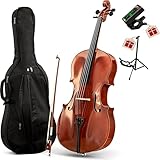


Quick picks by beginner situation
| Player situation | Best choice | Why it fits | Typical 2026 market range |
|---|---|---|---|
| Child still growing, school or rental program | Quality fractional-size cello from a rental shop | Easy size changes, local adjustments, and fewer resale problems | $25–$70 per month to rent, depending on region and insurance |
| Adult beginner practicing 3–5 days per week | Setup student cello in 4/4 or 7/8 size | More comfortable long-term ownership and better value than replacing a very cheap instrument | $700–$2,000 |
| Limited budget, occasional practice | Used laminate or laminate-back student cello, inspected by a luthier | More resistant to minor climate changes and usually less expensive to repair | $400–$900 used, depending on condition |
| Committed learner planning lessons and ensemble playing | Solid-wood student cello from an established workshop | Greater tonal range and a better platform for developing bow control | $1,200–$3,000 |
Choose the cello size before comparing brands
A cello that is too large can make first-position notes, shifts, and relaxed bowing unnecessarily difficult. A cello that is too small may feel cramped and can limit comfortable technique. Age is only a rough guide; arm length, hand span, torso length, and flexibility matter more.
| Cello size | Approximate body length | Common player range | Useful starting point |
|---|---|---|---|
| 1/8 | 17–18 in | About 4–5 years old | Small children; measure rather than relying on age |
| 1/4 | 20–21 in | About 5–7 years old | Children who can sit securely with both feet supported |
| 1/2 | 24–25 in | About 7–9 years old | Often suitable for growing elementary-age players |
| 3/4 | 27–28 in | About 9–12 years old | A common intermediate size, but not automatically right |
| 7/8 | About 28–29 in | Smaller teens and adults | Useful when a full-size instrument causes shoulder or hand strain |
| 4/4 | About 29–30 in | Most larger teens and adults | Standard full size, provided the reach is comfortable |
For a fitting, sit upright with the cello supported between your knees. The upper bouts should rest comfortably against the inside of your knees, the neck should reach toward your left ear, and your left hand should be able to reach first position without the thumb collapsing or the shoulder lifting. If possible, have a teacher or cello specialist compare two adjacent sizes.
Solid wood versus laminate construction
Solid-wood cellos
A solid spruce top and maple back, ribs, and neck are traditional specifications. A well-made solid cello generally offers more color, projection, and dynamic contrast. It may also become more rewarding as the player develops. The trade-off is greater sensitivity to humidity, temperature changes, impacts, and poor storage.
Solid wood is not automatically synonymous with good sound. A poorly graduated or badly adjusted solid instrument can be less playable than a modest laminate cello. Inspect the setup and workmanship before paying for the label.
Laminate and hybrid cellos
Laminate backs and ribs, or laminate construction throughout, use thin wood layers bonded under pressure. These cellos are often more tolerant of school lockers, travel, and moderate climate fluctuations. They can be practical first instruments for children and occasional players, especially when repair costs need to stay predictable.
Laminate instruments may have less tonal complexity, but that limitation is usually less important than a comfortable neck, accurate fingerboard, and responsive strings. A hybrid cello with a solid spruce top and laminate back and ribs can be a sensible middle ground.
Setup quality matters more than a long accessory list
The most important difference between a usable beginner cello and a frustrating one is often setup. Before buying, ask who will perform the final adjustment and whether the instrument is shipped ready to play rather than merely assembled at the factory.
- Bridge: It should be correctly fitted to the cello’s top, stand upright, and have cleanly shaped string grooves.
- Nut: The string slots should not force the strings too high above the fingerboard near the scroll.
- Fingerboard: It should have a smooth, even scoop, without buzzing or deep tool marks.
- Pegs: They should turn with controlled resistance and hold pitch instead of slipping or binding.
- Soundpost: It should be standing securely in the correct position, not leaning loosely or rattling.
- Strings: A functional set from a recognized manufacturer is preferable to anonymous, excessively stiff strings.
- Endpin: It should extend smoothly, lock securely, and retract without damaging the socket.
A cello that arrives with a bridge installed but no meaningful setup may require bridge fitting, peg work, string replacement, and soundpost adjustment. Those repairs can add roughly $100–$300 or more, depending on local labor and parts. Include that amount when comparing a low advertised price with a ready-to-play instrument.
Bow performance and included accessories
The bow is not a minor extra. A warped or badly balanced bow makes it difficult to produce a clean tone, even when the cello itself is acceptable. For a first bow, look for a straight stick, a frog that moves smoothly, a firm but not brittle feel, and hair that grips the string evenly after appropriate rosin is applied.
Student bows are commonly made from fiberglass, carbon fiber, or inexpensive pernambuco substitutes. A sound fiberglass bow can be durable and consistent. Carbon-fiber bows often provide reliable straightness and resilience for travel. A basic wood bow may feel pleasant, but quality varies widely at the same price.
A useful beginner package should include:
- A padded cello bag or case with adequate bridge and endpin clearance
- A bow with usable hair and a functioning screw mechanism
- Cello rosin, preferably not a tiny unbranded cake of unknown age
- An endpin anchor or strap for safe practice on smooth floors
- A clip-on tuner or another dependable tuning method
- A cleaning cloth that will not shed fibers onto the strings
A shoulder strap, music stand, and spare strings are useful additions but should not compensate for a poor bridge or unplayable bow. Avoid applying excessive rosin: it creates a powdery layer that attracts dirt and can make the sound harsh.
Repairability and ownership costs
Ask whether replacement bridges, tailpieces, endpins, pegs, and compatible strings are readily available. Common inexpensive-cello problems include loose fine tuners, slipping pegs, open seams, bridge warping, cracked fingerboards, and tailpieces that sit too low or too high. A local luthier who regularly works on student instruments is more valuable than a remote warranty that requires expensive shipping.
Use this simple ownership calculation before deciding between renting and buying. Suppose a cello costs $900, remains useful for three years, and needs $120 of setup work plus $60 of replacement strings annually:
Estimated three-year cost: $900 + $120 + (3 × $60) = $1,200, or about $33 per month before resale value. A $45 monthly rental may cost more over that period, but it can include size exchanges and maintenance. For a growing child, that flexibility may outweigh the apparent savings of ownership.
Store the cello in its case, away from radiators, sunny windows, damp basements, and car trunks. Moderate indoor humidity is preferable; a small case hygrometer can reveal whether seasonal conditions are becoming extreme. Never leave the instrument under tension with a fallen bridge or continue playing after a major crack, loose seam, or collapsed soundpost.
Named beginner options worth investigating
Established student lines such as the Yamaha VC5S, Eastman 100-series cellos, and Stentor student models are examples to investigate, but the exact setup and seller preparation still matter. Specifications and availability can vary by market and year. A less famous cello adjusted by a competent shop can be a better purchase than a recognizable model shipped without inspection.
For a first purchase, compare the instrument in this order: correct size, comfortable setup, reliable pegs and endpin, responsive bow, repair support, then tone and appearance. That order keeps a beginner from paying for decorative features while overlooking the parts that determine whether daily practice feels manageable.
Final buying checklist
- Confirm the size with a teacher or cello specialist.
- Play every string in first position and listen for buzzing or rattling.
- Check that the bridge is upright and properly fitted.
- Turn every peg and fine tuner several times.
- Inspect the bow for straightness and even hair tension.
- Ask what setup work has been completed and what is covered after purchase.
- Compare the case, strings, rosin, and bow as a complete package.
- Find out where future repairs and size exchanges will be handled.
The best cellos for beginners are not necessarily the cheapest or the most ornate. They are instruments matched to the player’s body, adjusted so that the left hand and bow can work naturally, and supported by a repair path that makes continued learning practical.
0 Comments