What's inside
As an Amazon Associate I earn from qualifying purchases. This post may contain affiliate links at no extra cost to you.
The best car seat gap fillers are the ones that match your seat angle, leave the seat belt buckle unobstructed, and stay firmly in place without turning the console into a cramped storage bin.
For most vehicles, a flexible foam or silicone gap blocker is the safest starting point: it is inexpensive, easy to clean, and more tolerant of different seat designs than a rigid organizer. Choose a console-side storage caddy only when you also need a dedicated place for coins, cards, sunglasses, or a charging cable.
As an Amazon Associate we earn from qualifying purchases at no extra cost to you.


Quick picks by situation
| Situation | Best filler type | Why it fits the use case | Typical market range |
|---|---|---|---|
| Lowest-cost protection | Plain foam wedge | Blocks crumbs and dropped items with minimal bulk | $8–$18 per pair |
| Frequent spills or muddy use | Closed-cell silicone or rubber blocker | Non-absorbent surface wipes clean and resists liquid soak-in | $15–$35 per pair |
| Need extra storage | Seat-gap organizer with pocket or cup holder | Combines gap coverage with accessible storage | $20–$45 per pair |
| Wide center console | Adjustable or tapered organizer | Accommodates uneven space between the seat and console | $25–$50 per pair |
| Sports or heavily bolstered seats | Low-profile flexible insert | Bends around bolsters rather than pushing the seat outward | $12–$30 per pair |
What separates the best car seat gap fillers
Fit across different seat designs
Measure the gap at both the front and rear of the seat before ordering. Many gaps are not uniform: the opening may be about 1 inch wide near the seat cushion and 2 to 3 inches wide near the backrest. A filler that is too narrow can slide down; one that is too wide can press against the seat controls or buckle.
Flexible fillers measuring roughly 15 to 18 inches long and 2 to 3 inches wide cover the most common front-seat gaps. Look for a tapered or compressible shape if your vehicle has deeply sculpted bolsters. Rigid rectangular organizers work better in broad, straight gaps beside a high center console, but they are more likely to interfere with powered seat movement.
Seat height matters too. A low car seat with a shallow console may need a thin blocker under 2 inches tall. A taller SUV seat can accommodate a 3- to 4-inch organizer, provided it does not reach the steering wheel area or obstruct the buckle.
Storage capacity without console clutter
A simple blocker is best when the main goal is keeping phones, keys, coins, and food from disappearing under the seat. Storage models vary widely. A small pocket may hold approximately 0.2 to 0.4 liters—enough for cards and a charging cable—while a box-style caddy may hold 0.8 to 1.5 liters.
More capacity is not automatically better. A full organizer can become a hard object beside the driver’s thigh, and loose items can rattle. If you choose a storage model, prioritize a soft-sided pocket, a low outer wall, and a separate slot for the seat belt receptacle. Avoid designs that require the belt to pass through a narrow opening or that cover the buckle release button.
Material durability and spill resistance
Open-cell foam is light and inexpensive, but it can absorb coffee, milk, and cleaning solution. It may also flatten where the driver repeatedly brushes against it. Closed-cell foam resists absorption better, although its outer coating can crack after prolonged exposure to heat and sunlight.
Silicone and molded rubber generally offer the easiest cleanup. They tolerate repeated wiping and do not hold liquid in the same way as fabric. Their disadvantages are extra weight and a greater tendency to grip upholstery, which can make removal harder during seat adjustment.
Fabric organizers are useful when storage is the priority, but choose one with a removable liner or a water-resistant coating. Stitching, zipper edges, and the seam around the belt opening usually wear before the main fabric. A model with bar-tacked stress points and reinforced binding will last longer than one held together only by a single line of stitching.
Head-to-head: blocker versus storage organizer
| Feature | Flexible gap blocker | Storage organizer |
|---|---|---|
| Typical weight per side | 3–8 oz | 8–20 oz |
| Typical length | 14–18 in | 13–17 in |
| Approximate usable capacity | None to 0.1 L | 0.2–1.5 L |
| Spill cleanup | Best with silicone; moderate with coated foam | Depends on liner and fabric coating |
| Seat adjustment compatibility | Usually excellent | Good only if low-profile and flexible |
| Risk of buckle obstruction | Low when correctly sized | Moderate if the pocket surrounds the receptacle |
| Best for | Cleanliness and simple protection | Drivers who need organized small-item storage |
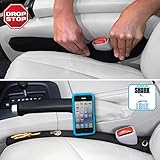
A product such as the Drop Stop represents the simple blocker category: its purpose is to close the opening rather than add a large container beside the seat. Comparable universal blockers are preferable when you frequently move the seat or share the vehicle. Storage caddies are the better choice for drivers who keep the same seating position and need quick access to small items.
Compatibility with seat belts and center consoles
Seat-belt access is the most important safety check. The filler should sit beside the buckle, not over it. After installation, insert and release the belt at least several times. The button must remain fully visible and easy to press, and the belt tongue must not scrape against a rigid plastic edge.
Check the console as well. Some center consoles widen toward the dashboard, while others taper sharply near the seatback. A filler that fits at the front may bind at the rear. If the console has a hinged lid, open it through its full travel. If it has a sliding cover, verify that the filler does not block the track.
Do not place a filler over seat-mounted airbag seams, wiring, seat-height levers, or electric seat tracks. If the manufacturer’s instructions for your vehicle or the accessory say not to cover a particular area, follow that guidance. No gap filler should be attached to, wrapped around, or used as a substitute for any restraint component.
How to size and install one correctly
- Measure the opening. With the seat in your normal driving position, measure the narrowest gap and the distance from the front edge to the rear of the opening.
- Check movement. Slide, recline, raise, and lower the seat. Note whether the gap changes by more than about 1 inch.
- Choose the smaller workable size. A filler that compresses slightly is usually more secure than one forced tightly between the seat and console.
- Clean both surfaces. Remove grit and oily residue so the filler’s friction surface does not pick up abrasive dirt or slide unexpectedly.
- Install beside—not beneath—the buckle. Keep the receptacle and release button completely exposed.
- Repeat the movement test. Move the seat through its normal range and confirm that the filler does not pinch, fold into the track, or pull on upholstery.
For example, suppose the gap measures 1.5 inches at the front and 2.25 inches at the rear. A compressible 2-inch-wide blocker is a better match than a rigid 3-inch caddy. The blocker can fill the narrow end without excessive pressure and expand into the wider section. If the seat moves forward 3 inches and the filler stays attached to the seat, select a design long enough to cover the opening throughout that movement—typically at least 16 inches.
Cleaning and ownership realities
Clean silicone and rubber fillers with warm water and mild dish soap, then dry them before reinstalling. For coated foam, wipe rather than soak it. Fabric organizers should be emptied weekly, vacuumed around the seams, and spot-cleaned promptly after a spill. Avoid bleach, solvent-based cleaners, and high heat unless the care label specifically allows them.
The first signs of failure are usually compression, peeling at a coated surface, stretched stitching, or a distorted belt opening. Replace a filler if it becomes loose enough to fall into the seat track, develops a sharp exposed edge, or makes the buckle difficult to operate. A cheap blocker that lasts three years can be better value than a larger organizer that needs replacement every few months.
Final buying recommendation
Choose a flexible, non-absorbent blocker if you want the best all-around protection with the fewest fit problems. Choose a low-profile organizer if you regularly need storage and can confirm that it leaves the buckle, seat controls, console lid, and seat track clear. For vehicles with heavily contoured seats, prioritize flexibility over capacity; for wide, straight console gaps, a structured caddy can provide useful storage without sacrificing fit.
0 Comments