RP Woodworks

  • Home
  • Reviews
  • Projects
  • Tools
  • Woodworking Techniques
  • About

Staining & Dyes

Choosing and applying wood stains, dyes, toners and color washes for even, predictable color.

AI-generated editorial illustration of wood stain
Staining & Dyes

Gel Stain vs Penetrating Stain for Vertical Wood Panels

Vertical wood panels are a difficult surface to stain evenly. Gravity pulls liquid downward, the wood may have inconsistent porosity, and large uninterrupted boards make lap marks easy to see. Gel stain and penetrating stain can both work, but they behave differently enough that choosing the wrong one can create Read more

By , 1 weekSeptember 25, 2026 ago
AI-generated editorial illustration of wood stain
Staining & Dyes

Water-Based Stain vs Oil-Based Stain on Open-Grain Hardwood

Open-grain hardwoods such as oak, ash, walnut, and mahogany absorb stain unevenly because their earlywood and open pores take up more color than the denser surrounding grain. The choice between water-based and oil-based stain affects more than drying time. It changes color, grain definition, working time, odor, cleanup, and how Read more

By , 1 weekSeptember 25, 2026 ago
AI-generated editorial illustration of wood stain
Staining & Dyes

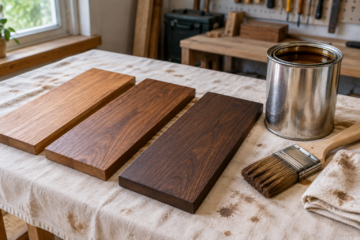
How to Make a Sample Board for Wood Stain and Finish

Why Make a Sample Board Wood stain rarely looks the same on a store sample, computer screen, or can label as it does on your project. Wood species, grain direction, sanding scratches, glue residue, and the finish over the stain all change the result. A sample board gives you a Read more

By , 1 weekSeptember 25, 2026 ago
AI-generated editorial illustration of wood stain
Staining & Dyes

How to Keep Wood Filler from Showing Through Stain

Wood filler often shows through stain because it does not absorb color the same way as surrounding wood. Most fillers contain fine mineral particles, glue, or resin that seal the surface. The result can be a pale patch, a dark outline, or a glossy spot after staining. The best fix Read more

By , 1 weekSeptember 25, 2026 ago
AI-generated editorial illustration of wood paint
Staining & Dyes

How to Seal End Grain Before Painting or Staining

End grain absorbs finish far faster than the long-grain faces of a board. The exposed fibers act like a bundle of tiny straws, pulling in stain, paint, and even water-based primer. If you finish it without preparation, the end usually looks darker, rougher, and less even than the rest of Read more

By , 1 weekSeptember 25, 2026 ago
AI-generated editorial illustration of wood stain
Staining & Dyes

How to Repair Small Dents in Wood Before Staining

Small dents are common on furniture, doors, trim, and unfinished boards. They usually come from dropped tools, clamps, or pressure against a hard edge. Before staining, the repair needs to do more than look smooth: it must absorb color at roughly the same rate as the surrounding wood. A filler Read more

By , 1 weekSeptember 25, 2026 ago
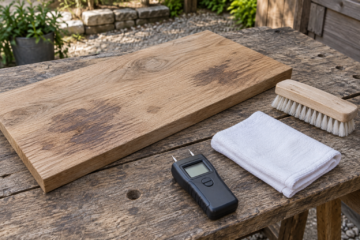
AI-generated editorial illustration of a discolored wood board, scrub brush, wiping cloth and two-pin moisture meter with blank display.
Staining & Dyes

How to Treat Mold-Stained Wood Before Applying Finish

Mold stains on wood are not always a surface problem. Mold can leave dark marks in the grain even after the living growth is gone, and water damage may have caused decay underneath. Applying stain, paint, or clear finish too soon can trap moisture, highlight discoloration, and cause peeling or Read more

By , 1 weekSeptember 25, 2026 ago
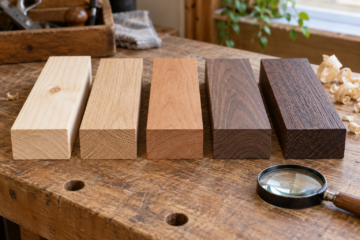
AI-generated editorial illustration: five wooden board samples showing different grain textures and colors.
Staining & Dyes

How to Select Wood for a Consistent Stain Color

Choose the Right Wood Before Staining A consistent stain color starts with the boards, not the stain can. Wood species, grain density, sapwood, knots, and moisture content all affect how much pigment the surface absorbs. Two boards labeled with the same species can still finish noticeably different if one is Read more

By , 1 weekSeptember 25, 2026 ago
AI-generated editorial illustration of wood stain
Staining & Dyes

How to Prepare Wood with Machine Tear-Out for Staining

Machine tear-out is one of the most common reasons stain looks uneven on otherwise well-built woodwork. A planer, jointer, router, or table saw can leave small lifted fibers, crushed areas, and torn grain that become much darker when stain reaches them. Stain does not hide this damage. It emphasizes it. Read more

By , 1 weekSeptember 25, 2026 ago
AI-generated editorial illustration of wood stain
Staining & Dyes

How to Identify When Wood Is Smooth Enough for Stain

Wood is smooth enough for stain when it feels uniformly refined, shows no obvious scratches or machine marks, and accepts a test coat without producing dark streaks or blotches. It does not need to feel like glass. In fact, sanding too finely can reduce stain absorption and leave the color Read more

By , 1 weekSeptember 25, 2026 ago

Posts pagination

Previous 1 2 3 4 … 16 Next
Recent Posts
  • Best Woodworking Clamps: Which Types to Buy and How Many You Need
  • Best Pocket Hole Jigs in 2026: Kreg, Massca and Milescraft Compared
  • Best Dovetail Jigs: Fixed, Multi-Template and Variable-Spacing Options Explained
  • Best Compact Wood Routers: Corded vs Cordless Picks for Edge Work and Trimming
  • How to Repair a Wood Split Caused by a Screw (Even in Thin Teak)
Recent Comments
No comments to show.
Archives
  • October 2026
  • September 2026
Categories
  • Clear Coats & Topcoats
  • Finish Problems & Fixes
  • Gift Guides
  • Grain Filling & Sealing
  • Guides
  • Oils & Waxes
  • Painting & Priming
  • Sanding & Surface Prep
  • Shop Setup & Safety
  • Staining & Dyes
  • Tool Troubleshooting
  • Tools
  • Wood Finishing
  • Wood Species & Lumber
  • Woodworking Techniques
Hestia | Developed by ThemeIsle