RP Woodworks

  • Home
  • Reviews
  • Projects
  • Tools
  • Woodworking Techniques
  • About

Painting & Priming

Priming and painting wood for a smooth, durable painted finish.

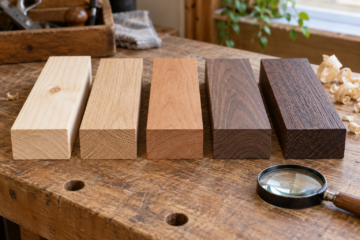
AI-generated editorial illustration: five wooden board samples showing different grain textures and colors.
Painting & Priming

Best Wood for a Painted Interior Door That Resists Dents

For a painted interior door that needs to stand up to knocks, solid poplar is a strong practical choice. It is tougher than the soft pine often used in budget doors, paints well, and usually costs less than harder hardwoods. But the wood is only part of the answer: door Read more
By , 2 weeksSeptember 25, 2026 ago
AI-generated editorial illustration: five wooden board samples showing different grain textures and colors.
Painting & Priming

Best Wood for a Painted Window Frame with Crisp Edges

For a painted window frame where the corners and glazing edges need to look sharp, choose clear, straight-grained pine for the best balance of cost and workability. If the frame will see frequent condensation or you want fewer knots and less resin trouble, use poplar. Either can take paint well Read more

By , 2 weeksSeptember 25, 2026 ago
AI-generated editorial illustration: five wooden board samples showing different grain textures and colors.
Painting & Priming

Best Wood for a Painted Interior Door with a Smooth Surface

Best all-around choice: poplar For a painted interior door, poplar is a practical balance of smoothness, price, and ease of machining. It is a hardwood, but it is softer and generally easier to cut and sand than oak or maple. Its fine, fairly even grain takes primer and paint without Read more

By , 2 weeksSeptember 25, 2026 ago
AI-generated editorial illustration: five wooden board samples showing different grain textures and colors.
Painting & Priming

Best Wood for a Painted Cabinet Face Frame That Resists Dents

For a painted cabinet face frame that needs to shrug off everyday bumps, hard maple is the best all-around choice. It is dense, stable when properly dried, and takes paint well after careful sanding and priming. If maple costs too much or is difficult to find in straight, clear stock, Read more

By , 2 weeksSeptember 25, 2026 ago
AI-generated editorial illustration of wood paint
Painting & Priming

How to Compare Water-Based and Oil-Based Wood Primers

Choosing between water-based and oil-based wood primer comes down to what you are painting, where you are painting it, and what topcoat you plan to use. Both seal the wood, even out absorption, and give the paint something to grip, but they do it differently. Pick the wrong one and Read more

By , 2 weeksSeptember 25, 2026 ago
AI-generated editorial illustration: five wooden board samples showing different grain textures and colors.
Painting & Priming

How to Select Wood for a Consistent Paint Finish Across Trim

For a trim paint job to look consistent, the wood underneath needs to be reasonably smooth, stable, and similar from piece to piece. The best choice depends on where the trim will go, how much detail it has, and whether you plan to paint it yourself or buy it factory-primed. Read more

By , 2 weeksSeptember 25, 2026 ago
AI-generated editorial illustration: five wooden board samples showing different grain textures and colors.
Painting & Priming

How to Choose Between Solid Wood and Veneer for a Painted Panel

For a painted panel, the choice is not simply “real wood” versus “fake wood.” Solid boards move as humidity changes; veneer-faced panels stay flatter but depend on a thin surface layer and a well-prepared core. If the paint will hide the grain, a stable veneered panel is often the practical Read more

By , 2 weeksSeptember 25, 2026 ago
AI-generated editorial illustration of wood paint
Painting & Priming

How to Identify Resinous Wood That May Interfere with Paint

Why Resin Causes Paint to Fail Resin is the sticky, hydrophobic extractive that conifers use to seal wounds. In lumber, it lives in resin canals, rays, and pockets as a mix of rosin and turpentine. It never truly cures like wood fiber does. When you paint over it, three things Read more

By , 2 weeksSeptember 25, 2026 ago
AI-generated editorial illustration: five wooden board samples showing different grain textures and colors.
Painting & Priming

How to Choose a Wood Species for a Translucent Painted Finish

A translucent painted finish lets the grain show through, but it does not hide uneven color, knots, or sanding marks as well as an opaque coat. Species choice matters: some woods give a calm, even background, while others add strong grain contrast or absorb paint unevenly. Choose the wood for Read more

By , 2 weeksSeptember 25, 2026 ago
AI-generated editorial illustration of wood paint
Painting & Priming

How to Choose Between Poplar and Maple for Painted Cabinet Frames

Poplar and maple can both make good painted cabinet frames, but they behave differently under a painted finish. Poplar costs less and cuts easily; maple is harder and usually provides a more consistent surface. The right choice depends on your budget, the frame’s construction, and how carefully you’re willing to Read more

By , 2 weeksSeptember 25, 2026 ago

Posts pagination

Previous 1 … 9 10 11 … 14 Next
Recent Posts
  • Best Woodworking Clamps: Which Types to Buy and How Many You Need
  • Best Pocket Hole Jigs in 2026: Kreg, Massca and Milescraft Compared
  • Best Dovetail Jigs: Fixed, Multi-Template and Variable-Spacing Options Explained
  • Best Compact Wood Routers: Corded vs Cordless Picks for Edge Work and Trimming
  • How to Repair a Wood Split Caused by a Screw (Even in Thin Teak)
Recent Comments
No comments to show.
Archives
  • October 2026
  • September 2026
Categories
  • Clear Coats & Topcoats
  • Finish Problems & Fixes
  • Gift Guides
  • Grain Filling & Sealing
  • Guides
  • Oils & Waxes
  • Painting & Priming
  • Sanding & Surface Prep
  • Shop Setup & Safety
  • Staining & Dyes
  • Tool Troubleshooting
  • Tools
  • Wood Finishing
  • Wood Species & Lumber
  • Woodworking Techniques
Hestia | Developed by ThemeIsle