RP Woodworks

  • Home
  • Reviews
  • Projects
  • Tools
  • Woodworking Techniques
  • About

Wood Finishing

Staining, sealing, oiling and clear-coating wood: product choice, application and fixes for common finish problems.

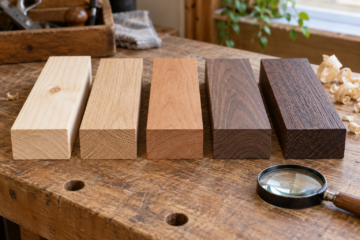
AI-generated editorial illustration: five wooden board samples showing different grain textures and colors.
Clear Coats & Topcoats

How to Choose a Wood Species for a Clear Natural Finish

A clear finish does not make every board look “natural.” It usually deepens the color, increases contrast, and makes differences between boards more obvious. The best species depends on the color you want, how much grain you want to see, the project’s exposure to wear and moisture, and how much Read more

By , 2 weeksSeptember 25, 2026 ago
AI-generated editorial illustration: five wooden board samples showing different grain textures and colors.
Painting & Priming

How to Choose Between Hardwood and Softwood for Painted Projects

The short answer For painted projects, hardwood is not automatically better. Softwood is usually the better buy for large trim, shelving, utility furniture, and outdoor projects where low cost and easy machining matter. Hardwood earns its price when you need a harder surface, cleaner edges, better dent resistance, or a Read more

By , 2 weeksSeptember 25, 2026 ago
AI-generated editorial illustration: five wooden board samples showing different grain textures and colors.
Clear Coats & Topcoats

How to Tell Red Oak from White Oak Before Finishing

Red oak and white oak look similar after milling, but they do not finish the same way. The wrong identification can leave you with a stain that turns too pink, too gray, or much darker than expected. Before you sand or apply finish, check the end grain, pores, color, and Read more

By , 2 weeksSeptember 25, 2026 ago
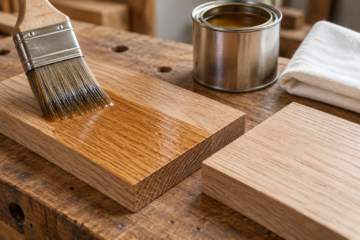
AI-generated editorial illustration: brush applying a clear wood finish to a board beside an unfinished offcut.
Clear Coats & Topcoats

How to Prepare Wood for a Spray Lacquer Finish

Why Preparation Matters Before Spraying Lacquer Spray lacquer dries quickly, which is both its main advantage and its biggest weakness. Dust, sanding scratches, glue residue, fingerprints, and uneven porosity can become permanently visible within minutes. Lacquer does not hide poor preparation; a thin sprayed film often makes defects easier to Read more

By , 2 weeksSeptember 25, 2026 ago
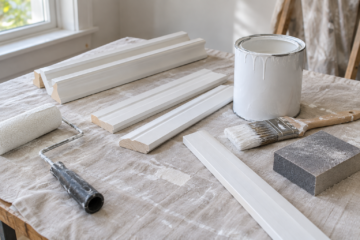
AI-generated editorial illustration of wood paint
Painting & Priming

How to Prepare a Wood Surface for Paint Adhesion

Paint adhesion depends more on preparation than on the paint itself. Wood can look clean and still contain sanding dust, wax, silicone, resin, or mill glaze that prevents a coating from gripping. A good preparation job creates a clean, slightly keyed surface, removes anything that can bleed through, and gives Read more

By , 2 weeksSeptember 25, 2026 ago
AI-generated editorial illustration: five wooden board samples showing different grain textures and colors.
Finish Problems & Fixes

How to Remove Pencil Marks from Bare Wood Before Finishing

Pencil marks are useful during layout, but they can show through clear finish, stain, and paint—especially on light woods such as maple, birch, ash, and pine. The graphite is usually easy to remove, but rubbing it deeper into the grain or sanding unevenly can create a more visible problem than Read more

By , 2 weeksSeptember 25, 2026 ago
AI-generated editorial illustration of wood stain
Staining & Dyes

How to Prepare Wood with Machine Tear-Out for Staining

Machine tear-out is one of the most common reasons stain looks uneven on otherwise well-built woodwork. A planer, jointer, router, or table saw can leave small lifted fibers, crushed areas, and torn grain that become much darker when stain reaches them. Stain does not hide this damage. It emphasizes it. Read more

By , 2 weeksSeptember 25, 2026 ago
AI-generated editorial illustration: five wooden board samples showing different grain textures and colors.
Clear Coats & Topcoats

How to Prepare Wood with Resin Pockets for Finishing

Resin pockets are cavities or cracks in wood that contain liquid or hardened sap. They are common in pine, spruce, fir, larch, cedar, and some reclaimed softwoods. A board can look dry when you buy it, then release resin weeks later as the wood warms. If you stain, paint, or Read more

By , 2 weeksSeptember 25, 2026 ago
AI-generated editorial illustration: five wooden board samples showing different grain textures and colors.
Clear Coats & Topcoats

How to Flatten Cupped Wood Before Applying Finish

Cupped wood has a curved cross-section: the board’s edges rise or fall relative to its center. Applying stain, paint, or clear finish will not flatten it. Finish may slow future moisture exchange, but it cannot overcome a board that is already badly distorted. Flatten the wood first, then sand and Read more

By , 2 weeksSeptember 25, 2026 ago
AI-generated editorial illustration: brush applying a clear wood finish to a board beside an unfinished offcut.
Grain Filling & Sealing

How to Fill Open Pores Before Applying a Smooth Clear Coat

Open pores are the visible vessels and depressions in woods such as oak, ash, mahogany, walnut, and elm. If you apply clear finish directly over them, the coating may look glossy while the surface still feels rough and shows small valleys under reflected light. The reliable fix is to level Read more

By , 2 weeksSeptember 25, 2026 ago

Posts pagination

Previous 1 … 13 14 15 … 63 Next
Recent Posts
  • Best Woodworking Clamps: Which Types to Buy and How Many You Need
  • Best Pocket Hole Jigs in 2026: Kreg, Massca and Milescraft Compared
  • Best Dovetail Jigs: Fixed, Multi-Template and Variable-Spacing Options Explained
  • Best Compact Wood Routers: Corded vs Cordless Picks for Edge Work and Trimming
  • How to Repair a Wood Split Caused by a Screw (Even in Thin Teak)
Recent Comments
No comments to show.
Archives
  • October 2026
  • September 2026
Categories
  • Clear Coats & Topcoats
  • Finish Problems & Fixes
  • Gift Guides
  • Grain Filling & Sealing
  • Guides
  • Oils & Waxes
  • Painting & Priming
  • Sanding & Surface Prep
  • Shop Setup & Safety
  • Staining & Dyes
  • Tool Troubleshooting
  • Tools
  • Wood Finishing
  • Wood Species & Lumber
  • Woodworking Techniques
Hestia | Developed by ThemeIsle