What's inside
As an Amazon Associate I earn from qualifying purchases. This post may contain affiliate links at no extra cost to you.
Best Horseshoe Sets for Backyard Games and Competition
The best horseshoe sets depend on whether you need regulation-weight steel shoes for serious practice or a lighter, portable set for occasional backyard play: choose a professional 2.5-pound set for competitive accuracy, a mid-weight steel set for frequent family use, or a rubber-and-plastic set when portability and safer casual play matter most.
Quick Picks by Playing Situation
| Player or situation | Best set type | Useful specifications | Typical market range |
|---|---|---|---|
| League practice or tournament preparation | Regulation steel set | Four shoes at about 2.5 lb each; two 1-inch steel stakes | $70–$160 |
| Regular backyard games | Recreational steel set | Four shoes at roughly 1.5–2.5 lb each; steel stakes; carry case | $40–$100 |
| Children, travel, or occasional use | Rubber or plastic horseshoe set | Four lightweight shoes; plastic or narrow metal stakes; compact case | $20–$50 |
| Permanent outdoor pit | Heavy-duty steel components | Regulation-style shoes, 1-inch stakes, boxed sand or clay pits | $100–$250 before landscaping |
Prices vary with the number of accessories, stake construction, storage quality, and whether the kit includes pit frames or fill material. A low-priced set can be good value if the shoes are used on suitable ground; it is a poor buy if thin stakes bend after a few sessions.
As an Amazon Associate we earn from qualifying purchases at no extra cost to you.
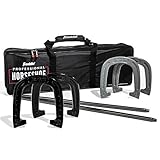


Best Regulation-Size Horseshoe Sets
A regulation-size steel set is the right choice when you want throws, ringers, and scoring to feel close to organized competition. Look for shoes weighing approximately 2.5 pounds each, with a shape and opening intended for adult play. St. Pierre Manufacturing is a well-known source of competition-oriented horseshoes and complete steel sets, while Gordon Professional horseshoes are another established option for players seeking heavy steel shoes.
The advantage of this category is consistency. A heavy shoe has enough mass to carry through a controlled throw and is less easily deflected by a firm sand or clay pit. It also gives you useful practice if you may later play under National Horseshoe Pitchers Association rules.
Regulation equipment does not automatically make a regulation pit. Competition-style play normally uses stakes set about 40 feet apart, measured from stake to stake, with the stakes leaning toward each other by approximately 3 inches over their exposed height. A backyard installation may use less distance, but that changes the difficulty and should be agreed on before a match.
What to inspect before buying
- Shoe weight: Confirm the weight of each shoe rather than relying on “professional” in the title. Four shoes at 2.5 pounds create a 10-pound set before stakes and packaging.
- Stake diameter: A roughly 1-inch solid steel stake resists bending better than a narrow rod, especially in compacted soil.
- Point and finish: A pointed lower end helps installation, while a blunt or capped top is safer to handle. Avoid sharp exposed edges around a family play area.
- Grip features: Raised heel calks and toe calks can improve control, but they also catch on rough surfaces and may wear if thrown onto concrete.
- Storage: Heavy shoes need a reinforced canvas bag, molded case, or separate hardware tote. A thin drawstring bag may tear at the seams.
Best Recreational Steel Sets for Backyards
Recreational steel sets are the best compromise for most households. They retain the satisfying feel and durability of metal without requiring a permanent regulation-length installation. Many include four shoes, two stakes, a carrying bag, and occasionally a basic measuring cord.
These sets are especially suitable when players have mixed experience levels. A family can shorten the throwing distance for beginners and move the stakes farther apart as skills improve. Shoes in the 1.5- to 2.5-pound range are easier to carry and may be less tiring for younger or smaller players, but the lighter designs can bounce or slide more on hard ground.
Champion Sports and Franklin Sports have offered recreational horseshoe games and outdoor equipment, but specifications can differ between product lines and production years. Check the current package for shoe material, individual weight, stake diameter, and included accessories rather than assuming all sets from one brand are identical.
Steel versus rubber or plastic
| Feature | Steel shoes | Rubber or plastic shoes |
|---|---|---|
| Typical individual weight | 1.5–2.5 lb | 0.2–0.8 lb |
| Best surface | Sand, clay, or soft soil | Grass, packed soil, or indoor-friendly surfaces |
| Noise | Loud impact | Much quieter |
| Portability | Moderate; usually 8–12 lb for shoes alone | High; commonly under 4 lb for the complete game |
| Competition suitability | Yes, when regulation dimensions are met | No; intended for casual play |
| Common failure point | Bent stakes or chipped coating | Cracked shoes, distorted openings, or worn plastic stakes |
Rubber and plastic sets are a sensible choice for a patio, campsite, apartment courtyard, or household where noise is a concern. They are also more forgiving when a shoe lands outside the pit. Their main limitation is that they do not reproduce the weight, bounce, or scoring feel of competition shoes.
Pit Setup: The Part Most Sets Do Not Solve
The stakes are usually the first component to expose a weak set. A thin stake may look adequate in loose soil but bend when driven into compacted ground. For steel shoes, install the stakes in prepared pits rather than hammering them directly into a hard lawn.
- Choose a clear lane. Allow room behind each stake and keep the throwing line away from walkways, windows, vehicles, and seating.
- Measure the distance. For regulation-style practice, set stake centers approximately 40 feet apart. For casual play, 20–30 feet is more manageable and still allows useful pitching.
- Prepare each pit. Create a level area about 6 feet long and 3–4 feet wide. Remove roots and stones that can deflect a shoe.
- Set the stake. Drive it firmly so roughly 14 inches remains above the pit surface. Angle the top about 3 inches toward the opposite stake across that exposed height.
- Add suitable fill. Packed clay or sand gives steel shoes a more predictable landing than grass or bare hard soil. Keep the fill level and top it up as it settles.
- Mark the foul line. A visible line prevents arguments and keeps players from stepping too close to the stake.
For a temporary installation, use a tape measure, two stake sleeves, and a removable pit border. Sleeves make it easier to pull the stakes out after play and reduce damage to the surrounding lawn. Do not rely on decorative plastic anchors to hold a heavy steel stake in compacted soil.
Durability and Ownership Costs
Steel shoes generally outlast the included bag and stakes. Surface paint or powder coating will eventually chip where shoes strike one another or the stake. That is cosmetic unless rust begins spreading under the coating. Wipe wet shoes dry before storage, and apply a light protective oil to bare steel if the set will sit unused through a damp season.
Stakes wear first when they are installed in rocky ground or struck repeatedly near the top. Straighten a mildly bent stake only if it remains structurally sound; replace one with cracks, severe deformation, or a loose tip. Do not use a damaged stake simply because it came with the original kit.
A simple cost-per-use calculation helps compare a cheap recreational set with a heavier one. Suppose a $60 steel set lasts 60 outings: that is $1 per outing before replacement fill and maintenance. A $120 competition-style set lasting 150 outings costs $0.80 per outing, despite the higher purchase price. The calculation favors the heavier set only if it is stored properly and used often enough to justify its weight.
How to Choose the Right Set
| Your priority | Choose | Avoid |
|---|---|---|
| Learning serious technique | 2.5-pound steel shoes with regulation-style stakes | Very light plastic shoes that behave differently from competition equipment |
| Fast setup and storage | Steel recreational set with a reinforced carry bag | Permanent pit frames or loose fill that must be rebuilt each time |
| Children or noise-sensitive neighbors | Rubber or plastic shoes with rounded stakes | Heavy steel shoes on concrete, decking, or hard-packed stone |
| Frequent outdoor use | Solid steel stakes and replaceable pit fill | Thin stakes and a fabric-only storage pouch |
| Limited yard space | Recreational set used at a shortened, agreed distance | Assuming a regulation game is possible without a safe throwing lane |
Final Recommendation
For competitive practice, buy a regulation-style steel set with four shoes near 2.5 pounds each and substantial 1-inch stakes. For the average backyard, a recreational steel set offers the best balance of cost, durability, and authentic feel. Choose rubber or plastic only when quiet operation, portability, or beginner-friendly handling matters more than regulation practice. Whichever type you select, a level pit, correctly spaced stakes, and dry storage will affect the game more than a decorative case or extra accessories.

0 Comments