Our Top Picks

What's inside
As an Amazon Associate I earn from qualifying purchases. This post may contain affiliate links at no extra cost to you.
Camping coolers fail in boring ways. The ice is gone by day two, the lid will not stay shut on the tailgate, or the thing is so heavy once it is loaded that nobody wants to carry it from the car to the site. Choosing well means matching capacity to your headcount and trip length, then deciding how much you value wheels, insulation thickness, and a lid you can sit on. A cooler that is too big wastes ice; one that is too small turns into a daily grocery run.
This guide is for car campers and campground regulars who are buying a wheeled hard cooler for weekend and week-long trips, not a soft pack for day hikes. It narrows seven rolling models from Coleman and Igloo, ranging from about 50 to 100 quarts, using only what each listing states about capacity, insulation, ice retention, and wheels. Shoppers in 2026 face the same trade-off as always: more insulation and size mean more weight when the cooler is full, so it pays to size honestly.
Quick Picks
As an Amazon Associate we earn from qualifying purchases at no extra cost to you.
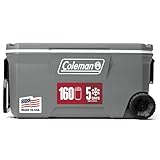


| Product | Best for | Key spec from the title |
|---|---|---|
| Coleman Classic 62-Quart | Family weekends | Holds 101 cans, listed 6 days insulated |
| Coleman Xtreme 50-Quart | Small groups, rough ground | Ice up to 5 days, 84 cans, heavy-duty wheels |
| Coleman Chiller 60-Quart | Short trips | TempLock insulation, 47 cans, 72 hours |
| Igloo Trailmate 52-Quart | Compact wheeled cooler | 80 cans, 1.5-inch foam walls and lid |
| Igloo Trailmate Journey 70-Quart | Big group trips | 112 cans, 10-inch all-terrain wheels |
| Coleman Marine 100-Quart | Boat, beach, and sun exposure | UV Guard coating, up to 160 cans |
| Coleman Classic 100-Quart | Maximum capacity | 100 quarts, insulated, rolling |
How to Choose
Match quarts to people and days
A rough starting rule is about 10 quarts per person for a weekend, plus extra if you carry perishable meals instead of just drinks. A 50 to 62 quart cooler suits two to four people over two or three nights. Past six people or a full week, a 70 to 100 quart model keeps you from opening several smaller chests. The can counts in the listings, from 47 up to 160, give a standardized way to compare, though ice takes up room too.
Insulation and the ice-retention claims
Wall thickness and foam type drive retention. The Igloo Trailmate lists 1.5-inch foam walls and lid, and the Journey names THERMECOOL foam, while Coleman references fully insulated bodies, TempLock insulation, and day counts from 3 to 6. Treat day figures as best-case numbers produced under controlled conditions: pre-chilling, a ratio of roughly two parts ice to one part contents, and shade will matter more than the badge on the lid.
Wheels, handles, and the walk from the car
If your site is more than a short carry from the parking spot, wheel quality matters. Look for wheels of at least 8 inches in diameter on dirt or gravel; the Journey lists 10-inch all-terrain wheels and the Xtreme calls out heavy-duty wheels for any terrain. A telescoping handle saves your back, as listed on both Igloo models. Add a loaded cooler’s weight to your math: 100 quarts of ice and food can be too heavy for one person.
Lid design and where budget models cut corners
A lid that locks down tightly and holds weight can double as a bench, which Coleman’s seat-lid wording suggests on the Classic. Entry-level coolers tend to cut corners on gasket quality, drain plug design, and hinge strength rather than on size. Ignore colors and gimmicks like built-in bottle openers, and instead check the drain plug, latch, and whether the lid can support a seated adult.
One last check is storage at home. A 100 quart chest takes up real garage space, and many families end up using a mid-size 50 to 70 quart unit far more often than the giant one. If you also use the cooler for tailgates and backyard parties, a model in that middle range gets used year-round instead of sitting in a corner.
The 7 Best Options
Coleman Classic 62-Quart
This rolling cooler is listed as fully insulated for 6 days, holding 101 cans, with a lid that supports sitting. It targets families who want a wheeled mid-size chest for weekend trips. Sixty-two quarts is a common sweet spot because it holds a few days of food for four people without becoming a two-person lift once the ice goes in, and the sold-as-insulated lid and body keep that cold air from escaping.
- Strength: the stated 101 can capacity at 62 quarts is a strong match for four people.
- Strength: the listing highlights a fully insulated lid and body plus a seat-capable lid.
- Trade-off: the six-day figure is a best-case claim, and a full 62-quart chest can be heavy to lift.
Skip it if you only need a small day cooler or if you regularly carry gear over rough ground without wheels in mind.
Coleman Xtreme 50-Quart
The Xtreme is listed as keeping ice up to 5 days, holding up to 84 cans, and rolling on heavy-duty wheels meant for any terrain. It suits two to four people who camp at sites with a bumpy walk from the car. For couples who also fish or paddle, the smaller footprint fits in a canoe or a crowded hatchback, and the wheels do the heavy work once you reach the trailhead parking area.
- Strength: the heavy-duty wheels are a clear advantage over the lighter wheels often found on budget coolers.
- Strength: compact 50 quart size makes it easier to fit into a trunk or tent vestibule.
- Trade-off: the smaller capacity limits big-group trips.
Skip it if you cook for six or more people, since you will outgrow it quickly.
Coleman Chiller 60-Quart
The Chiller lists TempLock insulation, a 47 can capacity, and cold retention of up to 72 hours. It is aimed at outdoor use with wheels, and fits weekend trips better than long expeditions. Think of it as the cooler for the family that leaves Friday afternoon and is home by Sunday dinner, with the drinks and a few sealed meals riding inside.
- Strength: the 60 quart outer size and wheeled design keep carrying simple.
- Strength: the three-day retention claim is a realistic fit for a long weekend.
- Trade-off: the 47 can count is notably lower than other 60-ish quart coolers here, which suggests thicker walls and less internal space.
Skip it if internal capacity matters most or you need ice to last more than three days.
Igloo Trailmate 52-Quart
The Trailmate is a roller cooler listed with 80 can capacity, 1.5-inch foam walls and lid, a telescoping handle, and wheels. It stands out in this group for naming its insulation thickness. That detail matters because thicker foam is one of the few insulation variables a buyer can compare across brands without relying on a marketing day count.
- Strength: the stated wall thickness gives you a specific spec to compare.
- Strength: the telescoping handle and wheels simplify movement for smaller campers.
- Trade-off: at 52 quarts it fills fast on trips longer than a weekend.
Skip it if you are feeding a large family or camping for a week or more.
Igloo Trailmate Journey 70-Quart
The Journey scales up the Trailmate idea to 70 quarts, holding 112 cans, with THERMECOOL foam insulation and 10-inch all-terrain wheels. It suits big groups and gravel or dirt campsites. If your usual trip involves two families sharing one chest, the added room and the oversized wheels are the reason to pay the weight penalty over the 52-quart sibling.
- Strength: 10-inch all-terrain wheels are larger than what you find on many wheeled coolers.
- Strength: 112 can capacity serves a group of six comfortably.
- Trade-off: a fully loaded 70-quart cooler gets heavy, so you will want a helper for loading.
Skip it if you only camp as a couple or need to keep the cooler light for storage.
Coleman Marine 100-Quart
The Marine cooler lists a UV Guard coating on both lid and body, ice for up to 5 days, and room for up to 160 cans. It is a natural fit for boats, beach days, and open campsites without shade. Because the coating is applied to both lid and body, the sun exposure that quickly degrades ordinary plastic coolers is less of a concern on long summer days.
- Strength: UV protection helps when the cooler sits in direct sun.
- Strength: 160 can capacity is the largest listed in the group.
- Trade-off: the title does not mention wheels, so a full chest will be hard to move.
Skip it if you must carry the cooler a long way from the vehicle.
Coleman Classic 100-Quart
The Classic 100-Quart is a portable rolling cooler in Rock Grey. Its title is short on details, so the main appeal is the size: 100 quarts of capacity with wheels for moving it once it is loaded.
- Strength: 100 quart size accommodates group meals and long trips.
- Strength: wheels make a large chest easier to move than a carry-only design.
- Trade-off: the listing offers no insulation or retention figures, so you cannot compare it directly with models that publish them.
Skip it if you want a documented ice retention figure or a compact footprint.
Which One Fits Your Situation
You camp with family for a long weekend
The Coleman Classic 62-Quart has the best combination of capacity and listed insulation for four people over two or three nights.
Your site is a hike from the parking lot
Take the Igloo Trailmate Journey 70-Quart for its 10-inch all-terrain wheels, or the Coleman Xtreme 50-Quart if you want something smaller with heavy-duty wheels.
You are camping by the water
The Coleman Marine 100-Quart brings UV Guard protection and the largest listed capacity, which suits boat trips and sunny shorelines.
You want a compact cooler for two
The Igloo Trailmate 52-Quart is the smallest wheeled unit with a named insulation thickness, a good fit for couples.
Common Mistakes
- Buying the biggest cooler available and then carrying it half empty with melting ice.
- Skipping pre-chilling, which can cost you a full day of cold retention; bring the cooler inside the night before and fill it with sacrificial ice to cool the walls.
- Ignoring wheel size when the campsite surface is gravel or sand.
- Leaving the cooler in direct sun when shade is available.
- Draining meltwater too early, which removes cold liquid that still helps hold temperature.
Related guides
- How To Strip Old Varnish From Furniture Without Sanding
- Random Orbital Sanders For Furniture Refinishing
- How Long To Wait Between Coats Of Polycrylic
Frequently Asked Questions
How many quarts do I need for a weekend?
Plan on roughly 10 quarts per person for a weekend. Add room if you bring raw meat and dairy rather than just drinks.
Do the ice retention claims hold up?
They are best-case figures from the maker. Pre-chilled contents, a high ice-to-food ratio, and shade will determine your real result.
Are wheels worth it?
If the walk from car to site is more than a few dozen steps, yes. Larger wheels roll better over gravel and roots.
Can I sit on a cooler lid?
Only if the listing says the lid supports a seated adult. The Coleman Classic wording points to a seat-capable lid.

0 Comments