What's inside
- Best Commercial Convection Ovens for a Bakery
- Best choices by bakery situation
- Recommended commercial convection oven categories
- How to match oven capacity to daily production
- Airflow, temperature recovery, and product quality
- Installation requirements people often miss
- Ownership costs and maintenance
- Final buying decision
- Best Commercial Convection Ovens for a Bakery
- Best choices by bakery situation
- Recommended commercial convection oven categories
- How to match oven capacity to daily production
- Airflow, temperature recovery, and product quality
- Installation requirements people often miss
- Ownership costs and maintenance
- Final buying decision
As an Amazon Associate I earn from qualifying purchases. This post may contain affiliate links at no extra cost to you.
Best Commercial Convection Ovens for a Bakery
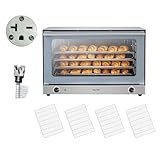
The best commercial convection oven for a bakery is usually a full-size 10-pan oven when you produce several sheet pans per hour, a half-size 5-pan oven when space and electrical capacity are limited, or a programmable combi oven when one appliance must handle bread, pastry, roasting, and humidity-controlled baking.
For most independent bakeries, a commercial electric convection oven with a 10-pan capacity, 600 x 400 mm or full-size sheet-pan compatibility, adjustable fan speed, and at least 50°F to 500°F temperature control is the most versatile choice. Gas can reduce operating cost in some locations, but it adds combustion, ventilation, and installation requirements that make electric the simpler option for many small production kitchens.
As an Amazon Associate we earn from qualifying purchases at no extra cost to you.

Best choices by bakery situation
| Bakery situation | Best oven type | Useful capacity | Why it fits |
|---|---|---|---|
| Small café or startup bakery | Half-size electric convection | 4–5 pans, 1/2-size or 600 x 400 mm | Lower purchase price, easier installation, and a smaller footprint |
| Daily pastry production | Full-size electric convection | 8–10 full-size pans | Good balance of batch size, recovery, and product flexibility |
| High-volume bread and pastry production | Gas or electric 10-pan convection | 10–20 pans, depending on model | Faster throughput and larger production batches |
| Mixed baking, roasting, and humidity-sensitive products | Combi oven | 6–10 pans | Adds steam and programmable cooking modes, at a higher cost |
| Limited power or mobile production | Stackable countertop convection ovens | 2–5 pans per cavity | Can expand capacity vertically if the building cannot support a large oven |
Recommended commercial convection oven categories
Best overall: a full-size 10-pan electric convection oven
A 10-pan electric oven is the strongest general-purpose choice for a bakery making cookies, croissants, muffins, laminated pastries, cakes, and sheet-pan products throughout the day. Common models accept full-size sheet pans measuring approximately 18 x 26 inches, while European-style models may use 600 x 400 mm pans. Confirm the rail spacing before ordering; an oven that accepts ten shallow pans may not accept your preferred tall cake pans or proofing racks.
Brands with established commercial convection ranges include Blodgett, Vulcan, Moffat, and Garland. Look for independently controlled top and bottom heat, multiple fan settings, a digital timer, a door window, interior lighting, and a cooking cavity made from stainless steel or similarly corrosion-resistant materials.
Expect a typical 10-pan electric oven to draw roughly 12 to 24 kW, depending on cavity size and heating design. That can require a dedicated three-phase circuit or a substantial single-phase circuit. Have an electrician verify voltage, amperage, breaker size, and available service before comparing prices.
Best for a small bakery: a 5-pan half-size convection oven
A 5-pan oven is sensible when daily output is modest, the bakery shares power with other equipment, or the available space is narrow. It works well for roughly 10 to 30 small batches per day, although the actual output depends on bake time, loading speed, and product size.
Half-size units commonly accept 12 x 18-inch pans, while some compact bakery ovens use 600 x 400 mm trays. A small cavity may recover temperature more quickly after the door opens, but it still cannot match the hourly output of a full-size oven. Avoid buying one based only on its pan count: two ovens with five rails can have very different usable rail spacing and airflow.
Best for a high-volume bakery: a heavy-duty gas or electric convection oven
When the bakery fills the oven repeatedly for most of the day, durability and recovery matter more than a low initial price. Heavy-duty ovens from manufacturers such as Blodgett, Vulcan, and Garland are designed for commercial service and generally offer stronger door hardware, more robust controls, and easier access to service parts than light-duty countertop equipment.
Gas ovens may be economical where natural gas is inexpensive and the building already has suitable gas service. They require a gas line, combustion air, a flue or approved exhaust arrangement, and compliance with local regulations. Electric ovens avoid combustion byproducts and often provide precise, even heat, but the required electrical service can be expensive to install.
Best for versatile production: a programmable combi oven
Rational and similar commercial combi-oven manufacturers offer programmable appliances that combine convection heat with steam and combination modes. A combi oven is useful for bakeries that also cook savory food, bake bread requiring humidity, or need repeatable programs for multiple operators.
It is not automatically the best choice for a pastry-only bakery. Combi ovens cost more, need water filtration and drainage, and require regular cleaning of the steam system and cavity. If the bakery rarely uses steam, a conventional convection oven usually provides better value and simpler ownership.
How to match oven capacity to daily production
Estimate capacity from the number of pans you need per hour rather than from the maximum pan count printed in a brochure. Use this calculation:
Required pan capacity per cycle = hourly pan demand × bake time in hours ÷ expected utilization.
For example, suppose a bakery needs 36 pans of cookies per hour. Each batch bakes for 15 minutes, or 0.25 hours, and the operator expects 80% practical utilization because of loading, unloading, and temperature recovery:
36 × 0.25 ÷ 0.80 = 11.25 pans.
A 10-pan oven would be undersized for that schedule unless the cookie recipe permits a shorter cycle or another oven handles part of the production. A 12- or 20-pan setup, or two 10-pan ovens, would provide more realistic capacity and useful redundancy.
Do not plan around a completely full oven at every cycle. Crowding can restrict airflow, extend bake times, and produce pale centers or over-browned edges. For delicate laminated dough and products with uneven pan loading, 70% to 85% practical utilization is a safer planning figure.
Airflow, temperature recovery, and product quality
Convection fans move hot air around the cavity, but more airflow is not always better. High fan speed can dry small cookies, distort delicate choux pastry, or create uneven browning if pans are loaded too closely. Variable fan control is valuable when one oven handles both sturdy bread products and light pastries.
Temperature recovery describes how quickly the oven returns to its set point after loading. Insulated doors, adequate heating power, a well-sealed gasket, and a correctly sized electrical or gas supply all contribute. Ask the dealer or manufacturer for recovery information under a realistic load, not just the empty-cavity heat-up time.
For consistent results, keep identical products on the same rack pattern and rotate pans only when the recipe requires it. Excessive door opening loses heat and changes airflow, while blocked fan guards or foil-lined oven floors can create hot spots and damage the equipment.
Installation requirements people often miss
- Measure the complete route: Check doorways, elevators, corners, ceiling height, and the oven’s shipping weight, not just the final counter space.
- Verify pan orientation: Some ovens load pans lengthwise and others crosswise. Confirm that your racks and carts fit the door opening.
- Check electrical service: Match voltage, phase, amperage, and disconnect requirements before purchasing an electric model.
- Plan ventilation: Baking releases heat, moisture, and odors. Gas models may require a listed exhaust hood, while electric ovens may still need mechanical ventilation under local code.
- Allow service clearance: Leave the manufacturer’s specified space around controls, motors, vents, and removable panels.
- Protect the water system: Combi ovens need appropriate filtration to reduce scale and protect steam components.
Ownership costs and maintenance
The first parts to wear are commonly door gaskets, hinges, latches, fan motors, heating elements, thermostats, and rack supports. Frequent high-temperature cleaning, slamming the door, and spraying water directly onto controls accelerate failures. Ask whether replacement parts are locally stocked and whether a qualified technician serves your area.
Clean crumbs from the cavity and fan guard daily. Wipe spills after the oven cools, wash racks according to the manufacturer’s instructions, and inspect the gasket for gaps or compression damage. A leaking door forces the oven to run longer and can create inconsistent browning. Schedule professional inspection of gas burners, electrical connections, temperature calibration, and safety controls at intervals appropriate to production volume.
Consumables also affect cost. These may include door gaskets, water filters, cleaning chemicals, light bulbs, and occasionally heating elements. A cheaper oven with poor parts availability can cost more over several years than a better-supported commercial model.
Final buying decision
Choose a 5-pan electric convection oven if you are space-constrained and produce in small batches. Choose a 10-pan full-size electric model for the broadest bakery use, especially when electrical service is available. Choose gas only when the building already supports safe, compliant installation and the production schedule justifies it. Choose a combi oven when steam, programmability, and mixed cooking are central to the business—not simply because it offers more features.
Before ordering, document your pan dimensions, pans-per-hour requirement, peak bake temperature, available utilities, ventilation plan, and service support. Those details will identify the best commercial convection oven for bakery production more reliably than pan count or purchase price alone.

0 Comments