What's inside
As an Amazon Associate I earn from qualifying purchases. This post may contain affiliate links at no extra cost to you.
The best countertop ovens for kitchen use are chosen by interior capacity, surrounding clearance, electrical load, and cooking modes—not by exterior size alone.
Start with the space, not the feature list
Measure the counter area where the oven will sit, then measure the oven’s width, depth, and height with the door fully open. A compact unit may occupy only about 18–22 inches of counter width, while a large convection or air-fryer oven can be 22–26 inches wide and 16–20 inches deep.
As an Amazon Associate we earn from qualifying purchases at no extra cost to you.
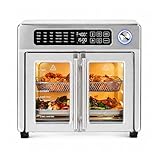
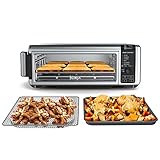
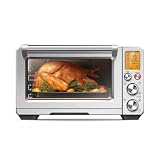

Leave the clearance specified in the manual around the top, sides, and rear. If the manual gives no clear figure, a cautious planning allowance is approximately 4 inches on the sides and rear and 6 inches above the oven, with extra room for ventilation and door movement. Do not place the oven directly beneath cabinets if hot exhaust will strike the cabinet surface.
Keep heat-sensitive items, paper towels, curtains, and plastic appliances away from the exhaust path. The oven should sit on a level, heat-resistant surface that can support its weight plus a full pan of food.
Countertop oven sizes compared
| Oven type | Typical interior capacity | Typical exterior size | Typical wattage | Best fit |
|---|---|---|---|---|
| Compact toaster oven | 0.4–0.6 cubic feet; 9–12 inch pizza | 18–22 in. W × 14–18 in. D | 1,000–1,300 W | One or two people, toast, reheating, small portions |
| Mid-size convection oven | 0.6–0.9 cubic feet; 12 inch pizza | 20–24 in. W × 16–20 in. D | 1,400–1,800 W | Frequent meals, baking, casseroles, family leftovers |
| Large countertop oven | 0.9–1.2 cubic feet; 13 inch pizza or 9 × 13 inch pan | 22–27 in. W × 18–22 in. D | 1,700–2,200 W | Families, batch cooking, large roasts, multiple racks |
| Countertop air-fryer oven | 0.7–1.0 cubic feet; basket plus rack system | 20–25 in. W × 17–21 in. D | 1,500–1,800 W | Fast crisping, wings, vegetables, frozen foods |
These are planning ranges rather than universal specifications. Two ovens with the same advertised capacity can have different usable space because of insulation, heating-element placement, rack positions, and the shape of the door. Check the largest pan or dish you actually use. A stated “12-inch pizza” capacity does not necessarily mean a 12-inch square baking dish will fit.
Choose capacity by cooking situation
| Your situation | Practical choice | Why |
|---|---|---|
| Limited counter, occasional use | Compact 0.4–0.6 cu. ft. oven | Lower footprint and usually lower electrical demand |
| One or two people cooking several times weekly | Mid-size convection oven | Enough room for a meal without heating a full-size oven |
| Family meals or meal preparation | 0.9 cu. ft. or larger | Accepts larger pans and reduces the number of batches |
| Mostly crisping frozen foods | Air-fryer oven with a removable basket | High airflow and a broad perforated cooking surface |
| Frequent bread, cakes, or casseroles | Convection model with stable temperature control | More even heat and better pan flexibility than a basic toaster oven |
Wattage, circuits, and operating cost
Higher wattage generally means faster preheating and stronger recovery after the door opens, but it also increases the load on the kitchen circuit. A 1,800-watt oven draws about 15 amps at 120 volts when its heating elements are fully energized. That is close to the practical limit of a 15-amp circuit once other appliances are included.
Use a properly grounded wall outlet rather than an extension cord or power strip. Avoid running the countertop oven simultaneously with a kettle, toaster, microwave, or portable induction burner on the same circuit unless you know the circuit can handle the combined load. If a breaker trips repeatedly or the plug becomes hot, stop using the setup and have the electrical arrangement checked by a qualified professional.
A simple energy estimate helps compare cooking habits. Suppose a 1,500-watt oven runs for 30 minutes while cycling its elements on and off. Its maximum consumption would be:
1.5 kW × 0.5 hour = 0.75 kWh.
At an electricity rate of $0.20 per kWh, that is about $0.15 for the session before accounting for cycling. Actual use may be lower, but a larger oven used for a single small item can still waste energy through longer preheating and greater heat loss.
Which cooking modes matter?
Convection
A fan circulates hot air, often improving browning and reducing temperature differences between rack positions. It is useful for roasted vegetables, cookies, and multiple items. Recipes written for a conventional oven may need a temperature reduction of roughly 25°F, or a shorter cooking time; check the food rather than relying on a fixed conversion.
Air frying
Air-fry modes use strong airflow and a perforated basket or tray. They work best when food is arranged in a single layer with space around it. A large basket is more useful than a high claimed air-fry temperature if you regularly cook enough food for several people.
Broiling and top heating
Broil elements brown the surface quickly but can scorch food close to the top. Confirm that the rack can be positioned safely and never use parchment or lightweight foil where it could contact the element.
Proofing, dehydrating, and slow cooking
These modes can be convenient, but accuracy at low temperatures matters more than a long mode list. Look for a clearly adjustable temperature range, a timer that can run long enough for the task, and instructions for airflow. A dehydrator setting is less useful if the oven’s lowest temperature is too high for your intended ingredients.
Features worth paying for
- Interior light: helps inspect browning without opening the door and losing heat.
- Removable crumb tray: speeds cleaning and prevents accumulated crumbs from smoking.
- Several rack positions: gives real flexibility for tall dishes and broiling.
- Clear controls: independent temperature, time, and mode controls are easier to adjust than a complicated menu.
- Automatic shutoff: useful protection, but it is not a substitute for staying nearby while cooking.
- Insulated door and cool-touch handle: can reduce accidental contact with hot surfaces, although the glass and exterior may still become hot.
- Dishwasher-safe accessories: convenient, but verify whether the manufacturer permits it; harsh cleaning can damage coatings.
Smartphone controls are optional rather than essential. Remote operation can create a safety problem if food is left unattended, and connectivity does not improve a weak heating system, cramped interior, or difficult-to-clean design.
Setup and clearance checklist
- Measure the counter and the oven’s open-door depth before purchase.
- Identify the wall outlet and determine what other appliances share that circuit.
- Place the oven on a stable, heat-resistant surface with the manufacturer’s clearances.
- Remove packaging, ties, cardboard, and protective films from inside and outside.
- Run the initial heating cycle specified by the manual with ventilation, since manufacturing residues may create an odor.
- Confirm that the door opens fully and that the crumb tray can be removed without moving the oven.
- Use metal bakeware rated for oven temperatures, leaving space around food for airflow.
Ownership realities: cleaning and wear
The crumb tray, door seal, nonstick basket, and heating elements usually determine how well a countertop oven ages. Brush out loose crumbs after the oven cools, wipe grease before it hardens, and clean the basket according to the manufacturer’s instructions. Do not pour water into the oven or spray cleaner onto heating elements, controls, or fan openings.
Never cover the entire crumb tray with foil unless the manual specifically permits it. Foil can block airflow, reflect heat toward an element, or interfere with the tray’s fit. Avoid abrasive pads on coated trays and do not scrape the glass door with an unsuitable blade.
Common mistakes include overcrowding an air-fry basket, placing a tall dish too close to the top element, using a metal pan that blocks the door from sealing, and assuming the oven’s timer is a substitute for a separate kitchen timer. If food repeatedly burns on one side, check rack position and airflow before assuming the thermostat has failed.
Bottom line
Choose a compact countertop oven for simple reheating and limited space, a mid-size convection model for the best everyday balance, and a large or air-fryer-style oven when pan size and batch cooking matter. Before buying, verify the usable interior dimensions, required clearances, wattage, circuit capacity, rack layout, and cleaning access. Those practical details determine whether the oven fits safely into your kitchen and remains useful long after the feature list stops being exciting.
0 Comments