What's inside
As an Amazon Associate I earn from qualifying purchases. This post may contain affiliate links at no extra cost to you.
The best 32-bit float portable audio recorder for most field and video work is the Zoom F3: it records two XLR inputs to 32-bit float files, runs on two AA batteries or USB power, and is compact enough to mount near a camera or carry in a small kit. Choose the Zoom H1essential for a lower-cost stereo recorder with built-in microphones, the Tascam Portacapture X8 when you need more inputs, or the Sound Devices MixPre-3 II when professional preamps, timecode features, and production workflows matter more than price and size.
As an Amazon Associate we earn from qualifying purchases at no extra cost to you.


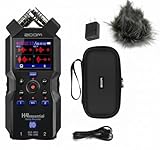

Quick comparison
These recorders all offer 32-bit float recording, but they solve different problems. Check the input type first: built-in microphones are convenient for ambience and quick capture, while XLR inputs are better suited to external microphones, booms, and wireless receivers.
| Recorder | Recording format | Inputs and microphones | Power | Weight and storage | Best fit |
|---|---|---|---|---|---|
| Zoom H1essential | Up to 96 kHz, 32-bit float | Built-in stereo microphones; 3.5 mm mic/line input | 2 AAA batteries or USB power | About 92 g without batteries; microSDXC | Portable stereo ambience, interviews, scratch audio |
| Zoom F3 | Up to 192 kHz, 32-bit float | 2 locking XLR/TRS inputs with phantom power | 2 AA batteries or USB power | About 242 g without batteries; SD/SDHC/SDXC | Two-mic field recording and camera sound |
| Tascam Portacapture X8 | Up to 192 kHz, 32-bit float | 4 XLR/TRS inputs plus 2 built-in microphones | 4 AA batteries or USB power | About 472 g without batteries; SD/SDHC/SDXC | Small crews, multichannel recording, location work |
| Zoom F6 | Up to 192 kHz, 32-bit float | 6 locking XLR inputs with phantom power | AA batteries, external DC, or USB power | About 520 g without batteries; SD/SDHC/SDXC | Multi-mic production and sound-bag setups |
| Sound Devices MixPre-3 II | Up to 192 kHz, 32-bit float | 3 XLR/TRS inputs with phantom power | AA batteries, USB-C, or supported external power | About 0.7 kg; SD/SDHC/SDXC | Professional location recording and video production |
Weights are approximate recorder-only figures; battery, card, cables, and mounting hardware add to the carried load. Battery life varies substantially with phantom power, headphone use, screen brightness, recording settings, and battery type. Treat manufacturer runtime figures as best-case planning estimates, not guaranteed field results.
Choose by recording situation
For quick stereo recording with minimal gear: Zoom H1essential
The H1essential is the straightforward choice when the recorder itself needs to capture the sound. Its built-in stereo microphones make it handy for room tone, outdoor ambience, rehearsals, and reference audio on a video shoot. It is far lighter and less cumbersome than an XLR recorder with a separate microphone.
The trade-off is flexibility. It has no XLR inputs, so connecting professional microphones may require adapters or a different recorder. Its small body is also less suited to rough handling or permanent camera-rig use than a recorder designed around locking connectors. Use a windscreen outdoors and keep the microphone capsules clear of clothing and handling noise.
For a boom or two professional microphones: Zoom F3
The F3 is the best balance for many solo recordists and video crews. Two locking combo inputs accept XLR or quarter-inch connections, and phantom power supports compatible condenser microphones. Its small footprint makes it easier to place in a pouch, on a stand, or near a camera than a larger multitrack machine.
There is no built-in stereo microphone pair, so budget for microphones, cables, and wind protection. Also plan how you will monitor: the F3 has a headphone output, but a compact recorder still needs a suitable cable and a way to secure it. For camera work, a short output cable can feed a camera’s reference input while the recorder captures the main audio.
For four or more sources: Tascam Portacapture X8 or Zoom F6
The Portacapture X8 combines four external inputs with built-in microphones, which is useful when a small crew wants both close microphones and a quick stereo ambience track. Its larger screen and guided recording modes can also make setup more approachable. The price of that flexibility is extra bulk, four-AA power demands, and more menu decisions.
The Zoom F6 is a better fit when six XLR inputs, a sound-bag workflow, and production-oriented controls are central to the job. It is not the smallest option, but it can replace several separate recorders in a multi-microphone setup. If you rarely record more than two sources, the F3 is easier to carry and simpler to deploy.
For professional production features: Sound Devices MixPre-3 II
The MixPre-3 II is aimed at users who need a more production-focused recorder, including high-quality preamps, multiple inputs, and timecode support. It makes sense when syncing and consistent location workflows are important enough to justify a larger investment and a more involved setup. For casual ambience recording, it is more recorder than most people need.
What 32-bit float does—and does not—fix
32-bit float files provide substantial digital headroom, so recording levels are less likely to become unusable simply because a sound was louder than expected. In post-production, you can often adjust a quiet or unexpectedly loud recording without the same fixed-level constraints as a conventional 24-bit recording.
It is not protection against every recording failure. If the microphone capsule or analog input stage overloads, the distortion may already be captured; 32-bit float cannot restore detail that was never recorded cleanly. Mic placement, wind protection, sensible gain settings, and headphone checks still matter. The format also creates larger files than some lower-rate alternatives, so verify card capacity and editing software support before a long session.
Battery, card, and portability planning
For a full workday, plan around the actual load rather than the smallest published runtime. Phantom-powered microphones, closed-back headphones, bright displays, and cold weather can all reduce battery life. Carry a spare matched set of fresh batteries, or use a tested USB or external power setup where the recorder supports it. Confirm that the power source can provide enough current and that its cable will not be tugged loose during a take.
Card capacity is easier to plan with a calculation. At stereo 48 kHz, a 32-bit float file is roughly 1.38 GB per hour before file-system overhead. A 64 GB card therefore holds about 46 hours of stereo audio at that setting in ideal conditions. A four-channel recording at the same sample rate uses roughly twice the space, and 96 or 192 kHz recording uses more again. Leave headroom rather than filling the card, and format it in the recorder before an important session.
Practical buying checklist
- Count sources: Buy for the number of microphones you need at once, not the number you might use someday.
- Match connectors: Built-in microphones suit fast stereo capture; XLR inputs suit external microphones and many wireless receivers.
- Check mounting and monitoring: Allow for a pouch, shock isolation, headphone access, and cable routing in a camera rig or sound bag.
- Budget for the whole kit: Microphones, wind protection, batteries, cards, cables, and mounting hardware can cost more than expected.
- Test the complete workflow: Record a sample, transfer it, open it in your editing software, and confirm your sync and backup process before a paid shoot.
Bottom line
Choose the Zoom H1essential when built-in stereo microphones and minimum weight matter most. Choose the Zoom F3 for compact two-input XLR recording and a strong balance of portability and flexibility. Step up to the Portacapture X8 or Zoom F6 when you need more simultaneous sources, and consider the MixPre-3 II when professional production features justify its size and cost. In every case, 32-bit float is a useful safety margin—not a substitute for sound placement, monitoring, and a reliable power and backup plan.
0 Comments