What's inside
As an Amazon Associate I earn from qualifying purchases. This post may contain affiliate links at no extra cost to you.
A 2200-watt generator occupies a specific niche: it runs a small window unit, powers a CPAP machine overnight, keeps a refrigerator and a few lights alive during an outage, or supplies enough juice for a tailgate project without hauling a noisy, heavy machine that requires a truck bed to transport. The category is crowded, but the range in quality, noise, and reliability among competing models is enormous, and the price spread between a viable budget option and a premium unit is easily three or four times. That gap forces buyers to make real tradeoffs around noise floor, fuel efficiency, build quality, and warranty support.
What separates the best 2200 watt generators from mediocre ones usually comes down to inverter technology quality, actual runtime at real-world loads, noise level at 25 percent versus 50 percent throttle, and whether the manufacturer supports the product with parts and service long after the sale. Owner feedback on forums and review platforms is revealing here: units that advertise quiet operation sometimes generate high-pitched whine under partial load, and lightweight frames often correlate with thinner fuel tanks that shrink runtime below marketing claims. This guide compares published specs, listed prices, and aggregated owner reports to help you narrow the field before you spend.
As an Amazon Associate we earn from qualifying purchases at no extra cost to you.


Our Top Picks
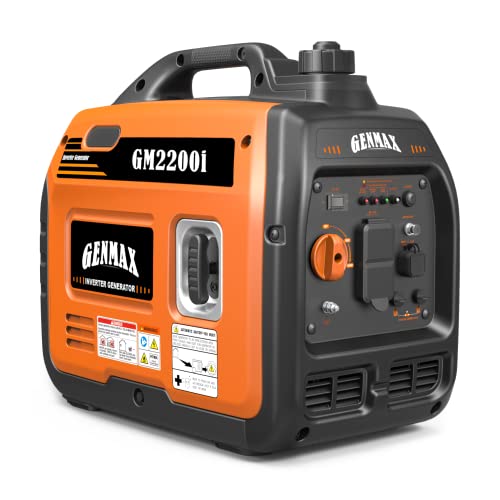 GENMAX Portable Generator,2200W Ultra-Quiet Gas Engine2200W18.9 x 11.4 x 17.3 inches41.8 poundsCheck on Amazon
 Honda EU2200i Companion 2200 Watt Inverter Generator20 x 11.4 x 16.7 inches53.57 poundsCheck on Amazon


Quick Picks
| Product | Best for | Price |
|---|---|---|
| GENMAX GM2200i | Overall value for home backup | $349.99 |
| Honda EU2200i (EU2200ITAN) | Resale value and long-term reliability | $1199 |
| Honda EU2200i (EU2200ITAN, alt listing) | Campers who prioritize ultra-quiet operation | $1199 |
| Honda EU2200i Companion (EU2200ITAN5) | Parallel-connection setups for doubled output | $1299 |
| Honda EU2200i (EU2200ITAN, run-time listing) | Extended overnight backup without refueling | $1199 |
| Pulsar PG2200BiS | Fuel flexibility at a mid-range price | $429 |
| Oxseryn 4400W | Higher wattage on a budget | $289.99 |
| Honda EB2200i (EB2200ITAN) | Job-site durability with GFCI protection | $1299 |
How We Picked
We filtered this category on four criteria: inverter output quality measured by total harmonic distortion claims and owner-reported electronics sensitivity, noise level at half load compared to the manufacturer’s stated figure, true runtime at 25 percent load versus the marketing headline, and verified service network breadth. Price is the fifth consideration but not the first; a generator that strands you at a campsite because a dealer cannot supply a carburetor rebuild kit is not a bargain regardless of sticker cost.
The 8 Best 2200 Watt Generators in 2026
GENMAX GM2200i
The GENMAX is the strongest entry point for anyone who needs clean backup power without spending four figures. It delivers rated 2200 watts through an inverter, includes Eco-Mode for fuel savings, and weighs enough to lift into a car trunk solo. Owners consistently praise the near-Honda noise signature at a fraction of the price, and EPA compliance means legal operation in every state. The con is longevity: several long-term owners report carburetor sensitivity to ethanol-blended fuel that demands a stabilizer routine Honda units tolerate more easily. Skip this if you need a machine that will run unmaintained for years between service intervals.
- Pro: Eco-Mode adjusts throttle to load, extending runtime without manual intervention
- Pro: Ultra-lightweight form factor suits campers and RV owners without a tow vehicle
- Con: Carburetor tuning is less forgiving of old or ethanol-heavy fuel over time
Honda EU2200i (EU2200ITAN)
This is the reference unit in the category. Honda’s inverter platform has set the benchmark for clean power, and EU2200i owners report decades of service with basic oil changes. The 2200-watt output handles a 10,000 BTU air conditioner plus small electronics simultaneously. Noise is low enough to hold a normal conversation at the unit itself. The obvious tradeoff is price, which is more than triple the GENMAX. Skip it if your use case is occasional and you cannot justify the premium over a budget inverter that meets the same power need.
- Pro: Exceptional resale value; units retain a large share of original price
- Pro: Widely available parts and service network across North America
- Con: Premium price is difficult to justify for infrequent backup use
Honda EU2200i (EU2200ITAN, alternate listing)
Identical to the unit above in hardware, this listing appears in retail channels that emphasize portability and camping positioning. The EU2200i’s sound envelope is quiet enough for campgrounds with strict noise ordinances, and its inverter produces clean sine-wave output safe for laptops and phones without additional filtering. The weight is competitive for its class. Where it falls short for some buyers is fuel tank capacity, which limits continuous runtime to roughly eight hours at light load. Skip this listing if the higher-priced Companion variant is available in your region and you anticipate needing parallel output.
- Pro: Clean power output safe for sensitive electronics without external conditioning
- Pro: Low noise makes it suitable for campground environments with sound restrictions
- Con: Tank size limits extended overnight runtime without a mid-night refill
Honda EU2200i Companion (EU2200ITAN5)
The Companion is designed to pair with a second EU2200i via Honda’s proprietary parallel cable, effectively doubling output to 4400 watts without the weight of a larger single unit. For woodworkers or RV owners who occasionally need a compressor or microwave but want lightweight portability day-to-day, this flexibility is the key selling point. At $1299 it carries a $100 premium over the standard unit for that parallel capability. Skip it if you will never add a second unit; the standard EU2200i does everything this one does independently.
- Pro: Parallel connection to a second unit scales output when demand spikes
- Pro: Same proven inverter platform and noise floor as the standard EU2200i
- Con: Requires a second unit and cable to realize its main advantage
Honda EU2200i (EU2200ITAN, run-time listing)
This listing highlights the EU2200i’s headline runtime of up to 8.1 hours at 25 percent load, making it the strongest choice for overnight home backup where refueling is impractical. The inverter maintains stable frequency and voltage across the load range, and the auto-idle feature reduces noise and fuel consumption when demand drops. Owners of this model report it reliably running a refrigerator plus a furnace blower through a power outage without hesitation. Skip this if you need more than 2200 watts and would be better served by a true 3000-plus watt unit from the start.
- Pro: Up to 8.1-hour runtime at quarter load supports overnight use without refueling
- Pro: Auto-idle reduces both fuel draw and audible noise during low-demand periods
- Con: 2200-watt ceiling means it cannot handle simultaneous high-draw appliances
Pulsar PG2200BiS
Pulsar’s dual-fuel design lets you run on gasoline or propane from a standard grill tank, which is a genuine advantage for preppers and RV owners who store fuel long-term. Propane burns cleaner and extends service intervals between carburetor cleanings. At $429 it undercuts Honda substantially while offering parallel capability for future output scaling. The inverter output is clean enough for most electronics, though some owners note a slightly higher harmonic distortion than the benchmark Honda unit. Skip it if you demand absolute lowest noise; it is quiet but not in Honda’s whisper tier.
- Pro: Dual-fuel flexibility eliminates ethanol-related carburetor issues when running propane
- Pro: Parallel-ready port allows output doubling without buying a different platform
- Con: Marginally louder than premium inverters and slightly less refined power quality
Oxseryn 4400W
This unit does not fit the 2200-watt category strictly; it is a 4400-watt open-frame generator listed at $289.99, which is an extraordinarily low price for that output. For buyers who need more headroom than a true 2200-watt inverter provides, it offers a 30-amp RV outlet and substantial surge capacity. The open-frame design means it is louder than any enclosed inverter in this roundup. Owner feedback on long-term reliability is thin compared to established brands. Skip it if quiet operation or clean sine-wave output for sensitive electronics is non-negotiable.
- Pro: Nearly double the wattage of other entries at the lowest price in this list
- Pro: 30-amp outlet makes it directly compatible with RV park pedestals
- Con: Open-frame construction produces significantly more noise than enclosed inverter designs
Honda EB2200i (EB2200ITAN)
The EB2200i is the contractor-grade version of the EU platform. It shares the same engine and inverter but adds a GFCI outlet, weather-resistant frame, and a more rugged handle design suited to job sites. For woodworkers running small dust collectors, table saws, or planers at a remote site, the GFCI protection is a meaningful safety feature that the EU variant lacks. At $1299 it matches the Companion price. Skip it if your use is residential backup or camping where the job-site ruggedness does not translate into practical benefit.
- Pro: Built-in GFCI outlet provides critical protection for power-tool use on-site
- Pro: Same legendary Honda inverter reliability with a frame designed for field abuse
- Con: Heavier and bulkier than the EU equivalent for the same output
Buying Guide
Inverter Quality and Power Cleanliness
The defining advantage of a 2200-watt inverter generator over a conventional unit is total harmonic distortion. A quality inverter keeps THD below 3 to 5 percent, which means laptops, LED drivers, furnace control boards, and medical devices will operate without flickering, overheating, or faulting. Budget units sometimes claim inverter technology but achieve higher distortion under partial load. Check owner reviews specifically for electronics sensitivity complaints before trusting a manufacturer’s datasheet alone.
Noise at Real-World Loads
Manufacturer decibel ratings are almost always taken at 25 percent load, which is not how most people run a generator. At 50 to 75 percent load, the engine pitches up and the cooling fan ramps. Honda and GENMAX units handle this transition with less audible intrusion than open-frame or older-generation inverters. If you camp near neighbors or use a unit near a bedroom window, prioritize models with proven quiet operation under medium load, not just idle.
Runtime, Tank Size, and Eco-Mode Effectiveness
Advertised runtime is at quarter load. Real overnight home backup at 40 to 60 percent load might cut that figure roughly in half. Eco-Mode adjusts engine speed to match demand, but some implementations throttle too aggressively and produce unstable output when a compressor kicks on. Look for owners reporting clean startup of inductive loads like refrigerators or power tools, because that is where both runtime claims and Eco-Mode calibration get tested.
Our Verdict
The top pick is the Honda EU2200i for anyone who values quiet, clean, long-lived power and can absorb the cost. It remains the category benchmark for good reason, and the 2026 market has not produced a budget unit that matches its service network and resale value. The budget pick is the GENMAX GM2200i, which delivers the best balance of inverter quality, noise control, and price for home backup and camping. The conditional winner is the Pulsar PG2200BiS: if fuel storage longevity matters more to you than absolute quiet, dual-fuel capability on propane solves the ethanol-degradation problem that plagues every gasoline-only unit in this list.
FAQ
Can a 2200-watt generator run a refrigerator?
Yes. Most household refrigerators draw between 100 and 400 running watts, well within 2200-watt capacity even with the compressor starting surge. A quality inverter unit like the Honda EU2200i handles the startup transient without voltage sag that could trip a refrigerator’s control board.
Is Eco-Mode always beneficial?
Not always. Eco-Mode reduces fuel consumption and noise during light loads, but some implementations throttle the engine so aggressively that a sudden compressor start causes a visible voltage dip before recovery. Owners of sensitive electronics occasionally prefer to run with Eco-Mode off for more consistent output.
How loud is a typical 2200-watt inverter generator?
Budget and mid-range inverters in this category generally operate in the 55 to 65 decibel range at light load, comparable to a quiet conversation. Premium units like Honda’s EU platform are on the lower end of that span. Open-frame designs like the Oxseryn are noticeably louder because they lack acoustic enclosures.
Can I parallel two different-brand 2200-watt inverters?
No. Parallel capability requires matched units of the same make and model connected by a manufacturer-approved cable. Mixing brands will not produce combined output and risks back-feeding damage to both inverters’ internal electronics.




0 Comments