- The Misconception: “More CFM Means Better Suction”
- What Separates an Extractor From the Shop Vac You Already Own
- Choosing a Dust Extractor for Woodworking: The Specs That Actually Decide It
- Where Most Setups Actually Leak Performance
- Matching the Machine to Your Shop
- Frequently Asked Questions
- The Practical Takeaway
As an Amazon Associate I earn from qualifying purchases. This post may contain affiliate links at no extra cost to you.
Most shops buy the wrong machine because they treat all suction as the same thing. You hook a 2.5-inch shop vac hose to a random orbit sander, the pad chatters, the bag clogs in twenty minutes, and the fine gray haze still settles on everything by Sunday night. A proper dust extractor for woodworking solves that, but not because it is a stronger vacuum. It solves it because it is a different kind of air mover, tuned for a different job, and understanding that difference is the whole ballgame.
So before any product talk, let’s get the mechanism straight. There are two distinct dust problems in a woodshop, they require opposite air behavior, and almost nobody explains which machine handles which.
The Misconception: “More CFM Means Better Suction”
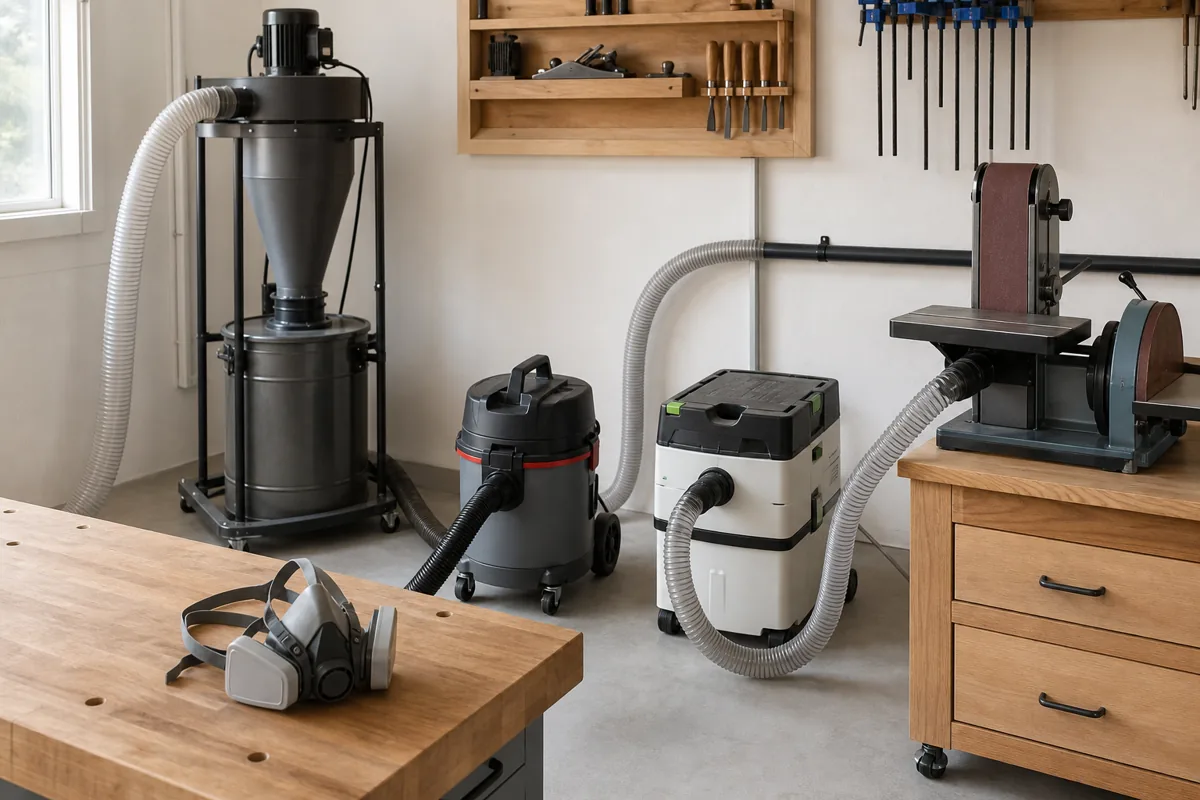
The claim you hear constantly is that a 1.5 HP dust collector rated at 1,000+ CFM must outperform a small extractor rated near 130 CFM. On paper that looks obvious. In practice, hook that big collector to a router or a sander and it barely picks up anything.
Here is the reason. Air movement has two properties that trade against each other: volume (CFM, how much air moves) and static pressure (usually stated in inches of water lift, how hard the machine pulls against resistance). Think of it like water plumbing. A fire hose moves enormous volume but at low pressure. A pressure washer moves very little water but at pressure high enough to strip paint. Neither is “stronger.” They are built for different resistance.
A big impeller dust collector is the fire hose. It moves a huge column of air through a 4-inch or 6-inch duct at low static pressure, which is exactly right for a table saw, jointer, planer, or bandsaw. Those machines throw large volumes of chips into a large open port. Choke that same collector down to a 1.25-inch sander port and the resistance spikes. The impeller stalls out against it and airflow collapses.
A dust extractor is the pressure washer. It uses a bypass motor with high static pressure, often in the 90 to 100 inches of water range on the better units, to force air through a narrow, restrictive hose against a tool shroud pressed flat against a workpiece. That is where the resistance lives, and that is why a small extractor beats a big collector at the sander every time.
Neither machine replaces the other. If you only own one, own the one matching the tools you actually use daily. Most hobbyists sand, rout, and cut sheet goods with a track saw far more than they run a 15-inch planer.
What Separates an Extractor From the Shop Vac You Already Own
A shop vac and a dust extractor share the same basic motor architecture, so the confusion is fair. Four real differences matter.
Filtration class. Wood dust in the sub-10-micron range is the part that reaches deep lung tissue, and standard shop vac filters pass a meaningful amount of it. Real extractors use HEPA or HEPA-equivalent filtration certified to capture 99.9%+ of particles down to around 0.3 microns. A shop vac with a fine dust bag and a good cartridge filter is a genuine improvement over bare, but it is not equivalent.
Automatic tool activation. Extractors have a switched outlet. Plug the sander into the extractor, pull the trigger, the extractor spins up and then runs on for a few seconds to clear the hose. It sounds like a luxury. It is the single feature that makes you actually use the machine instead of skipping it.
Variable suction and antistatic hose. Full suction on a random orbit sander glues the pad to the work and kills your finish quality. Being able to dial suction back is functional, not cosmetic. Antistatic hoses stop the shock that comes from dry wood dust building charge inside a plastic tube.
Filter cleaning. Drywall compound and MDF dust blind a filter fast. Better units pulse or manually back-flush the filter so airflow stays consistent through a job instead of dropping off after fifteen minutes.
| Machine type | Best at | Typical port | Weak point |
|---|---|---|---|
| Dust extractor | Sanders, routers, track saws, tile | 1.25 to 1.5 in | Low volume, small tank |
| Shop vac | Cleanup, wet spills, general mess | 2.5 in | Filtration and no auto-start |
| Dust collector | Table saw, jointer, planer, bandsaw | 4 to 6 in | Collapses on small ports |
| Ambient air cleaner | Airborne haze after the fact | n/a | Captures nothing at the source |
Choosing a Dust Extractor for Woodworking: The Specs That Actually Decide It
Ignore horsepower marketing entirely. Look at these instead.
Sealed static pressure in inches of water. Serious units sit in the 90 to 100 inch range, budget units noticeably lower. This is your ability to pull through a restrictive shroud.
Certified HEPA, stated as a class or a capture percentage, not “HEPA-style.” If a listing will not print a number, treat that as an answer.
Hose diameter and length. A 27mm hose gives higher velocity for sanders, a 36mm hose moves more volume for a track saw or miter saw. Longer hoses cost you static pressure, so buy the length you need and not much more.
Tank size and mobility. Anything from roughly 2.5 to 10 gallons is normal for this category. Larger tanks mean fewer bag changes but a heavier machine to drag around.
Bag versus bagless. Fleece bags cost money but keep fine dust out of your face at disposal time, which is the entire reason you bought the machine.
Cordless options. Battery extractors on the DeWalt XR, Milwaukee FUEL, and Makita LXT platforms are real now and excellent for installs and outdoor work. Runtime and sustained static pressure still trail corded units, so treat them as a second machine unless portability is your main constraint.
HEPA Dust Extractor with Auto Tool Start
This is the category to shop if you sand and rout regularly. Filter on certified HEPA plus a switched outlet, then compare static pressure numbers between models in your budget. A mid-size tank with a 36mm hose and a 27mm adapter covers the widest range of tools without a second purchase.
Where Most Setups Actually Leak Performance
Buying the machine is maybe half the result. The rest is the connection between machine and tool, and this is where good extractors get blamed for bad performance.
Adapters are the usual culprit. Every step-down fitting, every taped joint, every stretch of corrugated hose adds resistance. Corrugated internal walls create turbulence that eats static pressure over distance, which is why a 30-foot hose feels dramatically weaker than a 10-foot one on the same machine. Use the shortest hose that lets you work.
Tool shrouds matter more than people expect. A router with a proper dust hood captures a large share of the chips. The same router bare captures almost nothing no matter what you connect. Same story with track saws and miter saws, where a good hood plus a rear shield beats a stronger vacuum with a poor shroud.
Then there is the part nobody wants to hear: source capture and air filtration are separate jobs. An extractor grabs dust at the tool. Fine particles that escape stay airborne for hours, and a ceiling air cleaner or a box fan with a good filter handles those. Doing one and skipping the other leaves a real gap.
- ✔ High static pressure pulls through restrictive sander and router shrouds
- ✔ Certified HEPA filtration captures the fine dust that actually reaches your lungs
- ✔ Auto tool start means you use it instead of skipping it
- ✔ Variable suction keeps sanding pads from sticking to the work
- ✔ Doubles as jobsite cleanup and wet pickup
- ✘ Costs several times what a comparable shop vac costs
- ✘ Low CFM makes it a poor match for table saws and planers
- ✘ Fleece bags and HEPA filters are ongoing consumables
- ✘ Small tanks fill fast on demolition or drywall work
Matching the Machine to Your Shop
If your work is sanding, routing, track saw cuts, and general assembly, buy the extractor first and add a collector later when a planer or jointer arrives. If you already own big stationary machines with 4-inch ducting, you still need an extractor for handheld tools, because reducing that duct to a sander port throws away most of what the collector can do.
Small shops and garages often get the best result from an extractor plus an ambient air cleaner, skipping the large collector until floor space and a real dust budget exist. In tight spaces, the extractor also doubles as the shop vac, which is a genuine advantage.
Cordless Dust Extractor for Jobsite Work
Worth it if you do installs, trim work, or outdoor cutting where dragging a cord is the real obstacle. Stay on a battery platform you already own, and expect shorter runtime and slightly less pull than a corded unit of similar size. As a second machine it earns its keep quickly.
Frequently Asked Questions
Can I just use my shop vac with a better filter? It is a real improvement and a reasonable starting point, especially with a fine dust bag plus a cartridge filter. What you still lack is auto tool start, variable suction, and certified fine-particle filtration. If sanding is a big part of your week, the upgrade is worth it. If you sand occasionally, the improved shop vac may be enough for now.
Do I need both a dust extractor and a dust collector? Only if you own both kinds of tools. Handheld tools with small restrictive ports need high static pressure, and large stationary machines with 4-inch outlets need high volume. Trying to cover both with one machine means one set of tools gets served poorly.
Is a cyclone separator worth adding? Usually yes, particularly if you cut MDF or a lot of sheet goods. A separator drops the bulk of the chips before they reach the filter, so airflow stays consistent longer and filters and bags last considerably longer. It does add another hose connection and a bit of resistance, so keep the setup as short and direct as you can.
The Practical Takeaway
Stop shopping by horsepower and CFM alone. Decide which resistance problem you are solving, high pressure through a narrow shroud or high volume through a wide duct, then buy the machine built for it. For handheld woodworking tools, that means an extractor with strong static pressure, certified HEPA filtration, auto tool start, and the shortest hose that reaches your work. Add ambient air filtration for what escapes, and your shop gets measurably cleaner without buying a bigger motor.
Check prices on Amazon →
0 Comments