As an Amazon Associate I earn from qualifying purchases. This post may contain affiliate links at no extra cost to you.
You pull a battery off the shelf in March, snap it into the drill, and it runs for ninety seconds before the fuel gauge collapses. The pack was fine in October. Nothing hit it, nothing shorted, and yet the capacity is gone. That is not bad luck and it is usually not a defect. It is storage. Learning how to store lithium tool batteries matters more than most people expect, because lithium cells do not sit idle the way a nickel pack or a car battery does. They age chemically the whole time they are on the shelf, and the two things that control how fast they age are the state of charge you left them at and the temperature they sat in.
Here is the mechanism, because it makes every recommendation below obvious instead of arbitrary. Inside each cell there is a thin protective film on the negative electrode called the SEI layer. Think of it like the skin on a can of paint. It forms naturally, it is necessary, and it thickens over time. Every bit of thickening consumes a small amount of lithium that used to be available to carry charge, so the pack permanently loses a little capacity. Two things make that skin grow faster: high voltage (a full pack) and heat. That is it. That is the whole story. A battery stored hot and full is a battery being aged on purpose. A battery stored cool and partly charged is a battery in something close to suspended animation.
| Storage condition | What is actually happening | Effect over about a year |
|---|---|---|
| 100% charge, 100°F garage | High voltage plus heat, fastest SEI growth | Large, permanent capacity loss |
| 100% charge, 70°F room | Voltage stress without heat stress | Noticeable loss, worse on older packs |
| 40-60% charge, 70°F room | Low voltage stress, low heat stress | Minimal loss, the target zone |
| 40-60% charge, 40°F basement | Chemistry slowed further | Excellent, essentially the ideal |
| Fully dead, forgotten for months | Cell voltage can drift below the safe floor | Risk of a pack the charger refuses |
The misconception: “top them off so they’re ready”
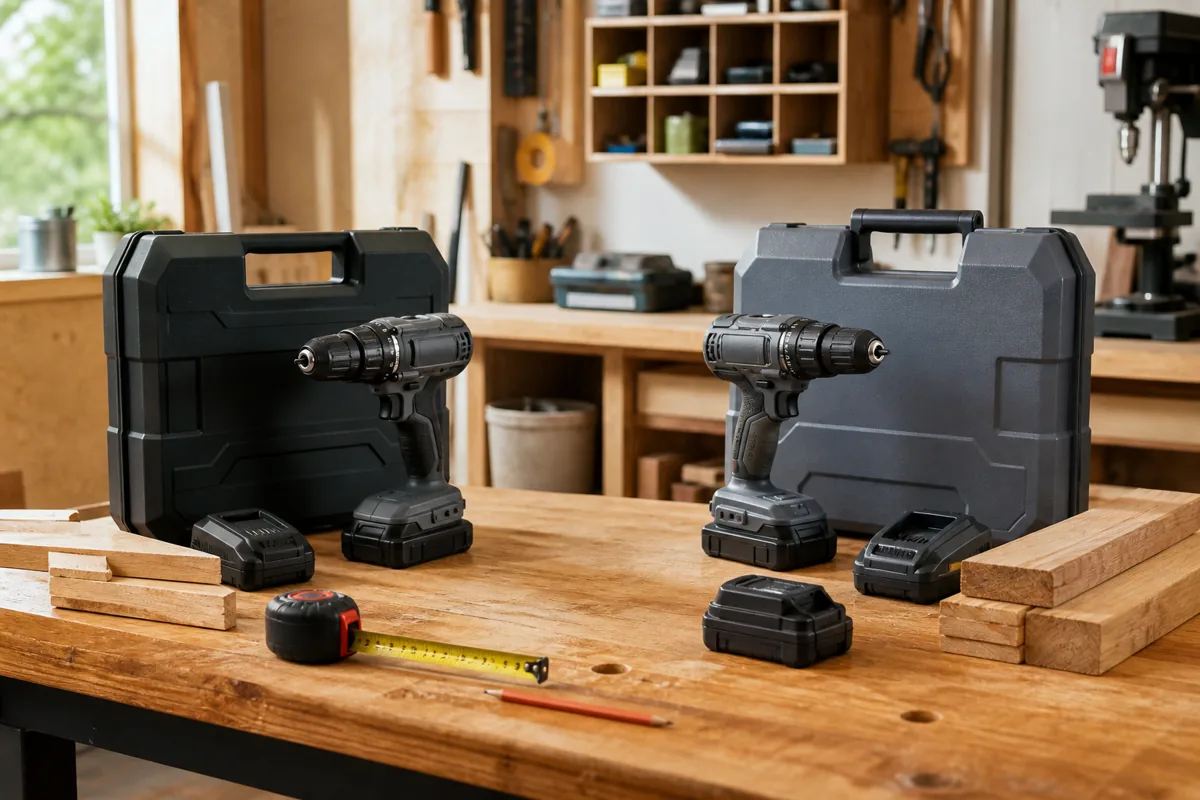
Almost everyone does this. You finish a project, you put every pack on the charger so the whole row shows four green lights, and you feel organized. That habit is the single most common way people shorten pack life, and it comes from muscle memory built on older tools. Nickel-cadmium packs genuinely did want to be cycled and drained, and lead-acid batteries in cars and mowers genuinely do want to sit full because they sulfate when they sit low. Lithium is the opposite animal. It has no memory effect to fight, and a full charge is its most stressful resting state.
Full charge means the cells are held near their maximum voltage, roughly 4.2 volts each, and voltage is the electrical equivalent of pressure. Storing a pack full is like leaving a pneumatic hose pressurized all winter. Nothing dramatic happens on day one, but the seals age faster than they would empty. Store at 40 to 60 percent instead, which on a four-light fuel gauge means two lights, and you take most of that pressure off. Charge to full the night before you need it. A modern charger fills a mid-size pack in well under an hour, so nothing about this costs you real time.
The mirror-image mistake is just as damaging. A pack run to shutdown and then left for six months keeps self-discharging slowly, and every cell has a floor voltage below which the internal electronics will refuse to accept a charge. Some tool batteries can drift under that floor and become genuinely unrecoverable. So neither extreme: not full, not empty, two lights on the gauge.
Fireproof lithium battery storage bags
These are woven fiberglass pouches meant to contain a thermal event rather than prevent one. They are not a substitute for good storage habits, but if you keep six or eight packs in a finished basement or an attached garage, a bag around the ones in long-term storage is a low-cost way to limit the worst case. Buy one sized so packs sit flat with the terminals not touching each other, and skip the very cheapest listings with no material description.
How to store lithium tool batteries through a cold winter
Cold is where the advice online gets genuinely confused, so separate two different things: storing cold and using cold. Cold storage is good. Chemical reactions slow down as temperature drops, so an unheated basement at 45°F is a better shelf than a spare bedroom at 72°F. There is no meaningful risk in letting a lithium tool pack sit at freezing or a bit below while it is idle.
Charging cold is the actual hazard. Below roughly 32°F, lithium ions stop tucking neatly into the negative electrode and instead plate out as metallic lithium on its surface. Those deposits are permanent, they eat capacity, and in the worst case they can grow into internal shorts. Good chargers from the major lines will refuse to start or will blink a fault until the pack warms, which is a feature, not a malfunction. Discharging cold is not damaging in the same way, but the pack will feel weak because internal resistance rises. That drop is temporary and returns when it warms.
So the winter routine is simple. Leave packs in the cold shop if you want, but bring them inside and let them reach room temperature before charging, which for a big pack means an hour or two, not ten minutes. Do not leave batteries in a truck bed or an unheated van overnight in January and expect to charge them at the jobsite at 6 a.m.
Heat deserves the stronger warning. An uninsulated garage in Phoenix or a closed truck cab in a Texas July can pass 130°F, and that is where packs die quietly. A pack cooked all summer at full charge can lose a serious fraction of its capacity in a single season. If you only change one thing after reading this, move your batteries out of the hot vehicle.
Where to physically put them
Beyond charge and temperature, the rest is mechanical. Terminals are exposed metal, and a pack sitting loose in a drawer with screws, drill bits, and a spare blade is a short circuit waiting for the right piece of debris. Batteries have internal protection, but a dead short through the terminals is a thermal event, not an inconvenience. Store packs terminals-up or in the molded slots of an organizer so nothing bridges the contacts, and keep them out of the bottom of the bucket where offcuts collect.
Pick a spot that is cool, dry, and not directly against an exterior wall or a water heater. Avoid the shelf above the miter saw where fine dust settles into the vents. Avoid the sealed plastic tote in a damp basement, because condensation forms inside it as temperature swings and corrosion on the contacts follows. An open shelf or a slotted rack in conditioned space beats a closed container in an unconditioned one.
Wall-mount battery holders and charger racks
Cheap molded brackets that screw to a stud and hold packs by their rail. The real value is that packs stop rattling around a drawer where debris can bridge the terminals, and you can see the fuel gauges at a glance so nothing sits forgotten at zero. Look for holders that match your specific rail design rather than universal ones, and mount them somewhere out of direct sun and away from saw dust.
The practical routine that fits real shop life
The perfect storage protocol nobody follows is worthless, so here is the version that actually sticks. Keep two packs as your daily drivers and charge them however you like, since they are cycling constantly and voltage stress barely matters over a few days. Everything beyond those two is inventory, and inventory gets the two-light treatment. Once a season, walk the shelf, look at the fuel gauges, and top up anything that has drifted to one light or none. That single check is what prevents the deep-discharge bricks.
Two more habits worth adopting. Take the pack off the charger once it is done rather than treating the charger as a shelf, because many chargers keep the cells sitting at full and warm. And let a battery cool after hard work before charging it, since a pack straight off a circular saw is already hot and charging adds more heat on top.
- ✔ Two lights on the gauge for anything sitting more than a few weeks
- ✔ Cool and dry beats warm and convenient, always
- ✔ Cold storage is fine, cold charging is not
- ✔ Terminals protected, no loose packs in a debris drawer
- ✔ One seasonal walk-by check to catch drifting packs
- ✘ Leaving everything full because it feels organized
- ✘ Batteries living permanently in a hot truck or attic
- ✘ Charging a pack straight out of freezing weather
- ✘ Sealed totes in damp basements, condensation and corrosion
- ✘ Running a pack to shutdown and forgetting it for a season
Frequently asked questions
Should I take the battery off the tool when I put it away? Yes, for anything you are not using this week. A pack left in a tool draws a small standby current from the tool’s electronics and switch, and over months that can pull a stored pack low enough to matter. It also protects the trigger from a bump on a crowded shelf. For the two packs you use every day, it makes no practical difference.
Can I leave batteries on the charger all the time? Not as a storage strategy. Chargers from the major lines are smart enough not to overcharge, so nothing dangerous happens, but the pack sits near full voltage and often slightly warm, which is exactly the combination that thickens the SEI layer. Charge, remove, shelve. If you want packs ready to grab, that is what the daily-driver pair is for.
My old pack only runs for a few minutes. Can storing it better bring the capacity back? No. Capacity loss from SEI growth and lithium plating is permanent chemical change, not a calibration issue, so there is nothing to reset. What sometimes looks like recovery is a pack whose cells drifted out of balance being brought back in line by a full slow charge, which can help a little. Good storage protects the packs you still have; it cannot heal one that is already worn out. Recycle the dead one at a hardware store drop-off rather than the trash.
Store cool, store around half, keep the terminals clear, and check the shelf once a season. Everything else about lithium tool batteries is detail on top of those four things, and packs treated that way commonly stay useful for many years instead of dying quietly in a hot garage over one summer.
Check prices on Amazon →

0 Comments