What's inside
- Quick picks by RV type and storage situation
- What makes the best RV covers different?
- Head-to-head: light, medium, and heavy-duty covers
- How to choose the correct size
- Wind straps matter more than extra fabric
- Decision matrix for real storage conditions
- Installation steps that prevent premature wear
- Ownership costs and common failure points
- Final buying advice
- Quick picks by RV type and storage situation
- What makes the best RV covers different?
- Head-to-head: light, medium, and heavy-duty covers
- How to choose the correct size
- Wind straps matter more than extra fabric
- Decision matrix for real storage conditions
- Installation steps that prevent premature wear
- Ownership costs and common failure points
- Final buying advice
As an Amazon Associate I earn from qualifying purchases. This post may contain affiliate links at no extra cost to you.
The best RV covers are breathable, UV-resistant, securely strapped, and sized to your RV’s actual body dimensions—not simply the length printed in the brochure.
Quick picks by RV type and storage situation
| RV type or situation | Best cover specification | Useful size range | What to prioritize |
|---|---|---|---|
| Class A motorhome | Heavy-duty multilayer polypropylene or polyester, roof access, reinforced corners | 30–45 ft | Wind straps, mirror pockets, ladder protection, ventilation |
| Class C motorhome | Breathable multilayer fabric with a cab-over-compatible shape | 20–33 ft | Correct height, windshield protection, cinch panels |
| Travel trailer | Polypropylene or polyester cover with separate access panels | 18–40 ft | Allowance for propane tanks, spare tire, and slide-outs |
| Fifth-wheel trailer | Tall, tapered cover with reinforced front cap and extended straps | 25–45 ft | Front-cap fit, high-point abrasion protection, roof ventilation |
| Frequent short-term use | Light-to-medium multilayer cover, preferably with a storage bag | Match measured body length | Fast installation, zipper access, low packed volume |
| Long-term outdoor storage | Heavy-duty breathable fabric with UV treatment and reinforced seams | Match measured body length | Water resistance, wind resistance, roof support, repairability |
What makes the best RV covers different?
An RV cover has to balance two opposing jobs: stopping rain and sunlight while allowing trapped moisture to escape. A cover that is completely impermeable may keep out rain, but condensation can remain between the fabric and roof. Over time, that moisture can encourage mildew, stain graphics, and accelerate corrosion around roof fixtures.
As an Amazon Associate we earn from qualifying purchases at no extra cost to you.
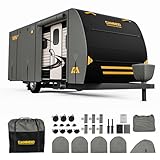
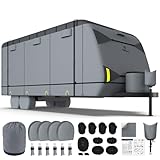
For most owners, a multilayer polypropylene or polyester cover is the best compromise. These fabrics are typically water-resistant rather than permanently waterproof, and that is often preferable for outdoor storage. Look for a cover with a breathable top panel, vent flaps, or mesh sections. “Waterproof” marketing is less useful than information about seam construction, fabric weight, and ventilation.
Polypropylene versus polyester
- Polypropylene: Usually lighter and less expensive, with good water resistance and breathability. It is a practical choice for moderate climates and seasonal storage.
- Polyester: Often denser and more abrasion-resistant, particularly when coated or woven in multiple layers. It suits windy locations and longer outdoor storage, although it may cost more.
- Single-layer fabric: Packs easily but tends to wear faster at roof edges, corners, and contact points.
- Multilayer fabric: Better at resisting punctures and UV exposure, but it is bulkier and can be awkward for one person to install.
No fabric should be allowed to rub directly against a sharp antenna, gutter, awning bracket, ladder edge, or slide-out corner. Even a strong cover can develop a hole through repeated movement.
Head-to-head: light, medium, and heavy-duty covers
| Cover class | Typical fabric | Approximate packed weight | Expected outdoor service | Best use |
|---|---|---|---|---|
| Light-duty | Single or two-layer polypropylene | 8–18 lb | 1–3 seasons with careful use | Covered storage, mild weather, frequent removal |
| Medium-duty | Three- to four-layer polypropylene or polyester | 15–30 lb | 2–5 seasons | General outdoor storage and mixed climates |
| Heavy-duty | Dense multilayer polyester or reinforced composite fabric | 25–45 lb | 3–7 seasons, depending on exposure | Long-term storage, strong sun, snow, and wind |
These service ranges are not guarantees. Constant wind, tree sap, abrasive dust, snow load, and poor installation can shorten cover life substantially. A more expensive cover is not automatically better if it is loose enough to flap or too tight to clear the RV’s fittings.
How to choose the correct size
Measure the RV body from the rearmost usable body panel to the frontmost body panel. Do not include the hitch or tow vehicle. Depending on the manufacturer’s instructions, you may need to include the spare tire, ladder, or rear-mounted storage box. Measure the height from the ground to the highest fixed roof feature, such as an air conditioner, and check the cover’s stated height range.
For example, suppose a travel trailer has a 28-foot body, a 2-foot spare-tire carrier extending beyond the rear, and a 1-foot propane assembly at the front. If the cover manufacturer says its listed length includes those accessories, a 28- to 30-foot cover may fit. If the listed length refers only to the body, you may need a 31- to 32-foot option. Adding an arbitrary extra 3 feet is not always safer: excess fabric can balloon in wind and rub against the finish.
Allow enough room for slide-outs only when the cover is specifically designed for them. Some covers fit over retracted slide-outs; others require slide-out toppers or separate sections. Never force a standard cover over an extended slide-out unless the manufacturer provides that configuration.
Wind straps matter more than extra fabric
Elastic hems help hold a cover in place, but they should not be the only retention system in exposed storage. Look for adjustable straps that run beneath the RV, ideally with padded buckles or buckle covers. At least three cross straps are useful on shorter trailers; larger motorhomes and fifth wheels generally benefit from four or more, with additional front and rear cinch points.
Do not overtighten straps until the fabric is stretched like a drum. The goal is to prevent flapping while retaining a small amount of movement. Plastic buckles can become brittle in cold weather and may scratch the lower body if they hang loose. Tie or secure excess strap ends so they cannot strike the paint.
Decision matrix for real storage conditions
| Your situation | Recommended choice | Why |
|---|---|---|
| Limited budget and covered storage | Light-duty breathable cover with basic straps | The roof already supplies much of the UV and rain protection. |
| Bright sun and outdoor storage for several months | Medium- or heavy-duty UV-treated multilayer cover | Sun damage often weakens fabric and fades decals before rain does. |
| Frequent weekend use | Medium-duty cover with zippered access panels | You can reach doors and compartments without removing the entire cover. |
| Very windy site | Heavy-duty cover with multiple underbody straps and reinforced corners | Retention and abrasion resistance are more important than maximum waterproofing. |
| One-person installation | Lighter cover with labeled front and rear panels | A cover that is easy to install correctly is less likely to be dragged across the RV. |
| Snowy long-term storage | Breathable heavy-duty cover, plus roof support and regular snow removal | A fabric cover is not a structural roof and should not carry deep, wet snow. |
Installation steps that prevent premature wear
- Wash and dry the RV. Dirt trapped beneath fabric acts like fine sandpaper. Let the roof and sidewalls dry fully before covering.
- Protect protruding parts. Pad sharp corners, wrap the antenna if permitted, and close awnings and slide-outs. Remove or cover accessories that can puncture the fabric.
- Identify the front and rear. Lay the cover out with its front marker visible. Many installation problems start with reversing a shaped cover.
- Use a soft ladder or roof-safe method. Feed the cover over the roof rather than pulling it aggressively from ground level. Avoid stepping on wet or slick fabric.
- Close zippers and secure straps. Keep zippers fully closed, connect the underbody straps, and remove slack without creating extreme tension.
- Inspect after the first windy day. Check corners, buckles, roof fixtures, and areas where fabric touches the RV. Correct movement early.
Ownership costs and common failure points
General market pricing is roughly $70–$150 for light-duty covers, $120–$280 for medium-duty versions, and $220–$500 or more for large heavy-duty motorhome and fifth-wheel covers. A $240 cover used for four annual storage periods of five months each costs about $12 per month of storage, before replacement straps or repairs.
The first parts to wear are usually the lower corners, zipper ends, elastic hem, strap buckles, and roof contact areas. Keep a small repair kit with compatible fabric patches and adhesive intended for outdoor textiles. Patch a pinhole when it appears rather than waiting for a torn seam. Wash the cover according to its instructions—usually with mild soap and water—and never store it damp. Avoid chlorine bleach, aggressive pressure washing, and machine drying unless specifically approved.
Replace the cover when sunlight passes visibly through weakened fabric, seams separate repeatedly, or repairs no longer stop water and abrasion. Continuing to use a failing cover can cost more if loose fabric damages decals, paint, or roof sealants.
Final buying advice
For most travel trailers and Class C motorhomes, a correctly measured medium-duty breathable cover with UV treatment, zippered access, and three or more adjustable straps is the best balance. Choose a heavier polyester-based design for exposed, windy, or sunny storage. For Class A motorhomes and fifth wheels, prioritize shape-specific fit, reinforced high points, and secure retention over the lowest listed price. The best RV covers are the ones that fit without excessive slack, ventilate rather than trap condensation, and can be installed without dragging abrasive fabric across the vehicle.

0 Comments