What's inside
- Best gun safes by situation
- Capacity: calculate the space you will really use
- Steel thickness matters more than glossy interior features
- Lock types: convenience versus long-term simplicity
- Fire ratings: useful protection, not a guarantee
- Anchoring is part of the security system
- Practical access and responsible storage
- What wears out first
- Bottom line
- Best gun safes by situation
- Capacity: calculate the space you will really use
- Steel thickness matters more than glossy interior features
- Lock types: convenience versus long-term simplicity
- Fire ratings: useful protection, not a guarantee
- Anchoring is part of the security system
- Practical access and responsible storage
- What wears out first
- Bottom line
As an Amazon Associate I earn from qualifying purchases. This post may contain affiliate links at no extra cost to you.
The best gun safes for secure home storage are full-steel, independently researched models with a real fire rating, a reliable lock, and enough interior depth for your actual firearms—not merely the largest advertised capacity.
For most households, a 12- to 18-long-gun safe with a UL-listed Residential Security Container (RSC) rating, 11- to 14-gauge steel, a UL-listed electronic or mechanical lock, and four or more anchor holes is the most practical starting point. Choose a larger safe than your current collection requires, because scopes, slings, cases, and shelves consume space quickly.
As an Amazon Associate we earn from qualifying purchases at no extra cost to you.


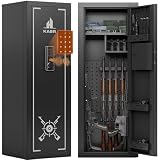
Best gun safes by situation
| Situation | Best fit | Useful specifications | Typical 2026 market range |
|---|---|---|---|
| Small collection or limited floor space | Compact 4- to 8-capacity long-gun safe | 14- to 16-gauge steel, 30- to 45-minute fire rating, 150-250 lb | $250-$700 |
| Typical household collection | 12- to 18-capacity RSC-rated safe | 11- to 14-gauge steel, 60- to 75-minute fire rating, 350-650 lb | $700-$1,800 |
| Growing collection or scoped rifles | 24- to 36-capacity wide safe | 10- to 12-gauge steel, adjustable interior, 60- to 120-minute rating, 600-1,000 lb | $1,500-$3,500 |
| Frequent access to a handgun | Separate quick-access handgun safe | Steel construction, tamper-resistant mounting, mechanical or battery-powered lock | $80-$400 |
| High-security priority | Premium composite or thick-steel RSC safe | 10-gauge or thicker body, substantial door, relocker, certified lock | $2,000-$6,000+ |
Advertised capacities are optimistic. A “24-gun” interior may hold about 12 to 16 rifles once scopes, pistol grips, and padded cases are included. If half your long guns have optics, size by the manufacturer’s scoped capacity when available, not the headline number.
Capacity: calculate the space you will really use
Measure each firearm from the muzzle to the deepest protruding accessory, then allow roughly 3 to 4 inches of horizontal width per long gun. Scoped rifles and modern sporting rifles often need more room than traditional slim hunting rifles.
For example, suppose you own eight long guns, four of which have scopes, and expect to add four more. A nominal 12-capacity safe is unlikely to be comfortable. If the scoped guns require approximately 5 inches each and the unscoped guns 3 inches each, your existing collection needs about 32 inches of usable rack width:
(4 × 5 inches) + (4 × 3 inches) = 32 inches
Add room for four future firearms and some clearance, and a 16- to 20-capacity safe is a more realistic choice. Shelves should be removable or adjustable so the interior can accommodate ammunition, documents, and handguns without blocking the long-gun rack.
Steel thickness matters more than glossy interior features
Safe steel is commonly described by gauge; a lower gauge number means thicker steel. Approximate thicknesses are 14-gauge at 0.075 inches, 12-gauge at 0.105 inches, and 10-gauge at 0.135 inches. These figures are useful for comparison, but total security also depends on the door, frame, bolt work, welds, pry resistance, and lock protection.
- 16-gauge bodies: Suitable for basic locked storage when paired with a good installation, but less resistant to determined attack.
- 14-gauge bodies: A common midrange choice for a residential safe.
- 12-gauge bodies: A meaningful upgrade for owners prioritizing pry and drill resistance.
- 10-gauge or thicker: Usually found in heavier premium safes and substantially increases weight and cost.
Be careful with “steel thickness” claims that refer only to a door plate or an interior liner. Ask whether the stated gauge applies to the body, the door, or both. A thick door with a thin cabinet is not equivalent to a fully heavy-gauge safe.
Lock types: convenience versus long-term simplicity
Electronic combination locks
Electronic locks provide fast access and allow the combination to be changed without a locksmith. They are useful when more than one authorized adult needs access. Choose a model with a replaceable external battery, low-battery warning, lockout protection, and a documented emergency power or override procedure.
The main ownership issue is the battery. Replace it on a schedule rather than waiting for failure, and keep the replacement type specified by the manufacturer. Do not store a mechanical override key inside the safe.
Mechanical combination locks
Mechanical dial locks do not require batteries and can remain serviceable for many years. They are attractive for low-maintenance storage, but opening them is slower and the combination process requires practice. Mechanical locks should be operated regularly so users remain familiar with the sequence.
Keyed and biometric locks
Keyed locks can be simple, but a lost or poorly controlled key undermines the storage plan. Biometric locks offer convenient access but depend on battery condition, sensor quality, and consistent enrollment. They are best treated as a convenience feature rather than the sole reason to buy a safe. Always confirm that a non-biometric backup method exists.
Fire ratings: useful protection, not a guarantee
Fire ratings are usually expressed as a time and temperature, such as 30, 60, or 120 minutes at a stated test temperature. A 60-minute rating is not automatically twice as protective as a 30-minute rating, because test methods, insulation materials, door seals, and internal temperature limits vary.
Look for a clearly stated test standard and the temperature limit used for the interior. Fireboard or gypsum-based insulation can add meaningful protection, but it also adds weight and may deteriorate if exposed to moisture. A fire rating does not make paper, ammunition, optics, or polymer components immune to heat. Keep important documents in a separate rated document container if that is a major concern.
Anchoring is part of the security system
A heavy safe is harder to move, but weight alone is not an adequate anti-theft strategy. A burglar may tip a smaller safe onto its back, attack it more easily in a garage, or remove it with equipment if it is not secured.
- Choose a safe with at least four factory anchor holes when possible.
- Anchor through the base into concrete or suitable structural framing, following the manufacturer’s instructions.
- Do not drill through the safe casually; you may damage insulation, wiring, or the lock mechanism.
- Verify the floor can support the safe and account for delivery equipment and concentrated load.
- Use a professional installer when the safe is very heavy, the floor construction is uncertain, or stairs are involved.
For a wood-framed floor, anchoring only into thin flooring is ineffective. Fasteners need to engage appropriately sized joists or a properly built mounting platform. A concrete installation may require the correct masonry anchors and attention to hidden utilities.
Practical access and responsible storage
A safe should be accessible to authorized adults while remaining inaccessible to children, visitors, and unauthorized users. Store firearms unloaded unless your local law and a carefully considered safety plan require otherwise, and keep ammunition secured according to applicable law and the firearm manufacturer’s guidance. Never rely on a hidden location, trigger lock, or unloaded condition as a substitute for secure storage.
A large floor safe is not necessarily the right answer for a defensive firearm. It may take too long to open in an emergency, particularly in darkness or under stress. A better arrangement can be a properly mounted quick-access handgun safe for the specific firearm, plus a larger main safe for long-term storage. Rehearse access safely with an unloaded firearm and follow local requirements.
What wears out first
- Door seals: Dust, heat, and repeated compression can harden the seal. Replace it if it no longer closes evenly.
- Electronic batteries: Replace them proactively and inspect for corrosion.
- Interior fabric and foam: Foam can retain moisture against metal. Remove damaged lining and allow the interior to dry.
- Hinge and bolt mechanisms: Follow the manufacturer’s lubrication instructions; excess lubricant can attract dust.
- Humidity control: In damp locations, use a suitable dehumidifier rod or desiccant and monitor humidity rather than guessing.
Keep firearms clean and dry before storage, but avoid placing oily firearms directly against absorbent fabric. Inspect the safe after seasonal temperature changes, especially in garages and basements where condensation is common.
Bottom line
For most buyers, the best gun safes balance a 12- to 18-long-gun usable capacity, 11- to 14-gauge construction, a verifiable RSC rating, at least a 60-minute fire rating, and secure floor anchoring. Choose a mechanical lock for battery-free simplicity, an electronic lock for faster everyday access, and a separate quick-access safe when immediate handgun access is part of the plan. Buy for realistic, scoped capacity and installation quality rather than the largest number printed on the box.

0 Comments