What's inside
As an Amazon Associate I earn from qualifying purchases. This post may contain affiliate links at no extra cost to you.
The best large pasta serving bowl set for most family meals is a two-piece, 13- to 15-inch glazed stoneware set with at least a 5-quart capacity per bowl, dishwasher-safe construction, and a stackable or nesting profile.
That size is large enough for a full batch of pasta, sauce, and vegetables without crowding, while two matching bowls let you serve a main dish and salad, separate sauces, or place one at each end of a long table. For frequent entertaining, choose porcelain or vitrified stoneware; for the lowest cost and easiest storage, choose durable ceramic or melamine, provided you do not need oven use.
As an Amazon Associate we earn from qualifying purchases at no extra cost to you.
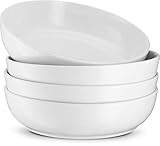

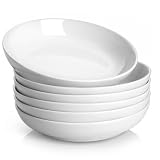

Quick comparison of large pasta bowl sets
The figures below are practical buying ranges rather than claims about one specific product. Manufacturers measure capacity differently, so usable serving capacity is normally lower than the brim-full volume.
| Set type | Typical diameter | Brim-full capacity | Usable serving capacity | Approx. set weight | Dishwasher safety | Best for |
|---|---|---|---|---|---|---|
| Lightweight melamine, 2-piece | 12-14 in. | 3.5-5 qt. | 2.5-3.5 qt. | 3-5 lb. | Usually yes; top rack preferred | Outdoor meals, casual entertaining, tight budgets |
| Everyday glazed ceramic, 2-piece | 13-15 in. | 4.5-6 qt. | 3.5-4.5 qt. | 7-11 lb. | Usually yes | Family dinners and regular use |
| Porcelain or vitrified stoneware, 2-piece | 13-15 in. | 5-7 qt. | 4-5 qt. | 8-13 lb. | Usually yes | Frequent hosting and formal table settings |
| Large single centerpiece bowl | 15-18 in. | 7-10 qt. | 5-7 qt. | 4-10 lb. | Depends on material | Buffets, potlucks, and very large groups |
How much pasta can a large serving bowl hold?
For a family meal, capacity is more important than diameter alone. A 13-inch bowl with steep sides may hold more food than a shallow 15-inch bowl. As a working estimate, one pound of dry pasta produces approximately 2 to 2.5 quarts after cooking, depending on shape and cooking time. Add 1 to 1.5 quarts of sauce and vegetables, and a four-quart usable bowl is close to full.
That makes a 4-quart usable capacity a sensible minimum for six moderate servings. For eight to ten guests, look for 5 to 7 quarts of usable capacity or use two bowls. Splitting food between two bowls is often easier than lifting one oversized, heavy vessel and helps guests serve from both ends of the table.
Best choices by entertaining situation
Best for everyday family dinners: glazed stoneware
A pair of glazed stoneware bowls is the most balanced option. Stoneware is heavier and less likely to slide than lightweight ceramic, and a quality glaze resists tomato stains, oil, and ordinary utensil marks. Many collections from brands such as Le Creuset, Emile Henry, Fiesta, and Gibson include coordinating serving pieces, although the exact bowl dimensions and oven ratings vary by collection.
Choose a gently curved interior, a stable foot ring, and a rim wide enough for serving spoons. Avoid very narrow bases if the bowl will be passed around a crowded table. The drawback is weight: two filled stoneware bowls can be awkward to carry, especially when hot.
Best for frequent hosts: porcelain or vitrified stoneware
Porcelain and vitrified stoneware are good choices when the bowls will go through the dishwasher repeatedly or appear at formal gatherings. Their dense bodies absorb less moisture than porous earthenware, and their clean white or restrained neutral finishes coordinate with many dinnerware patterns. Brands including Mikasa and Lenox offer serving collections with large bowls and matching platters, though each line should be checked for exact capacity and care instructions.
These materials are not unbreakable. The rim is usually the first area to chip, particularly when a large bowl is stacked directly on another without protection. A smooth, rounded rim and a reinforced foot are preferable to a thin decorative edge.
Best for outdoor entertaining: melamine
Melamine bowls are light, resistant to ordinary knocks, and useful on patios, decks, and picnic tables. They are also easier to carry when filled. Look for BPA-free material, a broad nonslip base, and a design rated for dishwasher cleaning.
Melamine is not a substitute for ovenware. Do not place it in an oven, under a broiler, or in a microwave unless the manufacturer explicitly permits that use. Tomato-based foods can gradually dull or stain some finishes, and abrasive cleaners may leave visible scratches. A two-piece melamine set is usually the practical choice when portability matters more than heat retention.
Best for a buffet: one oversized centerpiece bowl
A 16- to 18-inch centerpiece bowl makes a strong presentation for a buffet, but it is less versatile than two medium-large bowls. It can hold a large pasta salad or a family-size portion of spaghetti, yet it may be too wide for a standard dishwasher rack and too heavy to move when full.
Before buying, measure both the dishwasher opening and the storage shelf. A bowl that fits the table may not fit the appliance used to clean it. For buffet use, a shallow-to-medium depth is easier for guests to reach, while a very deep bowl keeps food warmer but requires a longer serving utensil.
Nesting, storage, and table space
Do not assume that two bowls nest well merely because they are sold as a set. Check the height of the nested pair and the diameter of the largest bowl. A typical 14-inch bowl may need a shelf at least 15 inches wide, while a pair of thick stoneware bowls can require 9 to 12 inches of vertical clearance when nested.
- Best nesting shape: tapered sides with a flat base and a rim that does not flare dramatically.
- Safest stacking: place a thin felt, cork, or dishcloth separator between glazed rims.
- Small-kitchen target: two bowls under 14 inches wide and under 10 inches total nested height.
- Drawer or cabinet check: measure the diagonal clearance, not just the shelf width.
- Serving utensil clearance: allow at least 2 inches above the rim if the bowls will be stored with tongs or spoons.
Wide bowls also use more table space than their capacity suggests. On a table that is 36 inches wide, two 15-inch bowls leave limited room for plates and glasses. In that situation, two 12- or 13-inch bowls may serve guests more comfortably, even if the food needs to be replenished once.
Durability and dishwasher realities
Dishwasher-safe does not mean damage-proof. The most common failure points are rim chips, glaze scratches, thermal shock, and hairline cracks caused by stacking damp dishes tightly. Large bowls also experience more flexing and impact because people lift them with both hands while they are full.
To extend service life:
- Let a hot bowl cool briefly before placing it against a cold countertop or rinsing it with cold water.
- Keep bowls away from the dishwasher heating element and follow the stated rack recommendation.
- Do not force an oversized bowl into a crowded rack; contact with plates and metal cookware causes chips.
- Use non-abrasive cleaners on colored or matte glazes.
- Inspect the rim and underside periodically for chips that can worsen during handling.
For tomato sauce, a glossy medium- or dark-colored glaze generally hides discoloration better than an unglazed or matte white finish. For oily pasta salads, a wide opening and rounded interior reduce the scrubbing needed around corners.
Matching pieces worth prioritizing
A matching set is most useful when it includes pieces that solve serving problems, not simply when every item has the same pattern. Look for a large platter for grilled bread or vegetables, a smaller bowl for grated cheese or olives, and serving utensils that do not scratch the interior.
For a family meal, two large bowls plus one 2- to 3-quart side bowl are more flexible than four identical oversized bowls. For a formal setting, matching dinner plates and a low serving platter may matter more than a second pasta bowl. Check whether replacement pieces remain available in the collection; discontinued colors can make future additions difficult.
Buying decision matrix
| Your situation | Recommended specification | Why |
|---|---|---|
| Budget-conscious, occasional use | Two 12-14 in. ceramic or melamine bowls; 3.5-4 qt. usable capacity | Lower purchase cost and enough capacity for ordinary family meals |
| Small kitchen or limited cabinet space | Two tapered 12-13 in. bowls; under 10 in. nested height | Better storage and less table crowding |
| Weekly pasta dinners | Glazed stoneware or porcelain; 13-15 in.; dishwasher-safe | Balances durability, heat retention, and easy cleanup |
| Monthly gatherings of 8-10 people | Two bowls with 4-5 qt. usable capacity each | Splits weight and provides serving access at both ends of a table |
| Outdoor or children’s gatherings | Melamine, broad base, 12-14 in.; no oven use | Lightweight and less vulnerable to ordinary knocks |
Bottom line
For the widest range of family meals and gatherings, choose a dishwasher-safe pair of 13- to 15-inch glazed stoneware or porcelain bowls with at least 4 quarts of usable capacity each. Pick tapered nesting bowls if storage is limited, melamine if portability and impact resistance matter most, and a single 16- to 18-inch bowl only when buffet presentation outweighs storage and handling convenience. The best set is the one whose filled weight, dishwasher fit, and cabinet footprint you can manage as comfortably as its listed capacity.

0 Comments