What's inside
- Start with the projects, not the horsepower
- Swing determines diameter; center distance determines length
- Why variable speed is worth prioritizing
- Horsepower: useful reserve, not a competition
- Spindle and tailstock standards affect your future options
- Tooling changes the real purchase price
- Stand stability matters more than beginners expect
- Decision matrix for a first purchase
- Ownership realities and a simple budget calculation
- Bottom line
- Related Guides
- Start with the projects, not the horsepower
- Swing determines diameter; center distance determines length
- Why variable speed is worth prioritizing
- Horsepower: useful reserve, not a competition
- Spindle and tailstock standards affect your future options
- Tooling changes the real purchase price
- Stand stability matters more than beginners expect
- Decision matrix for a first purchase
- Ownership realities and a simple budget calculation
- Bottom line
- Related Guides
As an Amazon Associate I earn from qualifying purchases. This post may contain affiliate links at no extra cost to you.
The best wood lathe for a beginner is usually a variable-speed midi lathe with about 12–14 inches of swing, 18–24 inches of center distance, a #2 Morse taper, and enough stand stability to handle the projects you actually plan to turn—not necessarily the largest machine your budget allows.
As an Amazon Associate we earn from qualifying purchases at no extra cost to you.


Start with the projects, not the horsepower
A lathe’s headline size describes its maximum theoretical capacity. Your useful capacity depends on the work being turned, the tooling you can afford, and whether the machine stays stable while cutting. A beginner making pens and small spindle projects has different needs from someone planning bowls or table legs.
| Typical beginner project | Useful swing | Useful center distance | Recommended machine type | Typical machine budget |
|---|---|---|---|---|
| Pens, small handles, ornaments | 8–10 in. | 12–18 in. | Compact benchtop lathe | $250–$600 |
| Spindles, gavels, small hollow forms | 10–14 in. | 18–24 in. | Midi lathe with variable speed | $500–$1,200 |
| Bowls and platters | 12–16 in. | 16–24 in. | Heavy midi or small full-size lathe | $900–$2,000 |
| Large bowls, long legs, production work | 16–20+ in. | 24–40+ in. | Full-size floor lathe | $1,800–$4,000+ |
These are broad market ranges for the lathe itself, not a complete setup. A chuck, tools, sharpening equipment, measuring tools, face protection, and dust control can add several hundred dollars.
Swing determines diameter; center distance determines length
Swing over the bed is the largest diameter that can theoretically rotate above the lathe bed. A lathe advertised as having 12 inches of swing can turn a workpiece approximately 12 inches in diameter when mounted over the bed, but real bowl capacity is often lower because the chuck, tool rest, mounting method, and safe cutting technique consume clearance.
Some machines also quote “swing over the tool rest” or “outboard swing.” Check which measurement is being used. For bowl turning, look for a removable or repositionable tool rest and a manufacturer’s stated bowl capacity rather than relying only on the headline swing.
Center distance is the maximum length between the headstock and tailstock with the tailstock at its furthest usable position. It is not the same as the maximum finished spindle length. You need extra room for drive centers, a live center, workpiece overhang, and safe tool access. If you want to turn a 24-inch table leg, a lathe with exactly 24 inches of stated capacity will be frustratingly tight.
Why variable speed is worth prioritizing
Variable speed is one of the most useful beginner features because the correct speed changes with diameter, shape, balance, and stage of the cut. A small, balanced spindle may run around 1,500–2,500 RPM, while a large rough bowl blank should start much slower—often around 300–600 RPM—until it is round and balanced.
Electronic variable speed lets you adjust speed without stopping to move a belt. Belt-drive machines with stepped pulleys can work well and may cost less, but changing speeds takes more time and usually offers fewer settings. A good beginner range is roughly 250–3,500 RPM. The low end matters for large or uneven blanks; the high end helps with small, balanced work and sanding.
Do not use speed as a substitute for balance. An out-of-round blank can generate dangerous forces at any RPM. Start low, stand out of the firing line, and increase speed only after the work rotates smoothly.
Horsepower: useful reserve, not a competition
For pens and small spindles, approximately 1/2 to 3/4 horsepower is generally adequate. A 1 to 1-1/2 horsepower motor is a more comfortable target for bowls and larger spindle work. Machines above 2 horsepower are helpful for heavy cuts and large blanks, but they also demand more mass, stronger mounting, better electrical service, and more disciplined technique.
Horsepower is only part of the equation. A lightweight lathe with a powerful motor can still move across the floor or vibrate badly. A heavier machine with a slightly smaller motor may produce better cuts because it resists twisting and absorbs vibration. Consider continuous-duty motor ratings carefully, since some marketing figures represent peak rather than sustained output.
Spindle and tailstock standards affect your future options
Headstock spindle
Common spindle standards include 1 inch x 8 threads per inch on many midi lathes and 1-1/4 inch x 8 TPI on many full-size machines. A larger spindle generally supports heavier chucks and larger work, but accessories must match the exact thread and shoulder arrangement. Before buying, check whether replacement faceplates, drive centers, and chucks are readily available in that size.
A #2 Morse taper, often written MT2, is a particularly practical beginner standard. It is widely used for drive centers, drill chucks, and other accessories. The taper should seat cleanly and firmly; damaged tapers can cause runout or allow an accessory to loosen.
Tailstock travel and alignment
Useful tailstock features include a quill with a readable scale, enough travel for drilling, and a locking mechanism that holds position securely. A live center with sealed bearings is preferable to a rough or loose center. The headstock and tailstock should align closely when checked with a center in each end. Misalignment can produce tapered spindles and complicate drilling.
For bowl turning, the tailstock may not support the finished form once the opening is cut, but it remains valuable during initial roughing. For long spindles, it is essential. A lathe with modest swing but accurate alignment is usually more useful than one with a larger capacity and sloppy adjustment.
Tooling changes the real purchase price
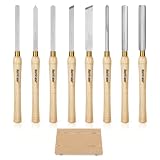
A lathe is only the power unit. A workable starter setup normally includes:
- A bowl gouge or spindle roughing gouge matched to the projects you intend to make.
- A spindle gouge, parting tool, and skew or scraper for basic spindle work.
- A four-jaw scroll chuck if bowls or repeatable mounting are planned.
- Drive and live centers, calipers, a ruler, and a depth-measuring tool.
- A sharpening system, such as a slow-speed grinder with an appropriate wheel and sharpening accessories.
- Eye and face protection, hearing protection, and dust control.
Be cautious with very large bargain tool sets. A smaller set of properly ground high-speed steel tools is often a better investment than many poorly shaped tools. High-speed steel edges can be sharpened repeatedly, while cutting edges wear faster when used on abrasive or dirty stock.
Stand stability matters more than beginners expect
Vibration is often blamed on the lathe when the real problem is the stand. A narrow, light bench can flex under a bowl blank, causing chatter, rough surfaces, and unpredictable tool catches. The stand should be level, rigid, and wide enough to resist rocking. Bolting it to the floor is useful in a dedicated shop, but a heavy freestanding stand can work if it has broad feet and does not twist.
As a practical target, a midi lathe stand should add substantial mass—often 100 pounds or more for demanding bowl work—through a steel frame, a solid lower shelf, or removable ballast. A rubber pad may reduce sliding, but it cannot correct a flexible frame. Place the lathe so you have clearance for long stock and can stand slightly to the side during initial startup.
Decision matrix for a first purchase
| Your situation | Prioritize | Reasonable choice | Trade-off |
|---|---|---|---|
| Limited budget and occasional use | MT2, common spindle thread, rigid bench mounting | Compact or basic midi lathe | Less capacity and slower speed changes |
| Small shop or shared workspace | 250–3,500 RPM variable speed, manageable footprint | 10–12 in. midi lathe | May require removing the tailstock for wider bowls |
| Weekly bowl turning | Low-speed control, 1–1-1/2 HP, heavy stand, 12–16 in. swing | Heavy midi or compact full-size lathe | Higher total cost and more floor space |
| Long spindle projects | 24+ in. center distance, robust tailstock, extension options | Full-size or extendable-bed lathe | Less convenient for small work |
| Planning to upgrade accessories | Standard spindle thread, MT2 taper, replaceable bearings | Established midi or full-size platform | Higher initial price, but fewer obsolete accessories |
Ownership realities and a simple budget calculation
Belts, bearings, drive-center points, chuck jaws, and tool edges are the parts most likely to need attention. Keep tapers clean and dry, remove pitch and dust from the bed, lubricate exposed threads, and inspect the belt for cracking or glazing. Do not leave a chuck key in the chuck, and do not run the lathe with loose clothing or unsecured work.
Suppose a $700 lathe requires $350 of tooling and safety equipment, bringing the initial setup to $1,050. If you use it twice a month for three years, that is 72 sessions, or about $14.60 per session before wood and consumables. Using it weekly for the same period produces 156 sessions, reducing the equipment cost to about $6.73 per session. This is why a cheaper machine that you use comfortably may be a better purchase than a larger machine that remains difficult to access.
Bottom line
For most beginners, choose capacity around 12–14 inches of swing, at least 18 inches of center distance, variable speed with a low setting near 250–500 RPM, MT2 accessories, a common spindle thread, and a rigid stand. Spend less on unused maximum capacity and more on a suitable chuck, sharp high-speed steel tools, sharpening, and safety equipment. The right lathe is the one whose capacity matches your projects, whose standards leave room to grow, and whose mass keeps the cut controlled.
0 Comments