What's inside
- Top 3 Picks
- Quick Comparison
- How We Chose
- 1. MATEIN Personal Item Backpack – Best for Most Travelers
- 2. Narwey Personal Item Travel Bag – Best Budget Foldable Duffle
- 3. ECOHUB 17″ Small Travel Backpack – Best for United-Sized Underseat Fit
- 4. Taygeer Personal Item Backpack – Best for Maximum Capacity on Longer Trips
- 5. Narwey Carry on Duffle Bag Underseat – Best Premium Underseat Duffle
- 6. lifwimner 15 Inch Small Carry On Bag – Best for Spirit Airlines Personal Item Limits
- How to Choose
- Top 3 Picks
- Quick Comparison
- How We Chose
- 1. MATEIN Personal Item Backpack – Best for Most Travelers
- 2. Narwey Personal Item Travel Bag – Best Budget Foldable Duffle
- 3. ECOHUB 17″ Small Travel Backpack – Best for United-Sized Underseat Fit
- 4. Taygeer Personal Item Backpack – Best for Maximum Capacity on Longer Trips
- 5. Narwey Carry on Duffle Bag Underseat – Best Premium Underseat Duffle
- 6. lifwimner 15 Inch Small Carry On Bag – Best for Spirit Airlines Personal Item Limits
- How to Choose
As an Amazon Associate I earn from qualifying purchases. This post may contain affiliate links at no extra cost to you.
The best underseat personal item bag for most airline travelers in 2026 is the MATEIN Personal Item Backpack, because its dimensions sit inside the 18 x 14 x 8 in envelope that Spirit, Frontier, and American use for the free bag that slides under the seat, and its detachable shoe compartment lets you split a weekend load without carrying a second bag. If you want the smallest possible outlay and you do not need structure, the Narwey Personal Item Travel Bag is the budget pick: a foldable duffle that collapses flat when you are not traveling. If you fly United and want a bag built to its published 17 x 10 x 9 in personal-item limit — with a laptop sleeve and 16 pockets — the ECOHUB 17″ Small Travel Backpack is the premium choice. This guide compares six currently listed bags against the real personal-item limits of the major US airlines, and it covers the things a product listing will not tell you: what a bag’s printed dimensions actually mean once it is packed, how much usable volume disappears into padding and structure, whether a laptop sleeve is genuinely protective, and how easily each bag slides out from under the seat in front of you.
Top 3 Picks
Best overall: MATEIN Personal Item Backpack. It is the safest single choice for a traveler who flies a mix of carriers, because it is sized in the classic 18 x 14 x 8 in personal-item class rather than being built around one airline’s tighter envelope. The detachable shoe compartment is a real packing advantage, not a gimmick — you can leave it at home for short trips and add it back for longer ones. It is a mid-range purchase that behaves like a bag costing more.
Best budget: Narwey Personal Item Travel Bag. A foldable duffle in the budget tier, and the right answer if your priority is spending as little as possible on a bag that will only ever hold clothes and a toiletry kit. It weighs almost nothing empty, packs into its own footprint, and works as an emergency second bag on a return trip when you have bought more than you left with.
Best premium: ECOHUB 17″ Small Travel Backpack. Built to United’s published 17 x 10 x 9 in personal-item size, with 16 pockets and a water-resistant shell. It is the pick for the traveler who wants organization, a dedicated laptop compartment, and a bag that looks tidy in a meeting after it has spent two hours on an airport floor.
Quick Comparison
The table below covers every bag in this roundup. “Fit class” describes the airline envelope the bag is built to satisfy, based on the dimensions stated in the listing or, where the listing does not publish numbers, the size class the bag belongs to. Price tiers are budget, mid-range, and premium — actual prices move constantly and depend on colorway and season, so treat the tier as the only reliable signal.
| Product | Best for | Key specs | Price tier |
|---|---|---|---|
| MATEIN Personal Item Backpack | Most travelers; mixed-carrier flyers | Personal-item backpack class, roughly 17–18 x 11–12 x 7–8 in; detachable shoe compartment; padded rear laptop sleeve; soft-sided with structured back panel | Mid-range |
| Narwey Personal Item Travel Bag (foldable) | Lowest spend; backup and overflow bag | Foldable duffle class; packs into its own pocket; unstructured nylon-type shell; typically 30–40 L when full and well under 2 lb empty | Budget |
| ECOHUB 17″ Small Travel Backpack | United flyers; organization and laptop carry | Stated 17 x 10 x 9 in; 16 pockets; water-resistant fabric; dedicated laptop compartment; ~25 L box volume at those dimensions | Premium |
| Taygeer Personal Item Backpack | Maximum capacity on longer trips | Stated 35 L; carry-on backpack class; compression straps; padded laptop section; soft-sided so it can be squashed into tighter envelopes | Mid-range |
| Narwey Carry on Duffle Bag Underseat | Premium duffle carry; one-bag weekenders | Underseat duffle class; structured body; shoulder strap and grab handles; typically built to the 18 x 14 x 8 in envelope | Premium |
| lifwimner 15 Inch Small Carry On Bag | Spirit Airlines personal item limits; ultra-light travel | Stated 15 in size class; foldable travel duffle; very light empty weight; unstructured so it conforms under the seat | Budget |
How We Chose
Every bag here earns its place on four criteria, and none of them involve a lab. First, envelope fit: the bag has to be dimensioned for a real, published airline personal-item limit, not a vague “fits under the seat” claim. We worked from the stated dimensions where a listing gives them and from the size class where it does not, then checked those numbers against the current published limits for Spirit, Frontier, American, United, Allegiant, JetBlue, and Southwest. Second, usable capacity: box volume is not the same as packable volume, and we discounted for padding, structure, and pockets that eat into the main compartment. Third, protection and access: whether the laptop sleeve is padded and suspended, and whether the bag slides out from under the seat with a laptop inside or requires you to unzip half of it in a row of seats. Fourth, upgrade path and ownership reality: what you actually get for stepping up a tier, what wears out first, and whether the bag is still useful in three years. Where a listing is silent on a specification, we describe the bag by spec class rather than guessing a number.
1. MATEIN Personal Item Backpack – Best for Most Travelers
As an Amazon Associate we earn from qualifying purchases at no extra cost to you.

The MATEIN Personal Item Backpack is the bag to buy if you want one underseat bag that works on almost any US carrier and you do not want to think about it again. The listing leads with a detachable shoe compartment, and that feature turns out to be the most useful thing about the design: a personal item bag is a space problem before it is anything else, and a compartment you can remove when you do not need it gives you two bags in one. On a two-day trip you leave the compartment at home and the bag stays slim enough to slide under the seat without a fight. On a four-day trip you attach it, put shoes or dirty laundry in it, and keep the main compartment for clothes and a laptop.
In size terms, this bag lives in the standard personal-item backpack class — roughly 17 to 18 in tall, 11 to 12 in wide, and 7 to 8 in deep when packed but not bulging. That footprint matters more than any other specification in this article, because 18 x 14 x 8 in is the envelope Spirit, Frontier, and American publish, and a bag that starts inside that box has room to expand slightly before it becomes a problem at the gate. The counterexample is a bag marketed as 35 L or 40 L: those numbers come from a full box measurement, and a full box at carry-on proportions will not fit a personal-item sizer.
The rear panel is where the laptop goes. In this class, MATEIN’s travel backpacks typically use a padded sleeve against the back wall, which is the right place for it — closest to your spine, best protected from knocks, and it keeps the bag’s center of gravity close to your body. If you carry a 15.6 in laptop, check that the sleeve has at least 15 x 10.5 in of clear internal space; a 16 in machine measures about 14 x 9.8 in, so the sleeve needs that much room plus padding, or you will be forcing the zipper every time you pack. The soft-sided shell is the other quiet advantage: a bag with no hard frame can be compressed by hand at the gate, and gate agents respond far better to a bag that visibly squashes than to one that does not.
Build quality is where a mid-range bag separates itself from a budget one. Expect a structured back panel with some padding, a sternum or compression arrangement to keep the load from sagging, and zippers that feel substantial rather than papery. What you will not get at this tier is a warranty story or a lifetime guarantee, and the materials are functional rather than premium — that is the honest trade.
- Envelope fit: sits inside the 18 x 14 x 8 in envelope used by Spirit, Frontier, and American when not overpacked
- Signature feature: detachable shoe compartment — removable for short trips, added back for long ones
- Laptop carry: padded rear-panel sleeve in the 15.6 in class; verify internal sleeve dimensions before buying for a 16 in machine
- Structure: soft-sided with a padded, semi-rigid back panel, so it holds shape when half-full and compresses when needed
- Carry modes: backpack straps; check the specific model for a luggage pass-through if you pair it with a rolling carry-on
- Price tier: mid-range
Pros
- Fits the strictest widely published personal-item envelope without needing to be emptied at the gate
- The detachable shoe compartment adds genuine flexibility rather than a fixed volume you always carry
- Padded rear laptop sleeve in the right position for protection and balance
- Soft shell compresses, which is what actually saves you at the gate on a full flight
- Mid-range price with the organization and padding of a more expensive bag
Cons
- Not dimensioned for United’s narrower 17 x 10 x 9 in envelope, so it is not the ideal United-specific bag
- No hard shell, so a heavily packed bag will look bulky even if it measures correctly
- Materials are functional rather than premium — expect visible wear on the base and corners after a few years of hard use
- Laptop sleeve sizing in this class is built around 15.6 in machines, not 16 in or 17 in workstations
Against the nearest alternative, the choice is straightforward. The ECOHUB 17″ is built to United’s tighter 17 x 10 x 9 in limit and offers more pockets and a water-resistant shell — but at 10 in wide it gives up lateral room, and it is a premium-tier purchase. The MATEIN wins on the envelope most travelers actually face and on price. If you fly United more than half the time, go ECOHUB; for everyone else, the MATEIN is the safer bet.
2. Narwey Personal Item Travel Bag – Best Budget Foldable Duffle

The Narwey Personal Item Travel Bag is the bag you buy when you have decided that a personal item is a container, not a piece of luggage. It is a foldable duffle in the budget tier, and its entire design premise is that it disappears when you are not using it. Folded, it takes up about the space of a paperback; unfolded and full, it is a soft-sided bag that conforms to whatever space it is given under the seat in front of you. That conforming behavior is exactly what you want in a personal item, because the constraint is not volume, it is the shape of the gap between your feet and the seat ahead.
Who it suits is easy to describe. It suits the traveler who takes two or three short trips a year and does not want to store a structured bag the rest of the time. It suits the traveler who flies a budget carrier and has learned that the personal item is the only free bag, so the bag needs to be as close to weightless as possible. It suits the traveler who wants a backup: a folded duffle in the bottom of a carry-on costs almost nothing in space and rescues you on the return leg when you have bought more than you planned.
What it does not do is protect anything fragile. A foldable duffle is unstructured, which means a laptop inside it has no padding behind it, no suspended floor beneath it, and no rigid panel to stop a corner impact. If you are carrying a laptop, treat this as a clothes bag and carry the computer in a separate sleeve — or choose the MATEIN or ECOHUB instead. The same lack of structure means the bag will not stand up on its own in a hotel room, and a heavy load will sag toward the bottom and pull on the shoulder strap.
In this class, foldable personal-item duffles typically land somewhere between 30 and 40 L when full, with an empty weight well under 2 lb. That volume figure is deceptive in a useful way: an unstructured bag at 35 L can be squeezed into a personal-item sizer in a way that a 35 L backpack cannot, because there is no frame resisting you. If you pack it loosely, it will measure correctly. If you pack it to the zipper line with dense items, it will not.
- Type: foldable travel duffle, unstructured, packs into its own pocket
- Typical capacity class: roughly 30–40 L when fully loaded
- Empty weight class: well under 2 lb, among the lightest options in this roundup
- Carry: shoulder strap and top handles; no back panel or load-bearing hip structure
- Protection: none for electronics — no padding, no false bottom, no rigid panel
- Envelope fit: conforms to the 18 x 14 x 8 in class when packed loosely; can exceed it when overfilled with dense items
- Price tier: budget
Pros
- Lowest-cost way to get a usable personal item bag that meets the standard envelope
- Folds down small enough to live permanently in a carry-on or a desk drawer
- Unstructured shell squeezes into tight underseat gaps and into an airline sizer
- Very light empty weight, which matters on carriers that weigh bags
- Works as a second bag for souvenirs, laundry, or overflow on the way home
Cons
- No laptop protection whatsoever — you need a separate sleeve
- No back panel or hip belt, so a heavy load is carried entirely on one shoulder
- Zippers and fabric are budget-tier; expect the slider to be the first thing to go
- Does not hold its shape, which makes packing and unpacking slower than a structured bag
- An overfilled bag will fail a sizer check that a structured bag of the same volume would pass
Compared with the lifwimner 15 Inch Small Carry On Bag, the other budget option here, the Narwey is the more general-purpose choice. The lifwimner is built around a 15 in size class and is aimed specifically at Spirit’s personal-item rules, which makes it slightly better on that one carrier and slightly less useful everywhere else. If you fly Spirit exclusively, read the lifwimner section; if you fly a mix, the Narwey’s more generous unfolded volume is the better buy.
3. ECOHUB 17″ Small Travel Backpack – Best for United-Sized Underseat Fit
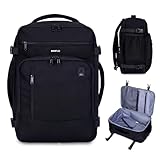
The ECOHUB 17″ Small Travel Backpack is the only bag in this roundup that publishes dimensions matching a specific airline’s personal-item rule: 17 x 10 x 9 in, which is United’s published personal-item envelope. That specificity is the whole argument for the bag. Most personal-item backpacks are built to the 18 x 14 x 8 in standard, which is fine until you fly an airline whose envelope is narrower, and then you discover that width and depth are not interchangeable. United’s limit trades width for depth: 10 in across instead of 14 in, and 9 in deep instead of 8 in. A bag built to the wrong envelope will not fit no matter how much it compresses.
At 17 x 10 x 9 in, the box volume is 1,530 cubic inches, or roughly 25 L. That is the honest capacity ceiling for this bag, and it is worth understanding what it means: a 25 L personal item is a two-to-three-day bag for one person in warm weather, or a two-day bag in cold weather when clothes are bulky. It is not a week-long bag, and no amount of pocket count changes that. What the 16 pockets do change is how usable those 25 L are. Organization is not capacity, but a bag with a place for cables, a passport, a water bottle, and a change of shirt wastes far less of its volume than a single-cavern duffle, because you stop digging and repacking.
The laptop compartment is the second reason to pay the premium. At 17 in tall and 10 in wide, the bag can accommodate a 15.6 in laptop in a dedicated padded section, and the narrower profile means the computer sits flat against your back rather than sliding around in a wide compartment. If you carry a 16 in machine (about 14 x 9.8 in), check the sleeve’s clear internal dimensions; a 17 x 10 in bag has just enough exterior width that internal sleeve space can get tight once padding is accounted for. The water-resistant shell is a genuine feature rather than a marketing line — for a bag that spends time on wet tarmac and under a seat where drinks get spilled, a coating that beads water is worth more than an extra pocket.
Who it suits: the traveler who flies United regularly, wants a laptop-compatible personal item that looks presentable in an office, and values organization over raw volume. It also suits the traveler who wants a bag that is unambiguously within the rules — because a bag whose dimensions exactly match the published limit is the least likely to attract a second look at the gate. That peace of mind is a large part of what the premium tier buys.
| Spec | Detail |
|---|---|
| Stated dimensions | 17 x 10 x 9 in |
| Box volume at stated dimensions | 1,530 in³, roughly 25 L |
| Airline envelope matched | United’s published personal-item limit |
| Pockets | 16 |
| Fabric | Water-resistant |
| Laptop carry | Dedicated compartment, 15.6 in class |
| Price tier | Premium |
Pros
- Dimensions match United’s published personal-item envelope exactly
- 16 pockets make a modest 25 L far easier to live out of than a single-compartment bag
- Dedicated laptop compartment with the narrow profile that keeps a computer flat against your back
- Water-resistant fabric is genuinely useful in the environments this bag lives in
- Tidy enough to carry into a meeting straight off a flight
Cons
- Premium tier pricing for a bag with roughly 25 L of capacity
- At 10 in wide, it is narrower than the 14 in allowed by Spirit, Frontier, and American — you are leaving width on the table on those carriers
- 9 in of depth exceeds the 8 in depth of the 18 x 14 x 8 in standard, so it is not the best fit for those airlines
- 25 L is a hard ceiling; this is not a bag for a week away
- Sixteen pockets means sixteen places to forget where you put your passport
The nearest alternative is the MATEIN Personal Item Backpack, and the decision between them is purely about which envelope you fly. Choose the ECOHUB if United is your carrier or if you want a laptop-first personal item with maximum organization. Choose the MATEIN if you fly Spirit, Frontier, American, or a mix, because its 18 x 14 x 8 in class fits more carriers and it costs less. The ECOHUB is the more specialized, better-organized bag; the MATEIN is the more broadly useful one.
4. Taygeer Personal Item Backpack – Best for Maximum Capacity on Longer Trips

The Taygeer Personal Item Backpack is the capacity play in this roundup. The listing states 35 L, which is roughly 40 percent more box volume than the ECOHUB’s 25 L and comfortably more than most bags in the personal-item class. That number needs a caveat attached to it, because 35 L is the number that gets travelers in trouble: a 35 L bag filled to its stated capacity will not fit an 18 x 14 x 8 in sizer, and the whole point of an underseat bag is that it does. The way to use a bag like this is to treat 35 L as headroom rather than a target. Pack it to about two-thirds and it compresses into the standard envelope; pack it to the zipper line and you are carrying a carry-on that you are pretending is a personal item.
Who it suits: the traveler taking a four-to-six-day trip who wants one bag and no checked luggage, and who is willing to accept that the bag will be slightly overstuffed-looking on the outbound leg. It also suits the traveler who flies carriers that do not strictly enforce personal-item dimensions — Southwest’s published envelope, for instance, is 18.5 x 8.5 x 13.5 in, which is a genuinely different shape and rewards a deeper bag. It suits photographers, remote workers, and anyone whose personal item has to carry equipment rather than just clothes.
The practical advantages of a larger soft-sided backpack in this class are compression straps and a real load-bearing harness. Compression straps are what convert a 35 L bag into something that behaves like a 25 L bag at the gate, and they are the single most important feature on a bag of this size. A padded back panel, a sternum strap, and a hip belt turn a heavy personal item from a shoulder ache into something you can walk a mile with. If you are carrying a laptop plus a change of clothes plus a camera, that harness is not a luxury.
Where this bag gives up ground is precision. It is not dimensioned to any one airline’s envelope, so on Spirit, Frontier, or United it is a bag you have to manage rather than a bag that simply fits. The padding that makes it comfortable also eats volume, so the difference between its stated 35 L and its usable capacity is larger than it is on a lightly built duffle. And a big backpack with a full load is harder to shove under a seat than a flat duffle, because the frame does not want to bend.
| Spec | Detail |
|---|---|
| Stated capacity | 35 L |
| Category | Carry-on backpack class, used as a personal item when compressed |
| Compression | Side compression straps to reduce packed depth |
| Laptop carry | Padded laptop section |
| Carry system | Backpack harness with padded back panel |
| Envelope fit | Fits the 18 x 14 x 8 in class when packed to roughly two-thirds; exceeds it when filled |
| Price tier | Mid-range |
Pros
- Largest stated capacity in this roundup at 35 L, which is a genuine four-to-six-day bag when compressed
- Compression straps let you shrink the packed footprint at the gate — the key feature for a bag this size
- Full backpack harness with padded back panel carries a heavy load far better than a duffle
- Padded laptop section handles a computer plus clothing plus accessories
- Mid-range price for carry-on-class volume
Cons
- Stated 35 L will not pass an 18 x 14 x 8 in sizer if you fill it
- Not built to any single airline’s envelope, so it requires packing discipline
- Padding and structure reduce usable volume below the stated number
- A framed backpack is harder to push under a seat than a flat duffle
- Easier to overpack than any other bag here, which is a real risk on strict carriers
The nearest alternative is the Narwey Carry on Duffle Bag Underseat, which takes the opposite approach: a structured duffle built to the standard personal-item envelope, with no capacity ambitions beyond it. If you want a bag that always fits and you pack light, the Narwey premium duffle is the safer, tidier choice. If you want one bag for a longer trip and you are willing to manage the packing, the Taygeer gives you roughly 10 L more to work with.
5. Narwey Carry on Duffle Bag Underseat – Best Premium Underseat Duffle

The Narwey Carry on Duffle Bag Underseat is the premium-tier duffle in this roundup, and it exists to solve a specific problem that backpacks do not: access. A duffle opens along its length, which means you can see and reach everything in it without unpacking. On a short flight where your bag is under the seat and you want a charger, a book, or a jacket, that difference in access is worth more than any organizational pocket grid. The premium tier buys structure — a duffle that holds its shape when half-full, keeps its zipper line straight, and does not collapse into a puddle on the floor of a hotel room.
Who it suits: the one-bag weekender who takes two-to-four-day trips, travels in a mix of business and leisure contexts, and wants a bag that looks intentional rather than improvised. It also suits the traveler who has tried an unstructured foldable duffle and found that living out of a shapeless bag is unpleasant. Structure costs weight and folded size, and if you travel often enough to notice, that trade is worth making.
The underseat geometry is the reason this category exists. The gap under an aisle or middle seat is not a box; it is a shallow slot bounded by a seat frame in front and a metal bar below. A duffle’s flat profile — long, wide, and shallow — matches that slot better than a tall backpack, and a duffle with a structured base slides in and out with one hand. That matters at the end of a flight when you are trying to retrieve a bag without standing up, and it matters more on a full flight when the row in front is reclined.
In the premium tier, expect a heavier-weight fabric, a sturdier zipper, reinforced grab handles at both ends, and a detachable shoulder strap with a pad. Expect the body to be built around the standard 18 x 14 x 8 in personal-item class rather than a specific airline’s narrower envelope. And expect the wear pattern to be different from a backpack’s: duffles fail at the strap anchors and along the base seam, not at the back panel, because the load pulls sideways rather than down.
- Type: structured underseat duffle with a flat, seat-gap-friendly profile
- Envelope class: built to the 18 x 14 x 8 in personal-item standard
- Access: full-length opening; everything visible without unpacking
- Carry: dual grab handles plus a detachable, padded shoulder strap
- Laptop carry: no dedicated suspended sleeve in this class — plan on a separate sleeve or a padded insert
- Wear points: strap anchors and base seam rather than the back panel
- Price tier: premium
Pros
- Flat profile slides into the underseat slot more easily than a framed backpack
- Full-length opening gives the best access of any bag shape here
- Structured body holds its shape and stands up in a hotel room
- Premium materials and reinforced handles at the points that actually fail on duffles
- Reads as a deliberate travel bag rather than a gym duffle
Cons
- Premium tier price for a bag with no laptop compartment
- Shoulder carry only — no backpack harness, so a heavy load is less comfortable over distance
- Structure costs weight and folded size compared with a foldable duffle
- Not dimensioned to United’s narrower 17 x 10 x 9 in envelope
- A long duffle is awkward to carry through a crowded terminal one-handed
The nearest alternative is the Narwey Personal Item Travel Bag, the budget foldable duffle from the same brand — and the comparison is a clean illustration of what the premium tier buys. Both are duffles. The budget version folds into nothing and conforms to any space, but it will not stand up, will not protect a laptop, and will sag under a heavy load. The premium version does all three and costs more. If you travel twice a year, buy the foldable. If you travel monthly, buy the structured one.
6. lifwimner 15 Inch Small Carry On Bag – Best for Spirit Airlines Personal Item Limits

The lifwimner 15 Inch Small Carry On Bag is the most narrowly targeted bag in this roundup, and that is its strength. The listing positions it as a Spirit Airlines personal item bag, and the 15 in size class it belongs to is deliberately undersized relative to the 18 x 14 x 8 in standard. That margin is the point. When your bag is visibly smaller than the sizer, you stop being a candidate for a gate check fee, and on a carrier whose entire business model depends on ancillary revenue, being a non-candidate is worth real money.
Who it suits: the Spirit or Frontier flyer who wants a bag that is unambiguously compliant, travels light by preference, and does not want to negotiate with a gate agent. It also suits the traveler taking a one-to-two-day trip with a change of clothes and a laptop sleeve, and the traveler who wants an ultra-light bag because the bag’s own weight counts against them on a weight-limited fare.
Foldability is the second feature. Like the Narwey budget duffle, this bag collapses for storage, which makes it a natural backup bag — the one you pack flat in case the return trip involves more stuff than the outbound. Unstructured bags of this type typically land in the 25–35 L range when full, with empty weights well under 2 lb, and because they have no frame they squeeze into gaps that a structured bag cannot.
The trade-offs are the same ones that apply to every foldable, ultra-light bag. There is no laptop protection, so a computer needs its own sleeve. There is no load-bearing harness, so a heavy bag pulls on one shoulder. The fabric is light, which means abrasion resistance is limited and the base is the first place you will see wear if you habitually set the bag down on concrete. And the smaller size class cuts both ways: you are comfortably inside the Spirit envelope, but you have less room than a bag built to the full 18 x 14 x 8 in standard, so this is not the bag for a five-day trip.
| Spec | Detail |
|---|---|
| Stated size class | 15 in |
| Type | Foldable travel duffle |
| Positioning | Spirit Airlines personal item bag |
| Typical capacity class when full | Roughly 25–35 L |
| Empty weight class | Well under 2 lb |
| Laptop protection | None — use a separate padded sleeve |
| Price tier | Budget |
Pros
- Deliberately undersized against the standard envelope, which is the best defense against a gate-check fee
- Folds flat for storage and doubles as an emergency overflow bag
- Very light empty weight, useful on fares where bag weight is scrutinized
- Budget tier price makes it a low-risk second bag
- Unstructured shell conforms to tight underseat gaps
Cons
- Smaller capacity class than the 18 x 14 x 8 in standard allows — you are voluntarily giving up space
- No laptop protection and no padded compartment
- No backpack harness; shoulder carry only
- Light fabric wears at the base and corners faster than a premium shell
- Budget zippers are the first component to fail on bags in this tier
The nearest alternative is the Narwey Personal Item Travel Bag. Both are budget foldable duffles, and the difference is one of margin: the Narwey unfolds to a more generous, general-purpose volume, while the lifwimner is sized for maximum compliance on strict carriers. If Spirit is your airline and you want zero risk at the gate, the lifwimner is the more targeted tool. If you fly several carriers and want the most bag for the least money, the Narwey is the better all-rounder.
How to Choose
The single most useful thing you can do before buying a personal item bag is to find out what envelope you are actually shopping for. Personal item limits are not standardized, they are published per airline, and they differ in shape as well as in total size. The table below lists the personal-item dimensions most commonly published or enforced by major US carriers as of 2026. Airlines change these numbers, and some enforce them more aggressively than others, so confirm the current figure on your carrier’s site before you fly — but use this to understand which bag class you belong in.
| Airline | Published personal-item limit (in) | Box volume | What it means for bag choice |
|---|---|---|---|
| Spirit | 18 x 14 x 8 | 2,016 in³ ≈ 33 L | The de facto US standard; wide and shallow |
| Frontier | 18 x 14 x 8 | 2,016 in³ ≈ 33 L | Same envelope as Spirit; enforcement varies by gate |
| American | 18 x 14 x 8 | 2,016 in³ ≈ 33 L | Same envelope; a bag built to this class fits all three |
| United | 17 x 10 x 9 | 1,530 in³ ≈ 25 L | Narrower and deeper; a wide 18 x 14 bag can be too wide |
| JetBlue | 17 x 13 x 8 | 1,768 in³ ≈ 29 L | Slightly shorter and narrower than the standard |
| Southwest | 18.5 x 8.5 x 13.5 | 2,123 in³ ≈ 35 L | A different shape entirely; rewards a deeper bag |
| Allegiant | 16 x 15 x 7 | 1,680 in³ ≈ 27.5 L | Short and wide; a tall backpack can be too tall |
| Delta | No published numeric limit | — | Must fit under the seat; treat 18 x 14 x 8 as a working guide |
Do the volume math before you trust a liter rating
Multiply length by width by depth and divide by 61.02 to convert cubic inches to liters. A bag at 17 x 10 x 9 in gives 1,530 in³, which is 25.1 L. A bag at 18 x 14 x 8 in gives 2,016 in³, or 33.0 L. That calculation is why the liter rating on a product page and the airline envelope are two different conversations: a bag marketed at 35 L is describing a box that is larger than any personal-item envelope in the table above, which means the only way it flies as a personal item is if you compress it or underfill it. When a listing says “35L” and “personal item” in the same sentence, the honest reading is “35 L of capacity, of which roughly 25 to 30 L is usable within the rules.”
The second calculation worth doing is the linear one. United’s envelope is 36 linear inches (17 + 10 + 9); Spirit’s is 40 (18 + 14 + 8). Linear inches are not what airlines measure, but they are a fast way to compare shape. Two bags with the same linear total can have very different fits: a 17 x 10 x 9 bag and a 18 x 12 x 10 bag both come to 36, but only the first is United-compliant.
Packed dimensions versus printed dimensions
Every bag in this article measures correctly when it is empty and slightly over when it is full. A soft-sided bag with a full main compartment, an expanded front pocket, and a water bottle in the side pocket can gain 1 to 2 in of depth over its printed number, and depth is the dimension that matters most under a seat. The practical rules: pack the main compartment first and the pockets last, so the pockets absorb slack rather than create bulge; keep the front-most pocket flat, because that is the surface that presses against the seat frame; and if a bag has compression straps, use them every time you close it, not just when it looks full. A bag compressed to 7.5 in of depth passes an 8 in sizer. The same bag at 9 in does not.
Wheels: what you give up
None of the six bags here has wheels, and that is not an oversight — it is the trade the personal-item category makes. A wheeled underseat bag gives up roughly 3 to 5 L of usable volume to the frame, the wheel housings, and the telescoping handle channel, and it adds 2 to 4 lb of empty weight. Airlines measure wheeled bags including the wheels and handle, which means a bag advertised at 18 in is often closer to 20 in as measured. In exchange you get to pull rather than carry. For a personal item that spends 90 percent of its life under a seat and 10 percent of its life being carried from a gate to a curb, that trade usually does not pay. If you have back or shoulder problems, it might — in which case look for a wheeled underseat bag and accept the capacity loss knowingly.
Laptop protection: what actually protects a computer
Three things matter. First, padding thickness on both faces of the sleeve — thin foam on one side only is a false sense of security. Second, a suspended or false bottom, so the laptop never rests directly on the bag’s base; if you drop the bag, the base takes the impact, and a sleeve that shares the base transfers that impact straight into the chassis. Third, position: a sleeve against your back is better protected than one in a front pocket, because your body absorbs shocks and because the front of the bag is the side that gets pressed against seat frames and kicked by other passengers. Sizing matters too. A 15.6 in laptop is typically around 14.2 x 9.9 in, and a 16 in machine around 14 x 9.8 in. The sleeve needs to be at least an inch larger in both directions than the device, plus padding, or you will be wrestling with the zipper and stressing the corners of the screen housing.
Underseat access: the specification nobody publishes
How easily a bag comes out from under the seat is a function of three things: how tall it is, how stiff its base is, and where its handles are. A flat duffle with a structured base and a grab handle at one end slides out with one hand. A tall framed backpack with no top handle has to be pulled by a shoulder strap, which means leaning down and to the side in a confined space. If you fly in economy on full flights, this is the specification you will notice most, and it favors duffles over backpacks and flat profiles over deep ones. The counterargument is that backpacks carry better through a terminal. If your trips involve long walks between gates, weight the harness more heavily; if they involve short hops and cramped rows, weight the profile.
Materials, durability, and what wears first
Fabric weight is the best proxy for durability in this category. Budget bags use light nylon or polyester that resists tearing reasonably well but abrades quickly at the base and corners. Mid

0 Comments