Key takeaways
- A solar generator is not a generator in the gasoline sense. It is a battery power station with an AC outlet and a solar panel that refills it.
What's inside
As an Amazon Associate I earn from qualifying purchases. This post may contain affiliate links at no extra cost to you.
A solar generator is not a generator in the gasoline sense. It is a battery power station with an AC outlet and a solar panel that refills it, and the two numbers that matter are watt-hours, which is how much energy it stores, and watts, which is how much it can deliver at once. Mix them up and you buy a unit that powers a phone for days but cannot start a kettle, or one that runs a refrigerator for an hour and then goes dark.
This guide is for campers, van and RV travelers and homeowners planning for outages who need a quiet, fume-free source of power. Seven bundles from the listings are compared strictly on what their titles state: battery capacity, AC output, panel size, battery chemistry, charge speed and expandability. Looking toward the 2026 storm and travel season, those figures are enough to sort units by the jobs they can realistically handle, from a fan and a phone to a home essentials circuit.
Quick Picks
As an Amazon Associate we earn from qualifying purchases at no extra cost to you.


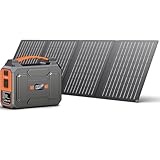
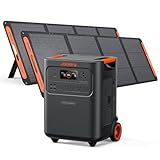
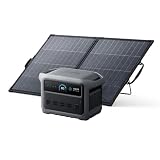
| Product | Best for | Key spec from the title |
|---|---|---|
| Jackery Solar Generator 300 and 40W Panel | Weekend camping basics | 292Wh, 300W AC, 40W panel |
| 300W Power Station with 60W Panel | Small loads on a tight setup | 280Wh, 300W, pure sine wave, 60W panel |
| Jackery Solar Generator 1000 v2 and 200W Panel | RV and cabin use | 1070Wh, 1500W AC, 1 hour fast charge |
| 100W Power Station with 40W Panels | Phones, lights and tablets | 146Wh, AC outlet, USB-A, USB-C |
| Jackery HomePower 3600 Plus | Essential home backup | 3584Wh, 3600W AC, expandable to 21kWh |
| Anker SOLIX C1000 Gen 2 | Fast-charging mid-size power | 1,024Wh LiFePO4, 2,000W, up to 3,000W output |
| EcoFlow Delta 3 Classic | Appliances with surge needs | 1024Wh, 1800W AC, 3600W surge, 220W panel |
How to Choose
Watt-hours versus watts
Capacity, in watt-hours, sets runtime. A 1,000Wh unit running a 100 watt load such as a laptop and lights lasts roughly 10 hours before losses. Output, in watts, sets which devices you can plug in: a 300W unit handles phones, fans and a small cooler, while a coffee maker or microwave needs 1,000W or more. Check surge ratings too, because motors in refrigerators briefly draw several times their running load.
Battery chemistry and lifespan
LiFePO4, also written LFP, is the chemistry named in several of these titles. It tolerates more charge cycles than standard lithium-ion cells and is stable under heat, which matters for units stored in a garage or a vehicle. Pure sine wave output is the other spec to look for, because sensitive electronics such as CPAP machines and laptops run best on clean AC. Cheaper power stations may use less durable cells or modified waves.
Solar input and charge speed
A bundled panel’s wattage drives how fast the sun can refill the battery, and real output is usually well below the label. A 40W panel adds only a small trickle to a 292Wh battery, while 200W panels on a 1,000Wh unit can refill it in many hours of good sun. AC wall charging is far faster: a title claiming a one-hour fast charge or 3.8 hours of solar charge is describing the best case. For long outages, bring more panel wattage than the bundle includes.
Ports, size and expandability
Count the AC outlets, USB-C ports with 60W or 100W output, and any DC ports. A unit with a built-in UPS mode can act as a battery backup for a router or computer. Weight matters: small stations carry in one hand, while 3,000Wh-plus systems need wheels and a helper. Expandable models, such as a system that scales up to 21kWh, let you add batteries as needs grow, but the base unit still costs more than a simple camp bundle.
The 7 Best Options
Jackery Solar Generator 300 with 40W Panel
The Jackery 300 bundle includes a 292Wh power station with 300W AC and a 40W solar panel, and lists a pure sine wave AC outlet. It is aimed at campers, RV owners and blackout planners who want to run phones, lights and small fans. Jackery also sells the same 292Wh station without a panel, so this bundle is the one for buyers who want solar included from the start and plan to refill it in daylight.
- Strength: pure sine wave AC output is better for sensitive electronics.
- Strength: a bundled panel makes it a ready-to-use solar kit.
- Trade-off: a 40W panel recharges a 292Wh battery slowly, so plan on wall charging before trips, since it can take a full day of strong sun to make a meaningful dent.
Skip it if you want to run a space heater, a coffee maker or a small refrigerator for hours, or a laptop and monitor setup that runs all day.
300W Portable Power Station with 60W Panel
This unbranded kit pairs a 280Wh, 300W pure sine wave power station with a 60W solar panel and offers 110V AC, USB QC3.0 and DC outputs. It suits budget-minded buyers who want a camping kit and who can accept less brand support. The USB QC3.0 and DC outputs mean phones and small 12V gear can charge without the inverter running, which stretches the battery on short trips.
- Strength: a 60W panel is larger than the bundled panel on the Jackery 300.
- Strength: pure sine wave AC output and multiple port types add flexibility.
- Trade-off: the title does not name the battery chemistry, so cycle life is unclear and the warranty terms are worth reading before you buy.
Skip it if you want a named LiFePO4 battery or a long warranty from a major brand, or a larger battery for appliances.
Jackery Solar Generator 1000 v2 with 200W Panel
The 1000 v2 bundle lists a 1070Wh LiFePO4 battery, 1500W AC output, a 100W USB-C port and a one-hour fast charge from the wall, plus a 200W solar panel. It suits RV and cabin users who want to run a small refrigerator, lights and electronics. The fast-charge claim also makes it practical as a backup at home, since it can top up between storms from a wall outlet rather than waiting on sun.
- Strength: 1070Wh and 1500W cover a wide range of appliances and tools.
- Strength: one-hour fast charging means a quick top-up from an outlet.
- Trade-off: it weighs much more than the 300 class units and needs a car or a cart to move, and it is bulky for hiking-in camps.
Skip it if you only need to power phones and a few LED lights, in which case the smaller kits cost less and are easier to carry.
100W Portable Power Station with 40W Panels
This 146Wh power bank has an AC outlet, USB-A, USB-C and DC outputs and ships with 40W solar panels. It is for people who want to keep phones, cameras and lights going on a camping trip and who prefer something that fits in a daypack. For overnight use it can charge a phone several times, keep a lantern lit and run a small USB fan, which is about the limit of what its capacity supports.
- Strength: it is the smallest and most portable kit in this group.
- Strength: the multi-port layout covers phones, cameras and small devices.
- Trade-off: 146Wh is only a small battery and will not run appliances for long, and the AC outlet suits only the smallest loads.
Skip it if you need any AC appliance beyond a charger or a small fan, such as a coffee maker or any heating appliance.
Jackery HomePower 3600 Plus
The HomePower 3600 Plus bundles two 200W panels with a 3584Wh LFP battery and 3600W AC output, and lists expandability to 21kWh. It is positioned as an essential home backup system for outages and off-grid living. With two 200W panels in the bundle it can recover meaningful energy in daylight, and the expansion path means you can start with the base battery and add more as budget allows.
- Strength: 3584Wh and 3600W AC can run several household essentials at once.
- Strength: expansion to 21kWh lets capacity grow over time.
- Trade-off: it is a heavy, large investment that overshoots camping needs, and it will not fit in a small car with the camping gear.
Skip it if your needs stop at camping, tailgating or charging devices, where it would cost far more than it adds.
Anker SOLIX C1000 Gen 2 with 200W Panel
The SOLIX C1000 Gen 2 pairs a 200W solar panel with a 1,024Wh LiFePO4 battery and lists a 2,000W output, with up to 3,000W of output. It suits users with high-wattage tools or appliances who also want a mid-size battery. The Gen 2 label means this is the second generation of the C1000, and the title leads with fast, high-output power rather than the lightest weight.
- Strength: a 2,000W rating suits power-hungry devices.
- Strength: LiFePO4 chemistry and a bundled 200W panel add longevity and solar capacity.
- Trade-off: a 1,024Wh battery drains fast under a 2,000W load, so run time will be short when you plug in a high-wattage appliance.
Skip it if you want long runtimes from small loads and prefer a larger battery that can run for many hours.
EcoFlow Delta 3 Classic with 220W Panel
The Delta 3 Classic includes a 220W solar panel with a 1024Wh LiFePO4 battery, 1800W AC output, a 3600W surge rating and a 100W USB-C port. It fits campers and homeowners who run appliances with startup surges. The 100W USB-C port can charge a laptop directly, and the large bundled panel helps it recover faster in good sun than the smaller kits.
- Strength: the 3600W surge rating helps with motor-driven appliances.
- Strength: a 220W panel is the largest bundled panel among the mid-size units.
- Trade-off: the 1024Wh capacity limits runtime for large loads, so a long outage will need extra panels or wall charging.
Skip it if you need whole-home backup capacity or the lightest possible kit for backpacking.
Which One Fits Your Situation
Weekend car camping
The Jackery Solar Generator 300 with 40W Panel keeps phones, a fan and lights going, and it is small enough to move with one hand.
RV or cabin with a refrigerator
The Jackery Solar Generator 1000 v2 with 200W Panel gives 1070Wh and 1500W, enough to run a compact fridge and electronics together.
Power tools or kitchen appliances
The Anker SOLIX C1000 Gen 2 or the EcoFlow Delta 3 Classic both offer high output and surge capability, with a 1,024Wh battery that suits short, heavy use.
Outage planning for the whole house
The Jackery HomePower 3600 Plus is the only system listed with 3,584Wh, 3600W AC and expansion to 21kWh.
Common Mistakes
- Buying on watt-hours alone without checking AC output for your appliances.
- Expecting a 40W panel to refill a large battery in a day.
- Ignoring surge ratings on motor-driven devices.
- Storing the unit fully empty for months.
- Running a power station indoors in a sealed space while charging in extreme heat.
Related guides
- How To Strip Old Varnish From Furniture Without Sanding
- Random Orbital Sanders For Furniture Refinishing
- How Long To Wait Between Coats Of Polycrylic
Frequently Asked Questions
How long will a power station run my refrigerator?
Divide watt-hours by the fridge’s average draw, then subtract losses. A compact fridge on a 1,000Wh unit can last a day or so with careful use.
Is LiFePO4 better than standard lithium-ion?
It typically lasts through more charge cycles and handles heat better. It is often heavier for the same capacity.
Can I use any solar panel with these units?
Not always. Check the voltage and connector ratings in the manual before connecting a third-party panel.
Do I need pure sine wave output?
It is best for sensitive electronics such as medical devices and laptops. Cheaper modified-wave units can cause noise or shutdowns.


0 Comments