What's inside
As an Amazon Associate I earn from qualifying purchases. This post may contain affiliate links at no extra cost to you.
Best CNC Drag Knives for Cutting Vinyl, Foam, and Thin Sheet Goods
The best cnc drag knife for most hobby routers is a spring-loaded, swivel-blade holder that accepts replaceable 45° blades, has an adjustable or documented blade offset, and fits a standard collet or router mount without requiring the spindle to turn. For vinyl and paper, choose a light holder with fine blades; for foam and thin sheet goods, prioritize blade reach, spring travel, and a rigid mount. A drag knife cnc setup is simple in principle, but the right choice depends on material thickness and how reliably you can set the blade offset in your CAM software.
What matters more than the product name
A drag knife is not a powered cutter. The CNC moves the tool while the blade swivels to follow the direction of travel. That swivel creates a small distance between the tool’s rotation axis and its cutting tip—the offset. CAM must account for it, usually by adding a lead-in, corner overcut, or compensation path. If the offset is unknown or changes when the blade is replaced, corners may be rounded or left connected.
As an Amazon Associate we earn from qualifying purchases at no extra cost to you.

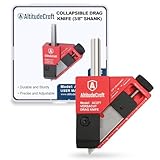


- Blade compatibility: Check the exact blade type and shank or holder size. “45-degree blade” alone does not guarantee compatibility; craft-knife blades and plotter blades use different fittings.
- Spring travel: A spring-loaded holder can follow modest surface variations, but it cannot compensate for thick material or poor workholding. Verify usable travel rather than assuming the spring makes the tool suitable for any thickness.
- Mounting: Many drag-knife holders use a cylindrical body that fits a collet or tool clamp. Confirm the holder diameter against your router or CNC mount, and check that the blade clears the dust shoe and clamps.
- CAM support: Look for a drag-knife toolpath or a documented method for offset compensation. A standard end-mill contour path may not handle sharp corners correctly.
Comparison: choose by material and setup
The table compares practical tool categories rather than implying that every holder in a category has identical specifications. Dimensions and capacities vary by model; treat the ranges as buying-screen estimates and confirm the manufacturer’s drawing before ordering.
| Drag-knife option | Typical blade / holder details | Best suited to | Practical limits and fit |
|---|---|---|---|
| Basic fixed-depth holder | Replaceable plotter-style blade; commonly 45°; about 6–12 mm body diameter | Adhesive vinyl, paper, thin stencil film | Often the lowest-cost option, roughly $15–$40. Fixed projection demands a flat spoilboard and consistent material thickness. Check whether the blade is included and what fitting it uses. |
| Spring-loaded hobby holder | Replaceable 45° or 60° blades; commonly 10–16 mm body diameter; spring travel often around 2–5 mm | Vinyl, card, gasket sheet, thin craft foam | Usually about $30–$90. The spring helps with small height changes, not deep cuts. Confirm holder diameter and usable travel before buying. |
| Adjustable or precision holder | Adjustable blade projection; model-specific blade collet or cartridge; often a 12–20 mm mounting body | Frequent production, repeatable templates, varied thin materials | Often about $70–$200 or more. Easier to tune and document, but still requires a suitable toolpath and secure mounting. Verify the actual blade offset specification. |
| Heavy-duty oscillating knife system | Powered blade motion and dedicated toolhead; blade and holder are system-specific | Thicker foam, corrugated plastic, or higher-volume sheet cutting | Typically a substantial cost step above a passive drag knife. Requires compatible controls and a rigid machine; it is not a drop-in drag-knife attachment for every router. |
Best choice by job
For adhesive vinyl and occasional labels
Choose a compact spring-loaded holder with replaceable 45° plotter-style blades, provided the blade fitting is clearly specified. Vinyl needs only a shallow cut through the face film and adhesive, not through the release liner. A light holder is easier to mount on a small CNC router and puts less load on a modest gantry. If the listing does not state the blade family, offset, and mounting diameter, ask before buying.
For foam, gasket material, and thicker flexible sheets
Look for a holder with adjustable projection and enough spring travel for the material’s surface variation. A 60° blade can be useful for tougher or thicker stock, but it does not by itself guarantee a deeper, cleaner cut: blade geometry, sharpness, drag force, and material density all matter. For thick foam or repeated production, a passive drag knife may deflect or pull the work loose; consider a purpose-built oscillating knife instead.
For thin plastic or other semi-rigid sheet goods
Use a drag knife only when the material is thin and flexible enough to cut without excessive blade force. Secure the sheet across its area, not just at the corners, and test for cracking, lifting, or burrs. Some rigid plastics and composite sheets are better suited to a router bit or a dedicated cutting system. A knife attachment is not a universal substitute for a spindle tool.
Fit check before you order
For a drag knife for cnc router use, measure the machine’s tool-clamping range and compare it with the holder’s stated shank or body diameter. A holder advertised for a 1/4-inch collet needs a true 1/4-inch mounting shank; a 10 mm body will not fit that collet safely just because the dimensions seem close. If your machine has a spindle-mounted tool, keep the spindle off during knife cutting unless the manufacturer explicitly specifies otherwise.
Also check vertical clearance. The holder must reach the work without the router body, dust shoe, or clamp contacting the sheet. For small desktop machines, a low-profile holder may fit better than a long, spring-loaded one. If the router uses a proprietary tool mount, confirm that an adapter is available and that it does not introduce excessive runout or looseness.
Setup: dial in the cut before making a full sheet
- Flatten and secure the work. Use a clean spoilboard and tape, a vacuum bed, or another method that holds the material uniformly. Height variation changes the cut depth and can snag the blade.
- Set minimal blade exposure. Extend only enough blade to cut the target layer. For vinyl, begin with a shallow projection that scores the vinyl and adhesive while leaving the backing intact.
- Find the actual offset. Use the holder’s documented value as a starting point, then cut a small square or test pattern. If corners do not meet, adjust the CAM offset or compensation rather than increasing blade depth.
- Test speed and corners. Start conservatively and inspect tight turns, small lettering, and inside corners. A drag knife can lag or lift at abrupt direction changes, so use CAM features such as corner overcut or suitable lead-ins where available.
- Check the result before production. Confirm that pieces weed cleanly and that the backing or spoilboard has not been cut unnecessarily. Change one setting at a time so the cause of any improvement is clear.
Ownership costs and common failure points
Blades are the main consumable. They dull faster on abrasive, filled, or contaminated materials than on clean vinyl, and a damaged tip can leave inconsistent corners even when the toolpath is correct. Keep spare blades compatible with the holder, protect their tips during storage, and replace a blade when test cuts begin to require extra force. Avoid touching the cutting edge while handling it.
Adhesive buildup can make a blade drag instead of swivel freely. Remove debris carefully with a suitable cleaner for the holder and blade material, then check that the blade rotates without sticking. Do not force a blade into a mismatched cartridge or bend it to correct a poor cut. The most common setup mistakes are excessive blade exposure, insufficient workholding, an incorrect offset, and expecting spring travel to compensate for a warped sheet.
For occasional vinyl work, a basic compatible holder is usually enough. For varied materials or repeat jobs, an adjustable spring-loaded model is easier to tune and document. If your work regularly exceeds a few millimetres in thickness or demands fast, reliable cuts through foam, invest in a dedicated knife system rather than asking a passive drag knife to do a job it was not designed for.
0 Comments