RP Woodworks

  • Home
  • Reviews
  • Projects
  • Tools
  • Woodworking Techniques
  • About

Sanding & Surface Prep

Sanding schedules, abrasives, grit choice and surface prep that decide how good a finish can look.

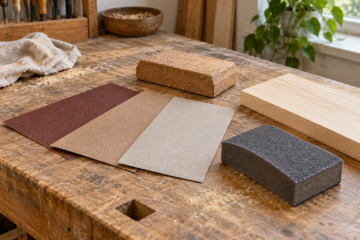
AI-generated editorial illustration of sandpaper
Sanding & Surface Prep

80-Grit vs 120-Grit Sandpaper for Removing Wood Finish

Choosing between 80-grit and 120-grit sandpaper depends on how much finish must come off and how smooth the wood needs to be afterward. For most refinishing jobs, 80 grit is the faster cutting abrasive, while 120 grit is the safer choice when the finish is thin, the wood is soft, Read more

By , 2 weeksSeptember 25, 2026 ago
AI-generated editorial illustration of sandpaper
Sanding & Surface Prep

How to Sand Between Coats of Wood Paint

Sanding between coats of wood paint is a light preparation step, not an attempt to remove the previous coat. Done correctly, it knocks down dust nibs, brush marks, raised wood fibers, and other small defects so the next coat bonds smoothly. Done too aggressively, it exposes bare wood, creates visible Read more

By , 2 weeksSeptember 25, 2026 ago
AI-generated editorial illustration of sandpaper
Sanding & Surface Prep

How to Sand a Wood Panel Without Creating Dish-Outs

Dish-outs are shallow hollows left when sanding removes more wood from one spot than the surrounding surface. They show up readily on broad panels, especially in raking light or under stain. The fix is mostly controlled sanding: keep the abrasive flat, use a suitable grit, and avoid pressing down or Read more

By , 2 weeksSeptember 25, 2026 ago
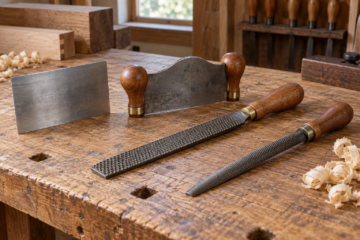
AI-generated editorial illustration of scrapers rasps files
Sanding & Surface Prep

How to Use a Cabinet Scraper to Prepare Wood for Finishing

A cabinet scraper is a thin piece of hardened steel that shaves off fine curls of wood. Used well, it can remove milling marks, glue residue, and shallow tear-out without the coarse scratches a plane or low-grit sandpaper may leave. It is especially useful on figured wood, where sanding across Read more

By , 2 weeksSeptember 25, 2026 ago
AI-generated editorial illustration of sandpaper
Sanding & Surface Prep

How to Sand Narrow Wood Profiles by Hand

Narrow profiles—beads, grooves, small coves, and routed edges—are easy to round over or flatten if you sand them like a broad board. The aim is to remove scratches and finish evenly while keeping the original shape. Use a backing that fits the profile, light pressure, and a grit sequence that Read more

By , 2 weeksSeptember 25, 2026 ago
AI-generated editorial illustration of sandpaper
Sanding & Surface Prep

How to Sand Wood Between Stain and Topcoat

Sanding between stain and topcoat is a light surface-preparation step, not a second round of wood shaping. The goal is to remove raised grain, dust nibs, and rough fibers without cutting through the stain. Done correctly, it gives the first coat of finish a smoother surface and better mechanical grip. Read more

By , 2 weeksSeptember 25, 2026 ago
AI-generated editorial illustration of sandpaper
Sanding & Surface Prep

How to Sand a Wood Tabletop Flat Before Applying Stain

Sanding a wood tabletop flat is mostly a leveling job, not a polishing job. The goal is to remove glue, mill marks, scratches, and small height differences without creating dips or rounding the edges. Stain makes preparation more demanding because it highlights sanding scratches, cross-grain marks, glue spots, and uneven Read more

By , 2 weeksSeptember 25, 2026 ago
Editorial illustration: wet-dry shop vacuum with a wide flexible hose.
Sanding & Surface Prep

How to Clean Sanding Dust from Open-Grain Wood

Sanding dust is hardest to remove from open-grain woods such as oak, ash, walnut, mahogany, and elm. The dust does not sit only on the surface; it packs into the pores and can remain there after a quick wipe. If it is left behind, stain may turn muddy or blotchy, Read more

By , 2 weeksSeptember 25, 2026 ago
AI-generated editorial illustration of sandpaper
Sanding & Surface Prep

How to Sand Bare Wood Without Leaving Swirl Marks

Swirl marks are shallow, circular scratches left by a random-orbit sander, sanding disc, or abrasive pad. They may be hard to see on dry bare wood, then become obvious after stain or clear finish. The usual causes are jumping between grits, using a loaded disc, sanding too fast, pressing down Read more

By , 2 weeksSeptember 25, 2026 ago
AI-generated editorial illustration of sandpaper
Sanding & Surface Prep

How to Sand a Veneered Cabinet Door Without Sanding Through

Veneer is a thin layer of real wood bonded to a cabinet door, not a solid-wood surface with plenty of sanding room. Many modern doors have veneer only about 0.5–1 mm thick; some are thinner, and the thickness is hard to judge by sight. Sand through it and the substrate—often Read more

By , 2 weeksSeptember 25, 2026 ago

Posts pagination

Previous 1 … 7 8 9 … 12 Next
Recent Posts
  • Best Woodworking Clamps: Which Types to Buy and How Many You Need
  • Best Pocket Hole Jigs in 2026: Kreg, Massca and Milescraft Compared
  • Best Dovetail Jigs: Fixed, Multi-Template and Variable-Spacing Options Explained
  • Best Compact Wood Routers: Corded vs Cordless Picks for Edge Work and Trimming
  • How to Repair a Wood Split Caused by a Screw (Even in Thin Teak)
Recent Comments
No comments to show.
Archives
  • October 2026
  • September 2026
Categories
  • Clear Coats & Topcoats
  • Finish Problems & Fixes
  • Gift Guides
  • Grain Filling & Sealing
  • Guides
  • Oils & Waxes
  • Painting & Priming
  • Sanding & Surface Prep
  • Shop Setup & Safety
  • Staining & Dyes
  • Tool Troubleshooting
  • Tools
  • Wood Finishing
  • Wood Species & Lumber
  • Woodworking Techniques
Hestia | Developed by ThemeIsle