RP Woodworks

  • Home
  • Top Picks
  • Reviews
  • Projects
  • Tools
  • Woodworking Techniques
  • About

Sanding & Surface Prep

Sanding schedules, abrasives, grit choice and surface prep that decide how good a finish can look.

AI-generated editorial illustration of sandpaper
Sanding & Surface Prep

Best Abrasive for Reclaimed Wood with Embedded Dirt

Reclaimed wood with embedded dirt is harder to sand than ordinary rough lumber. Soil, grit, old paint, and small bits of roofing material can clog abrasives or tear fresh scratches across the surface. The best approach is not to start with the finest sandpaper. Clean and inspect the boards first, Read more
By , 1 monthSeptember 25, 2026 ago
AI-generated editorial illustration of sandpaper
Sanding & Surface Prep

Best Sandpaper for Sanding Between Clear Coats

Sanding between clear coats is a light leveling step, not a full sanding operation. The goal is to remove dust nibs, tiny bubbles, brush marks, and minor roughness so the next coat bonds to a uniformly dull surface. The best sandpaper is usually fine enough to avoid deep scratches but Read more

By , 1 monthSeptember 25, 2026 ago
AI-generated editorial illustration of sandpaper
Sanding & Surface Prep

Best Sanding Discs for Flattening Wood Panels

Flattening a wood panel is mostly a matter of controlling the sanding pattern, not buying the most aggressive disc. A random-orbit sander can remove glue squeeze-out, mill marks, finish ridges, and small high spots. It will not reliably flatten a badly cupped or twisted panel; that job belongs to a Read more

By , 1 monthSeptember 25, 2026 ago
AI-generated editorial illustration of sandpaper
Sanding & Surface Prep

Best Abrasive for Sanding End Grain Smoothly

End grain is harder to sand smoothly than face grain because the abrasive cuts across the open ends of the wood fibers. It absorbs finish differently, shows scratches readily, and can develop a rough, fuzzy surface if the paper is dull. For most projects, the best all-around abrasive is quality Read more

By , 1 monthSeptember 25, 2026 ago
AI-generated editorial illustration of sandpaper
Sanding & Surface Prep

Best Sandpaper for Removing Varnish from Hardwood

Choosing Sandpaper for Removing Varnish from Hardwood The best sandpaper for removing varnish from hardwood is usually aluminum oxide paper in a coarse-to-fine progression: 60 or 80 grit to cut through the finish, 100 or 120 grit to remove the coarse scratches, and 150 or 180 grit to prepare the Read more

By , 1 monthSeptember 25, 2026 ago
AI-generated editorial illustration of sandpaper
Sanding & Surface Prep

Best Abrasive for Smoothing Epoxy-Filled Wood

Epoxy-filled wood is easiest to smooth with abrasives that cut cured epoxy without tearing up the surrounding timber. The best all-around choice is usually a sharp silicon carbide or aluminum oxide abrasive in the 80-to-120-grit range, followed by finer paper for the final surface. The right choice depends on how Read more

By , 1 monthSeptember 25, 2026 ago
AI-generated editorial illustration of sandpaper
Sanding & Surface Prep

Best Sandpaper for Preparing MDF Before Painting

MDF has a smooth, flat face, but it still needs careful sanding before paint. The dense face can develop shiny patches that resist primer, while the cut edges are soft, porous, and prone to swelling or showing fuzzy fibers. The best sandpaper is not one grit used everywhere. Use a Read more

By , 1 monthSeptember 25, 2026 ago
AI-generated editorial illustration of sandpaper
Sanding & Surface Prep

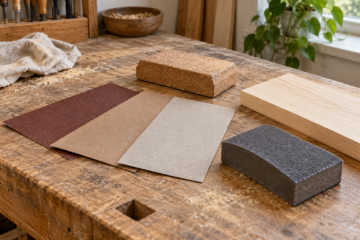
Best Sanding Sponge for Hand-Sanding Wood Edges

Hand-sanding wood edges is easy to underestimate. A flat sanding sheet can smooth an edge, but it tends to fold over, wear quickly, and leave uneven pressure marks. A sanding sponge is usually easier to control because its foam backing conforms to a slight profile while keeping the abrasive face Read more

By , 1 monthSeptember 25, 2026 ago
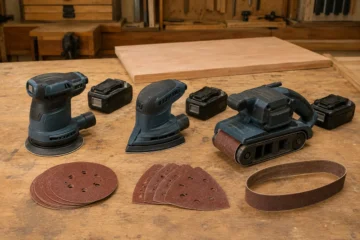
Editorial illustration: orbital, detail and belt sanders with matching abrasive shapes.
Sanding & Surface Prep

Detail Sander vs Sanding Sponge for Wood Profiles

Choosing the Right Profile Sanding Tool Wood profiles—beveled edges, coves, roundovers, ogees, and decorative trim—are easy to damage and awkward to sand. A flat sanding block bridges the shape instead of following it, leaving dull spots on the high points and untouched finish in the recesses. The two practical hand-tool Read more

By , 1 monthSeptember 25, 2026 ago
AI-generated editorial illustration of sandpaper
Sanding & Surface Prep

120-Grit vs 180-Grit Sandpaper for Stained Wood

Choosing between 120-grit and 180-grit sandpaper affects how evenly wood absorbs stain, how smooth it feels, and how visible sanding marks remain under the finish. Neither grit is universally better. The right choice depends on the wood species, the condition of the surface, and whether you are removing mill marks Read more

By , 1 monthSeptember 25, 2026 ago

Posts pagination

Previous 1 … 6 7 8 … 12 Next
Recent Posts
  • 7 Best Wood Finishes for Beginners (October 2026)
  • Osmo Polyx-Oil vs Rubio Monocoat: Which Hardwax Oil Fits Your Project?
  • How to Strip Old Varnish from Furniture Without Sanding
  • How Long to Wait Between Coats of Polycrylic
  • 10 Best Stain Conditioner for Pine (October 2026)
Recent Comments
No comments to show.
Archives
  • October 2026
  • September 2026
Categories
  • Clear Coats & Topcoats
  • Cordless Drills
  • Finish Problems & Fixes
  • Finish Problems & Fixes
  • Gift Guides
  • Grain Filling & Sealing
  • Guides
  • Laser Levels
  • Lifestyle
  • Oils & Waxes
  • Outdoor Cleaning
  • Outdoor Lighting
  • Painting & Priming
  • Painting & Priming
  • Power Tools
  • Sanding & Surface Prep
  • Shop Setup & Safety
  • Shop Vacuums
  • Spray Guns
  • Staining & Dyes
  • Staining & Dyes
  • Stud Finders
  • Tool Troubleshooting
  • Tools
  • Wood Finishes
  • Wood Finishing
  • Wood Species & Lumber
  • Wood Stains
  • Woodturning
  • Woodworking Techniques
  • Woodworking Tools
Hestia | Developed by ThemeIsle