RP Woodworks

  • Home
  • Reviews
  • Projects
  • Tools
  • Woodworking Techniques
  • About

Sanding & Surface Prep

Sanding schedules, abrasives, grit choice and surface prep that decide how good a finish can look.

AI-generated editorial illustration of sandpaper
Sanding & Surface Prep

How to Use a Sanding Sealer to Improve Surface Preparation

Sanding sealer is a first-coat product designed to make wood easier and more predictable to sand. It usually contains extra lubricants or soap-like additives that help sandpaper cut without loading as quickly. Some products also build a fast, uniform film that fills minor scratches and reduces uneven absorption. It is Read more

By , 2 weeksSeptember 25, 2026 ago
AI-generated editorial illustration of sandpaper
Sanding & Surface Prep

How to Hand-Sand a Wood Surface After Machine Sanding

Machine sanding removes material quickly, but it rarely leaves a surface ready for stain or clear finish. Orbital patterns, edge marks, clogged abrasive, and small swirls can remain visible after finishing. Hand-sanding is the slower final check: it levels problem areas, removes machine marks, and lets you sand edges without Read more

By , 2 weeksSeptember 25, 2026 ago
AI-generated editorial illustration of sandpaper
Sanding & Surface Prep

How to Sand Wood with a Vacuum Dust-Extraction System

Sanding wood with vacuum extraction is cleaner, safer, and usually faster than sanding without suction. The vacuum removes abrasive dust as it is produced instead of letting it settle on the workpiece, clog the abrasive, or enter your lungs. It also makes it easier to see scratches and uneven areas Read more

By , 2 weeksSeptember 25, 2026 ago
Editorial illustration: random orbital sander beside circular sanding discs.
Sanding & Surface Prep

How to Use a Random Orbital Sander on Narrow Boards

Narrow boards are easy to sand badly with a random orbital sander. The tool can round the edges, gouge the ends, or tip sideways and leave a visible low spot. The problem is not that a random orbital sander is unsuitable; it is that a narrow workpiece gives the pad Read more

By , 2 weeksSeptember 25, 2026 ago
AI-generated editorial illustration of sandpaper
Sanding & Surface Prep

How to Remove Black Sanding Marks from Light Wood

Black sanding marks on light wood usually come from contaminated or overheated abrasive, not from the wood itself. They are most obvious on maple, birch, ash, pine, and white oak, especially after applying a clear finish or pale stain. The marks may look like gray streaks, dark crescents, or fine Read more

By , 2 weeksSeptember 25, 2026 ago
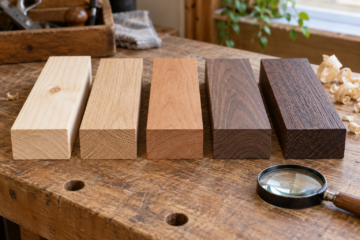
AI-generated editorial illustration: five wooden board samples showing different grain textures and colors.
Sanding & Surface Prep

How to Sand a Wood Surface Before Applying Oil

Sanding before oiling is less about making wood perfectly smooth than creating an even, clean surface that absorbs oil consistently. Sand too coarsely and the scratches remain visible. Sand too finely and the surface can become burnished, reducing absorption and leaving uneven sheen or pale patches. The right sanding schedule Read more

By , 2 weeksSeptember 25, 2026 ago
AI-generated editorial illustration of sandpaper
Sanding & Surface Prep

How to Sand a Wood Edge Without Creating a Bevel

A crisp, square wood edge is easy to lose during sanding. A few extra passes with loose sandpaper can round the corner, while a power sander can create a visible bevel in seconds. The goal is not to avoid sanding the edge entirely. It is to control where the abrasive Read more

By , 2 weeksSeptember 25, 2026 ago
AI-generated editorial illustration of sandpaper
Sanding & Surface Prep

How to Sand Wood After Applying Grain Filler

Why Sanding After Grain Filler Matters Grain filler levels the pores in open-grained woods such as oak, ash, walnut, mahogany, and some species of acacia. After it dries, the surface usually feels rougher than expected because filler sits both inside the pores and slightly above the surrounding wood. Sanding removes Read more

By , 2 weeksSeptember 25, 2026 ago
AI-generated editorial illustration of sandpaper
Sanding & Surface Prep

How to Sand Reclaimed Wood Without Removing Character

Reclaimed wood looks convincing because it carries evidence of its former life: saw marks, worn edges, dents, nail holes, old paint, and uneven color. Sanding should make it safe and usable without turning it into ordinary new lumber. The goal is not a perfectly uniform surface. It is to remove Read more

By , 2 weeksSeptember 25, 2026 ago
AI-generated editorial illustration of sandpaper
Sanding & Surface Prep

How to Sand Curved Wood Parts with Flexible Abrasives

Why Curved Parts Need Flexible Abrasives Flat sanding tools work poorly on chair spindles, bent laminations, turned legs, guitar bodies, boat trim, and other curved wood parts. A rigid sanding block touches only the high spots. Press harder and it cuts those spots even faster, leaving flat patches, sharp transitions, Read more

By , 2 weeksSeptember 25, 2026 ago

Posts pagination

Previous 1 … 4 5 6 … 12 Next
Recent Posts
  • Best Woodworking Clamps: Which Types to Buy and How Many You Need
  • Best Pocket Hole Jigs in 2026: Kreg, Massca and Milescraft Compared
  • Best Dovetail Jigs: Fixed, Multi-Template and Variable-Spacing Options Explained
  • Best Compact Wood Routers: Corded vs Cordless Picks for Edge Work and Trimming
  • How to Repair a Wood Split Caused by a Screw (Even in Thin Teak)
Recent Comments
No comments to show.
Archives
  • October 2026
  • September 2026
Categories
  • Clear Coats & Topcoats
  • Finish Problems & Fixes
  • Gift Guides
  • Grain Filling & Sealing
  • Guides
  • Oils & Waxes
  • Painting & Priming
  • Sanding & Surface Prep
  • Shop Setup & Safety
  • Staining & Dyes
  • Tool Troubleshooting
  • Tools
  • Wood Finishing
  • Wood Species & Lumber
  • Woodworking Techniques
Hestia | Developed by ThemeIsle