RP Woodworks

  • Home
  • Reviews
  • Projects
  • Tools
  • Woodworking Techniques
  • About

Sanding & Surface Prep

Sanding schedules, abrasives, grit choice and surface prep that decide how good a finish can look.

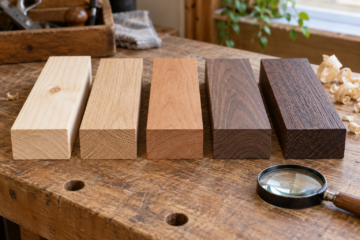
AI-generated editorial illustration: five wooden board samples showing different grain textures and colors.
Sanding & Surface Prep

How to Prepare Mill Marks on Rough-Sawn Boards

What Mill Marks Actually Are Rough-sawn boards come straight from the sawmill with distinct ridges, chatter, and sometimes burned or fuzzy patches left by the circular or bandsaw blade. On softwoods like pine and poplar these marks might be 1/64 inch deep (about 0.015″). On hardwoods like white oak or Read more

By , 1 weekSeptember 25, 2026 ago
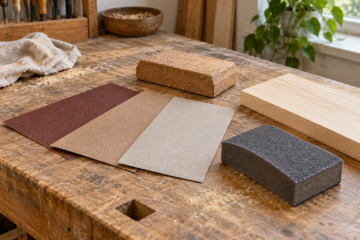
AI-generated editorial illustration of sandpaper
Sanding & Surface Prep

How to Sand Hardwood Without Polishing the Surface

Sanding hardwood for stain or a clear finish is not about getting it as smooth as possible. If you sand too fine, too fast, or with too much pressure, you compress and polish the surface fibers instead of cutting them. That polished, burnished surface looks perfect in raw wood, but Read more

By , 1 weekSeptember 25, 2026 ago
AI-generated editorial illustration of sandpaper
Sanding & Surface Prep

How to Sand Softwood Without Dishout

Why Softwood Dishes Out Softwood isn’t uniformly soft. Pine, fir, spruce, and cedar all have alternating bands of soft earlywood (spring growth) and hard latewood (summer growth). The earlywood can be 2-3 times softer on a Janka scale than the dense latewood right next to it. Any flexible abrasive will Read more

By , 1 weekSeptember 25, 2026 ago
AI-generated editorial illustration of sandpaper
Sanding & Surface Prep

How to Sand End Grain Without Creating Dark Patches

Why End Grain Turns Dark End grain is not just wood cut the other way. It’s a bundle of open straws. On face grain and edge grain, you are sanding the sides of those fibers. On end grain, you are looking straight down the tubes. Capillary action pulls any liquid Read more

By , 1 weekSeptember 25, 2026 ago
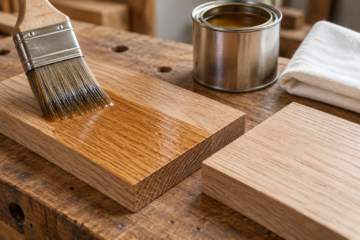
AI-generated editorial illustration: brush applying a clear wood finish to a board beside an unfinished offcut.
Sanding & Surface Prep

Shellac vs Sanding Sealer Before Clear Coating

Choosing between shellac and sanding sealer before a clear coat depends on what problem you are trying to solve. Shellac is a versatile barrier coat that can lock in odors, resin, stains, and contaminated surfaces. Sanding sealer is usually a modified version of the clear finish itself, designed to sand Read more

By , 1 weekSeptember 25, 2026 ago
AI-generated editorial illustration: five wooden board samples showing different grain textures and colors.
Sanding & Surface Prep

How to Remove Oxidized Surface Fibers from Outdoor Wood

Outdoor wood turns gray because sunlight breaks down lignin at the surface. Rain and freeze-thaw cycles then loosen the damaged fibers, leaving a fuzzy, raised layer often called oxidized wood fibers, weathered wood, or “gray wood.” This is not the same as ordinary dirt or mildew. A cleaner can remove Read more

By , 1 weekSeptember 25, 2026 ago
AI-generated editorial illustration of sandpaper
Sanding & Surface Prep

How to Sand Plywood Edges Before Painting

Plywood edges are harder to paint well than plywood faces. The exposed plies absorb primer unevenly, shed fibers, and leave a striped edge that remains visible under gloss or semi-gloss paint. Good results come from sanding in stages, sealing the end grain, and resisting the temptation to remove too much Read more

By , 1 weekSeptember 25, 2026 ago
AI-generated editorial illustration of sandpaper
Sanding & Surface Prep

How to Sand Turned Wood Parts Before Finishing

Turned parts are easy to damage because the workpiece is round, the grain changes direction, and the sanding tool can remove material unevenly in seconds. The goal is not simply to make the surface feel smooth. You also need to preserve the profile, avoid flat spots, and remove every scratch Read more

By , 1 weekSeptember 25, 2026 ago
Editorial illustration: wet-dry shop vacuum with a wide flexible hose.
Sanding & Surface Prep

How to Vacuum Fine Wood Dust from a Prepared Surface

Fine wood dust is easy to underestimate. After sanding, a surface can look clean while still carrying a powdery film that causes fisheyes, rough spots, poor adhesion, or visible specks in stain and clear coat. The safest method is not simply “vacuum harder.” Use the right vacuum, the right nozzle, Read more

By , 1 weekSeptember 25, 2026 ago
Editorial illustration: wet-dry shop vacuum with a wide flexible hose.
Sanding & Surface Prep

How to Remove Sanding Dust from Open-Grain Wood

Open-grain woods such as oak, ash, walnut, mahogany, and elm have deep pores that trap sanding dust. A quick wipe with a dry rag can make the board look clean while leaving fine particles packed into the grain. That dust can muddy a stain, create pale spots under finish, and Read more

By , 1 weekSeptember 25, 2026 ago

Posts pagination

Previous 1 2 3 … 12 Next
Recent Posts
  • Best Woodworking Clamps: Which Types to Buy and How Many You Need
  • Best Pocket Hole Jigs in 2026: Kreg, Massca and Milescraft Compared
  • Best Dovetail Jigs: Fixed, Multi-Template and Variable-Spacing Options Explained
  • Best Compact Wood Routers: Corded vs Cordless Picks for Edge Work and Trimming
  • How to Repair a Wood Split Caused by a Screw (Even in Thin Teak)
Recent Comments
No comments to show.
Archives
  • October 2026
  • September 2026
Categories
  • Clear Coats & Topcoats
  • Finish Problems & Fixes
  • Gift Guides
  • Grain Filling & Sealing
  • Guides
  • Oils & Waxes
  • Painting & Priming
  • Sanding & Surface Prep
  • Shop Setup & Safety
  • Staining & Dyes
  • Tool Troubleshooting
  • Tools
  • Wood Finishing
  • Wood Species & Lumber
  • Woodworking Techniques
Hestia | Developed by ThemeIsle