What's inside
- Top 3 Picks
- Quick Comparison
- How We Chose
- 1. TOPDON TS004 – Best for Entry-Level Handheld Scanning
- 2. AGM Global Vision Rattler V2 19-256 – Best Overall Weapon-Mounted Thermal Scope
- 3. RIX Storm S2 256×192 with 25 mm Lens – Best Premium Thermal Scope for Longer Shots
- 4. GOYOJO G210 – Best for Wide-Field Close-Range Scanning
- 5. CVLIFE 256×192 Thermal Monocular – Best Budget All-Round Handheld
- 6. ATN BlazeSeeker 6 – Best for Low-Contrast Nights and Wide-Field Detection
- 7. GOYOJO G215 – Best Budget 15 mm Scanner
- 8. Pulsar Axion XQ19 – Best Premium Handheld Scanner
- Top 3 Picks
- Quick Comparison
- How We Chose
- 1. TOPDON TS004 – Best for Entry-Level Handheld Scanning
- 2. AGM Global Vision Rattler V2 19-256 – Best Overall Weapon-Mounted Thermal Scope
- 3. RIX Storm S2 256×192 with 25 mm Lens – Best Premium Thermal Scope for Longer Shots
- 4. GOYOJO G210 – Best for Wide-Field Close-Range Scanning
- 5. CVLIFE 256×192 Thermal Monocular – Best Budget All-Round Handheld
- 6. ATN BlazeSeeker 6 – Best for Low-Contrast Nights and Wide-Field Detection
- 7. GOYOJO G215 – Best Budget 15 mm Scanner
- 8. Pulsar Axion XQ19 – Best Premium Handheld Scanner
As an Amazon Associate I earn from qualifying purchases. This post may contain affiliate links at no extra cost to you.
For most hog hunters in 2026, the best thermal scope for hog hunting is the AGM Global Vision Rattler V2 19-256. It is a weapon-mounted thermal riflescope with a 256×192 high-sensitivity sensor and a 19 mm lens, which puts it in the sweet spot of detection range, image stability, and recoil-rated construction without crossing into premium pricing. It suits the hunter who shoots pigs over feeders or in open pasture at 50–150 yards, wants a scope that holds zero on a .308-class rifle, and does not want to spend premium money to get there. If you need a handheld scanner first and a scope later, the TOPDON TS004 is the best budget entry point. If you want the longest practical identification range and the best low-contrast image in this roundup, the RIX Storm S2 with its 25 mm lens is the premium pick. Everything below compares these and nine more options on the criteria that actually decide a hog hunt: detection range, sensor resolution, refresh rate, identification clarity, recoil durability, battery runtime, and how the unit behaves at night.
Top 3 Picks
Best Overall: AGM Global Vision Rattler V2 19-256
The Rattler V2 19-256 is a dedicated thermal riflescope rather than a monocular pressed into double duty, and that single fact matters more than any spec sheet line. A 19 mm lens with a 256×192 core gives a roughly 9–10° horizontal field of view — wide enough to catch a sounder moving through brush at 60 yards, tight enough to place a shot. AGM builds these to take centerfire recoil, the 50 Hz class refresh keeps panning smooth, and the mount interface is standard Picatinny. It is the pick for the hunter who wants one tool that finds and shoots.
Best Budget: TOPDON TS004
At the budget tier, the TS004 is the least expensive way to see heat signatures at all. A 13 mm lens on a handheld monocular gives a wide, scan-friendly view of a field edge or feeder pen, and the 50 Hz refresh rate means the image does not smear into a slideshow when you sweep across a treeline. It will not identify a hog at 200 yards and you cannot mount it to a rifle, but as a first thermal and as a permanent truck scanner it earns its place.
Best Premium: RIX Storm S2 256×192 with 25 mm Lens
The Storm S2 pairs a 256×192 core with the longest lens in the affordable premium bracket at 25 mm. That combination roughly doubles the pixel count on a hog’s body compared with a 10–13 mm lens, which is the difference between “something warm is out there” and “that is a boar, and he is quartering away.” If your hunting is open country, senderos, or long field edges, the Storm S2 is the one that keeps you inside ethical shooting distance.
Quick Comparison
| Product | Best For | Key Specs | Price Tier |
|---|---|---|---|
| TOPDON TS004 | First thermal, handheld scanning | 13 mm lens, 50 Hz refresh, thermal monocular | Budget |
| AGM Global Vision Rattler V2 19-256 | Overall weapon-mounted hunting scope | 256×192 high-sensitivity sensor, 19 mm lens, riflescope mount | Mid-range |
| RIX Storm S2 | Longer-range hunting scope | 256×192 sensor, 25 mm lens, hunting riflescope | Premium |
| GOYOJO G210 | Wide-field close-range scanning | 256×192 sensor, 10 mm focal lens, monocular | Mid-range |
| CVLIFE 256×192 | Budget all-round handheld | 256×192 sensor, 15 mm lens, 1024×768 display, 50 Hz | Budget |
| ATN BlazeSeeker 6 | Wide-field detection with low NETD | 256×192, 12 μm pitch, ≤20 mK NETD, 10 mm lens, 1.7–13.6× | Mid-range |
| GOYOJO G215 | Budget 15 mm scanner | 256×192 sensor, 50 Hz, 15 mm focal lens, monocular | Budget |
| Pulsar Axion XQ19 | Premium handheld scanning | 384×288 sensor, 19 mm lens, compact monocular | Premium |
| GOYOJO GRS/GRL Series | Scope with integrated rangefinder | 256×192 class sensor, 25 mm lens, 256-25 rangefinder model | Premium |
| ATN Thor LTV | Recording and long-range identification | 4K+ 4056×3040 thermal sensor, 4K video, one-shot zero, ultralight | Premium |
| Hawke Vantage 3-9×50 | Daylight and legal-light backup | 3-9×50, 1″ mono-tube, shockproof/waterproof/fogproof, H2 optical system | Budget |
| Bansainong 384×288 Thermal Scope | Budget high-resolution sensor scope | 384×288 sensor, night vision scope, charger included | Budget |
How We Chose
This roundup is assembled from published manufacturer specifications, product listing data, and the optical physics that govern every thermal device — not from field testing, and not from any hands-on use of these units. The selection criteria were weighted for hog hunting specifically rather than general thermal use. Sensor resolution and pixel pitch come first, because they set how many pixels land on a hog’s body at a given distance. Lens focal length comes second, because it determines field of view and the pixel-per-meter figure that actually governs detection and identification range. Refresh rate comes third: 50 Hz panning is markedly smoother than 25 Hz, and smoothness matters when you are tracking a moving animal in a scope. We then filtered by category fit — dedicated riflescope versus handheld monocular versus conventional glass optic — because a monocular cannot do a scope’s job regardless of how good its sensor is. Recoil durability, mount interface, battery type and runtime, display resolution, and the upgrade path (can you add a rangefinder, external power, or recording?) rounded out the evaluation. Price tiers are given only as budget, mid-range, and premium, since street prices move daily.
1. TOPDON TS004 – Best for Entry-Level Handheld Scanning
As an Amazon Associate we earn from qualifying purchases at no extra cost to you.

The TS004 is the cheapest sensible doorway into thermal hog hunting. It is a handheld thermal imaging monocular built around a 13 mm lens and a 50 Hz refresh rate, and it suits the hunter who already has a rifle they trust and simply cannot find pigs in the dark. In that role it is genuinely useful: you park, you glass the field edge, and a hog’s body heat shows up as a bright blob against cool grass long before your eyes would ever resolve a black shape against black ground. It also suits the scouting use case — checking a feeder pen from 80 yards without walking in and blowing the stand — and the recovery use case, finding a downed animal in tall brush after a marginal shot.
Key specs
- Lens: 13 mm focal length — a wide, scan-friendly field of view
- Refresh rate: 50 Hz, the smoother of the two common classes (the other being 25 Hz)
- Format: handheld thermal imaging monocular, night vision capable, pocketable
- Sensor resolution: not stated in the listing; treat the TS-series monocular as an entry-class core
Run the field-of-view arithmetic and the 13 mm lens makes sense for its job. With a 256×192 core at a 12 μm pixel pitch, the horizontal field is roughly 3.07 mm of sensor width divided by 13 mm of focal length, which works out to about 13.5° — call it a 14° window. That is wide enough to sweep a whole feeder pen or a 40-yard stretch of field edge in one pass without panning constantly. It is also why the TS004 is not a long-range identifier: at 13 mm, one pixel covers about 9 cm at 100 yards, so a hog standing roughly 1 meter tall occupies about 10 pixels at that distance. That is a clear detection, a marginal recognition, and not an identification. Push to 200 yards and you are down to five pixels — you will know something warm is there, and that is all.
The 50 Hz refresh is the spec worth paying attention to, because it is the difference between usable and frustrating in a handheld. At 25 Hz, sweeping the unit across a treeline produces visible stutter and a lag between your hand movement and the image, which makes it easy to miss an animal you swept past. At 50 Hz the image keeps up with your wrist. For a scanner that you will pan constantly, that is the single most important quality-of-life spec in the device.
Pros
- Lowest-cost credible entry into thermal detection
- 50 Hz refresh keeps panning smooth and natural
- 13 mm lens gives a wide field of view, ideal for scanning feeders and field edges
- Small and light enough to live in a truck console or a jacket pocket
- Doubles as a recovery tool for tracking wounded game in heavy cover
Cons
- Not a weapon-mountable scope — you cannot shoot from it
- Short focal length means limited identification distance
- Entry-class core limits image detail on cold, low-contrast nights
- You will eventually want a dedicated scope, so it is a stepping stone rather than an endpoint
Compared with the nearest alternative in this list, the CVLIFE 256×192 monocular, the TS004 gives up lens length — 13 mm versus 15 mm — and therefore a little pixel density at distance. What it gains is the 50 Hz refresh rate and a simpler, more pocketable form. If your priority is spotting hogs in a field at 50–100 yards and then switching to a rifle-mounted optic, the TS004 is the smarter budget scanner. If you want the maximum handheld identification range for the money and do not mind a slightly larger body, the CVLIFE is the better call.
2. AGM Global Vision Rattler V2 19-256 – Best Overall Weapon-Mounted Thermal Scope

The Rattler V2 19-256 is the pick that answers the actual buying question most hog hunters are asking: what do I mount on the rifle? It is a dedicated thermal riflescope with a 256×192 high-sensitivity sensor behind a 19 mm lens, built by a company whose entire catalog is thermal and night vision optics. It suits the hunter who hunts pigs at night regularly — over feeders, along senderos, in crop fields, or from a truck — and who wants one unit that detects, identifies, and shoots without a separate scanner on the seat. It also suits the hunter who is tired of the compromise involved in holding a monocular up to a rifle scope, which never works as well as it sounds.
Key specs
- Sensor: 256×192, high-sensitivity core
- Lens: 19 mm focal length
- Format: weapon-mounted thermal riflescope with standard rail interface
- Refresh: 50 Hz class, smooth for tracking moving animals
- Build: recoil-rated for centerfire hunting cartridges
The 19 mm lens is the heart of why this works. Assuming a 12 μm pixel pitch, one pixel subtends about 0.63 milliradians, which is roughly 6.3 cm at 100 yards. A hog standing about 1 meter tall therefore fills about 14 pixels vertically at 100 yards, about seven pixels at 200 yards, and just under five at 300. Under the standard rule of thumb — detection at two pixels on target, recognition at six, positive identification at twelve or more — that puts reliable identification inside roughly 120–150 yards and confident recognition out to about 300. For the way most hogs are actually shot, that is the correct window. The 9–10° horizontal field of view is the trade-off: you will not see a whole sounder in the scope at close range, which is exactly why many hunters pair a scope like this with a wide handheld scanner.
The 256×192 core is worth defending here. It is fashionable to dismiss it as low resolution, but resolution and range are not the same thing. Identification distance is set by lens focal length and pixel pitch — the IFOV math above — while sensor resolution sets how much of the world fits in the frame and how much processing headroom the image engine has. A 256×192 sensor with a 19 mm lens and a 1024×768 display produces a clean, usable hunting image. Where the higher-resolution 384×288 and 640×512 cores earn their money is field of view at the same magnification and better performance in poor thermal contrast, not a magical extension of identification distance.
Pros
- Dedicated riflescope design — holds zero and mounts properly to a rail
- 19 mm lens balances field of view against identification range well
- High-sensitivity sensor handles low-contrast nights better than generic cores
- 50 Hz refresh keeps tracking smooth on moving pigs
- From a brand that specializes exclusively in thermal and night optics
Cons
- Mid-range pricing, well above the budget monoculars in this list
- 9–10° field of view is narrow for close-range sounder work
- 256×192 core limits detail compared with premium 384×288 and 640×512 units
- No integrated rangefinder on this model
Against the RIX Storm S2, the closest premium alternative, the Rattler V2 gives up lens length — 19 mm versus 25 mm — and therefore roughly a third of the pixel density on target. In exchange it comes in at a lower price tier and, for the majority of shots taken at feeders and in timber at 50–120 yards, that missing resolution changes nothing. The Storm S2 only justifies itself if your terrain routinely presents 200-yard shots. Against the budget Bansainong 384×288 scope, the Rattler wins on brand specialization, mount quality, and recoil-rated construction, while the Bansainong wins on raw sensor resolution per dollar. If reliability and warranty support matter more to you than pixel count, the AGM is the safer buy.
3. RIX Storm S2 256×192 with 25 mm Lens – Best Premium Thermal Scope for Longer Shots

The Storm S2 is the answer for hunters whose ground does not let them get close. It pairs a 256×192 thermal core with a 25 mm lens, the longest focal length in this roundup outside the rangefinding GOYOJO GRS/GRL series. It suits the hunter working open country — plowed fields, senderos, powerline cuts, pasture with scattered cover — where hogs are routinely first seen at 150 to 250 yards and the hunter has to close distance or take a longer shot. It also suits the hunter who wants to identify, not just detect, before pulling the trigger.
Key specs
- Sensor: 256×192 thermal core
- Lens: 25 mm focal length — the long end of the 256×192 class
- Format: weapon-mounted thermal riflescope built for hunting
- Field of view: approximately 7° horizontal at a 12 μm pitch — narrow and magnification-like
- Refresh: 50 Hz class for smooth tracking
Here is what the 25 mm lens buys, in numbers. At a 12 μm pitch, the instantaneous field of view is 12 ÷ 25,000, or about 0.48 milliradians. One pixel covers roughly 4.8 cm at 100 yards, 9.6 cm at 200, and 14.4 cm at 300. A 1-meter-tall hog therefore fills about 19 pixels at 100 yards, nine at 200, and six at 300. Applying the same rule of thumb — two pixels for detection, six for recognition, twelve for identification — the Storm S2 detects a hog at ranges that will exceed most shooters’ ability, recognizes one past 300 yards, and positively identifies one out to roughly 150–160 yards. Compare that with a 10 mm lens, where identification falls inside 65 yards, and the value of the long lens becomes obvious. It is not about seeing further; it is about identifying sooner, which is what lets you take a clean shot rather than an optimistic one.
The cost of the 25 mm lens is field of view. At roughly 7° horizontal, the scope shows a narrow window — about 12 yards of width at 100 yards. That is a genuine handicap for finding pigs. You will pan more, and you will miss animals at the edges of your scan. This is the classic case for a two-device setup: a wide handheld scanner for finding, and the Storm S2 for confirming and shooting. Hunters who try to use the Storm S2 alone as a search optic tend to conclude the scope is slow, when the real problem is asking one device to do two jobs.
Pros
- Longest lens in the mainstream 256×192 class — best identification range here
- Excellent for open terrain, fields, and senderos
- Weapon-mounted, recoil-rated hunting scope configuration
- 256×192 core keeps the price far below 384×288 and 640×512 premium units
- Strong image for placing shots on moving hogs at distance
Cons
- Narrow field of view makes it a poor primary search optic
- Premium price tier for a 256×192 sensor
- Practically demands a second wide-field scanner for finding game
- Not the best choice for thick timber or close feeder work
Set against the AGM Rattler V2 19-256, the Storm S2 trades field of view for pixel density. If your average shot is 60–120 yards in mixed cover, the AGM’s wider window will find you more pigs and the extra magnification of the RIX will go unused. If your average shot is 150–250 yards across open ground, the Storm S2’s 25 mm lens is the difference between shooting and guessing, and the narrow view becomes a fair price to pay. Against the GOYOJO GRS/GRL 256-25 rangefinder scope, the Storm S2 gives up the built-in rangefinder but typically comes in at a lower price within the premium tier — a reasonable trade if you already know your distances or use a separate rangefinder.
4. GOYOJO G210 – Best for Wide-Field Close-Range Scanning
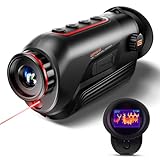
The G210 is a 256×192 thermal monocular with a 10 mm focal lens, and that short lens is its whole personality. It suits the hunter who works tight cover — pine plantations, creek bottoms, thickets, hog wallows — where pigs appear at 30 to 80 yards with no warning. It also suits the bowhunter or the hunter who stalks in on foot and needs to move quietly through brush with a device that shows everything within a stone’s throw. It is a detection tool first and an identification tool second.
Key specs
- Sensor: 256×192 thermal core
- Lens: 10 mm focal length — the widest field of view in this roundup
- Field of view: approximately 17–18° horizontal at a 12 μm pitch
- Format: handheld thermal monocular camera
- Pixel density: roughly 12 cm per pixel at 100 yards
Do the arithmetic on the 10 mm lens and the trade-off is stark and honest. The horizontal field of view works out to about 17.6° — more than twice the Storm S2’s window — which at 50 yards is roughly 15 yards of scene width. You see everything. What you give up is pixel density: at a 12 μm pitch, one pixel covers about 12 cm at 100 yards, so a 1-meter hog fills only about eight pixels at that distance. That is detection with a clear heat blob and a body shape, and it degrades to about four pixels at 200 yards, which is a warm dot. The practical identification ceiling for the G210 is roughly 60–65 yards. Inside that distance, in thick cover, it is genuinely excellent.
The use case where this device shines is the stalk. A hunter moving through heavy cover with a wide-field monocular can sweep a 15-yard window with a single glance and keep moving, checking each likely bedding area without stopping to pan. The same wide field is useful from a truck window at night when you are covering ground and want to see both sides of a fence line at once. It is also a strong choice for locating pig sign activity at a wallow or a feeder at close range, where a narrow scope would show you a patch of mud and nothing else.
Pros
- Widest field of view in this comparison — ideal for thick cover
- Fast target acquisition at close range with minimal panning
- 256×192 sensor keeps it in the mid-range price tier rather than premium
- Excellent for stalking and for scanning from a vehicle
- Compact handheld format
Cons
- Short 10 mm lens means a short identification distance, roughly 60 yards
- Not weapon-mountable
- Poor choice for open-country hunting or long field edges
- A 10 mm lens on a 256×192 core is a lot of money for a close-range-only tool
Against the ATN BlazeSeeker 6, the other 10 mm unit in this roundup, the G210 is the simpler proposition: both are wide-field devices, but the BlazeSeeker adds a low ≤20 mK NETD rating and a 1.7–13.6× magnification range, which gives it an edge in low-contrast conditions and more flexibility in the frame. The G210’s advantage is straightforwardness and a lower price point within the same tier. Against the GOYOJO G215 with its 15 mm lens, the G210 trades identification distance for field of view — a fair trade only if your hunting is genuinely close-range. If you hunt a mix of timber and field edges, the G215 is the more versatile GOYOJO of the two.
5. CVLIFE 256×192 Thermal Monocular – Best Budget All-Round Handheld

The CVLIFE 256×192 monocular is the most balanced budget scanner in this list. It combines a 256×192 thermal core, a 15 mm lens, a 1024×768 display, and a 50 Hz frame rate — a specification set that, on paper, looks like a mid-range device at a budget price. It suits the hunter buying their first thermal who wants something they can actually use across multiple situations: scanning field edges, checking feeders, spotting hogs in a pasture, and recovering downed game.
Key specs
- Sensor: 256×192 thermal core
- Lens: 15 mm focal length
- Display: 1024×768 — high enough that the sensor, not the screen, is the limiting factor
- Frame rate: 50 Hz
- Field of view: approximately 11–12° horizontal at a 12 μm pitch
- Format: handheld thermal imaging monocular
The 15 mm lens is the middle path, and the numbers explain why it is a good default. With a 12 μm pitch, the IFOV is about 0.8 milliradians — one pixel per 8 cm at 100 yards. A 1-meter hog fills roughly 11–12 pixels at 100 yards, six at 200, and four at 300. That places detection comfortably beyond 300 yards in ideal conditions, recognition around 190 yards, and identification inside roughly 90–95 yards. That is a meaningfully better identification window than the 10 mm and 13 mm units in this roundup, and it is achieved without the tunnel vision of a 25 mm lens. The field of view of about 11–12° horizontal gives roughly 20 yards of scene width at 100 yards — wide enough to sweep, tight enough to see detail.
The 1024×768 display deserves a mention because it is a spec that budget buyers overlook. A display with more pixels than the sensor has means the image engine can map sensor pixels to screen pixels cleanly, without the chunky, blocky look that comes from upscaling a small core onto a low-resolution screen. Combined with the 50 Hz frame rate, that produces a smooth, readable image that does not tire your eye during a long night of scanning. This is the sort of combination that makes a budget device feel considerably more expensive than it is.
Pros
- 15 mm lens gives the best balance of field of view and identification distance in the budget tier
- 1024×768 display keeps the image clean rather than blocky
- 50 Hz frame rate for smooth panning
- Budget price tier with mid-range specifications
- Versatile enough for scanning, spotting, and recovery work
Cons
- Handheld only — not a weapon-mountable scope
- 256×192 core limits fine detail in poor thermal contrast
- No rangefinder, recording, or ballistic features
- Build quality and warranty support will not match premium brands
Against the TOPDON TS004, the CVLIFE wins on lens length and display resolution and gives up nothing important except a slightly larger body. The TS004’s 13 mm lens puts about 9 cm per pixel at 100 yards versus the CVLIFE’s 8 cm — a real but modest difference that the CVLIFE’s display closes entirely in perceived clarity. Against the GOYOJO G215, which also uses a 15 mm lens and 50 Hz refresh, the two are close enough that the deciding factors are ergonomics, menu design, and which one you find at a better price on a given day. The CVLIFE’s 1024×768 display is the tiebreaker for most buyers.
6. ATN BlazeSeeker 6 – Best for Low-Contrast Nights and Wide-Field Detection

The BlazeSeeker 6 is a 10 mm thermal monocular with a 256×192 sensor, a 12 μm pixel pitch, a ≤20 mK NETD rating, and a 1.7–13.6× magnification range. That NETD figure is the headline, and it is the reason this device earns a place in a hog-hunting roundup. It suits the hunter who hunts in humid, heavy-air conditions — river bottoms, coastal plains, the Southeast’s thick night air — where thermal contrast collapses and cheap cores turn into mush. It also suits the hunter who wants a wide detection field and is willing to accept a short identification range to get it.
Key specs
- Sensor: 256×192 thermal core
- Pixel pitch: 12 μm
- NETD: ≤20 mK — excellent thermal sensitivity for this class
- Lens: 10 mm focal length
- Magnification: 1.7–13.6× (optical base plus digital zoom)
- Field of view: approximately 17–18° horizontal
NETD stands for noise equivalent temperature difference, and it measures the smallest temperature difference a sensor can resolve. Lower is better. A ≤20 mK rating is genuinely good — many budget and even some mid-range cores sit in the 40–50 mK range. What that means in the field is that on a muggy August night, when the air is thick with water vapor and the temperature difference between a hog and the ground behind it has shrunk to a degree or two, a 20 mK sensor still renders an edge where a 50 mK sensor renders a blur. For hog hunters in the South and Midwest, where summer night hunting is common and humidity is high, this is the single most underrated spec on any thermal device.
The magnification range of 1.7–13.6× needs a caveat. The base optical magnification is set by the lens and display, and everything above it is digital zoom — which enlarges pixels rather than revealing new detail. Using digital zoom to “identify” a hog at 250 yards does not work; you get a bigger blur. Where digital zoom is legitimately useful is framing and confirming an animal you have already detected, and in that role the BlazeSeeker’s range is generous. The 10 mm lens keeps the device firmly in the wide-field, close-to-mid-range category: roughly 12 cm per pixel at 100 yards means about eight pixels on a standing hog at that distance, and an identification ceiling in the 60–70 yard range.
Pros
- ≤20 mK NETD is the best thermal sensitivity rating in the mid-range tier here
- Wide 10 mm field of view is excellent for detection in thick cover
- Generous 1.7–13.6× magnification range for framing
- 12 μm pixel pitch is a modern, small-pitch design
- Strong performance on humid nights where contrast is poor
Cons
- 10 mm lens limits identification to close range
- Digital zoom above base magnification adds no real detail
- Monocular only — not weapon-mountable
- Mid-range pricing for a short-lens device
Against the GOYOJO G210, the other 10 mm monocular here, the BlazeSeeker 6 wins clearly on thermal sensitivity — ≤20 mK versus an unspecified but conventional core — and offers a wider magnification range. The G210 counters with a simpler interface and typically a lower price within the tier. If you hunt in high humidity, the NETD advantage is worth real money and the BlazeSeeker is the better buy. Against the CVLIFE with its 15 mm lens, the BlazeSeeker trades identification distance for field of view and low-contrast performance. Hunters who scan wide and then move in on foot will prefer the ATN; hunters who shoot from a fixed position at 100 yards will prefer the CVLIFE.
7. GOYOJO G215 – Best Budget 15 mm Scanner
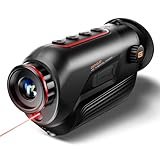
The G215 is a 256×192 thermal imaging monocular with a 15 mm focal lens and a 50 Hz frame rate, and it sits in the budget tier. It suits the hunter who wants the versatility of a mid-length lens without paying mid-range prices: enough field of view to scan, enough pixel density to make a judgment at 80–100 yards, and a frame rate fast enough to pan smoothly. It is the practical all-rounder of the GOYOJO line and arguably the best value in this entire comparison for a first-time thermal buyer.
Key specs
- Sensor: 256×192 thermal core
- Lens: 15 mm focal length
- Frame rate: 50 Hz
- Field of view: approximately 11–12° horizontal at a 12 μm pitch
- Pixel density: roughly 8 cm per pixel at 100 yards
- Format: handheld infrared night vision telescope/monocular
The 15 mm lens gives the G215 the same useful middle-ground performance as the CVLIFE: about 11–12 pixels on a standing hog at 100 yards, six at 200 yards, and an identification ceiling in the low 90s in yards. In practical terms, you can tell a boar from a sow, a hog from a calf, and a hog from a deer inside 90 yards, which covers the overwhelming majority of night shots taken by hunters who are not shooting from a bench rest. Beyond that distance you are detecting and tracking, not identifying, which is the correct expectation for any 256×192 device at this price.
What separates the G215 from the G210 in the same family is entirely the lens. The G210’s 10 mm lens gives about 17.6° of field — roughly 15 yards of scene at 50 yards — and roughly 12 cm per pixel at 100 yards. The G215’s 15 mm lens gives about 11.7° of field and about 8 cm per pixel at 100 yards. In other words, the G215 sees about a third less width and resolves about a third more detail. For hunters who work timber and creek bottoms where hogs appear at 30–50 yards, the G210’s width is the better tool. For hunters who glass field edges and feeders at 80–150 yards, the G215’s detail is the better tool. If you only buy one and you hunt mixed terrain, the G215 is the safer pick.
Pros
- 15 mm lens delivers a genuinely useful identification distance for the price
- 50 Hz frame rate keeps panning smooth
- Budget price tier with a versatile specification
- 256×192 core is well matched to the lens — no wasted resolution
- Good balance of field of view and detail for mixed terrain
Cons
- Handheld only, no rifle mounting
- No rangefinder, no recording, no ballistic features
- Budget-tier build and warranty support
- Marginal for shots beyond 150 yards
Against the CVLIFE 256×192 with 15 mm lens, the G215 is nearly a specification twin: same sensor class, same lens, same frame rate. The CVLIFE’s 1024×768 display is the differentiator on paper, giving it a cleaner image, and its slightly higher price tier reflects that. The G215 wins on price. Against the GOYOJO G210, the choice is the field-of-view-versus-detail trade described above. Buyers who already own a rifle-mounted scope and want a wide scanner should look at the G210; buyers who want one device that does everything reasonably well should take the G215.
8. Pulsar Axion XQ19 – Best Premium Handheld Scanner

The Axion XQ19 is a 384×288 thermal monocular with a 19 mm lens in a compact, pocketable body, and it is the premium scanner in this roundup. Pulsar is one of the most established names in consumer thermal, with a deep catalog and a long track record in the hunting market. The XQ19 suits the serious hog hunter who already owns a thermal scope and wants a scanner that will not be the weak link — someone who hunts 20 or more nights a year and is tired of squinting at a low-contrast blob.
Key specs
- Sensor: 384×288 thermal core — 2.25× the pixel count of a 256×192 core
- Lens: 19 mm focal length
- Format: compact handheld thermal monocular
- Field of view: approximately 20° horizontal with a 17 μm pitch; narrower with a smaller pitch
- Build: compact, rugged, designed for handheld field use
The 384×288 sensor is the point. It does not extend identification range — that is set by the lens and pixel pitch — but it delivers a wider field of view at the same magnification and, more importantly, more pixels on the display for the image processor to work with. The practical result is a smoother, less noisy image with better edge definition, which matters enormously when you are trying to decide whether the warm shape at 150 yards is a hog or a calf. The 19 mm lens on a 17 μm pitch works out to roughly 0.89 milliradians per pixel, or about 8.9 cm at 100 yards — comparable to a 13 mm lens on a 12 μm core — while the larger sensor keeps the field of view near 20°. That combination of

0 Comments