Key takeaways
- Portable solar panels look alike in photos, yet they solve three different problems: topping up a phone on a trail.
What's inside
As an Amazon Associate I earn from qualifying purchases. This post may contain affiliate links at no extra cost to you.
Portable solar panels look alike in photos, yet they solve three different problems: topping up a phone on a trail, feeding a portable power station at a campsite, or charging a 12-volt battery in a van. The wattage on the box is only part of the story. Connector type, voltage, weight and weather rating decide whether a panel actually works with the gear you own.
This guide is for campers, overlanders and home-backup shoppers comparing ten foldable panels from 28 watts up to 450 watts. Details come only from the listing titles, which is why the commentary stays on watts, weight, ratings and connectors. As you plan for the 2026 camping and storm seasons, match the panel to your battery or power station input first, then pick the size.
Quick Picks
As an Amazon Associate we earn from qualifying purchases at no extra cost to you.



| Product | Best for | Key spec from the title |
|---|---|---|
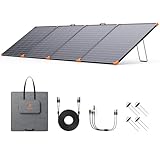
| FlexSolar 100W | Phones plus a power station | PD3.0 USB-C, QC3.0 USB-A, DC, IP67 |
| HQST 100W N-Type | Light carry | 25% efficiency, 5.91 lb, IP67 |
| BougeRV 100W N-Type | Rugged fiberglass build | 25% efficiency, fiberglass layer |
| 100W ETFE Panel | Angle-guided setup | 24% efficiency, ETFE, IP65 |
| SOKIOVOLA 200W | Mid-size power stations | 16BB N-type, 25%, IP68 |
| CTOLITY 400W | Fast station charging | 400W, 23.4%, 40V MC4/XT connectors |
| BigBlue 28W | Backpacking and phones | Dual USB-C and USB-A |
| ZOUPW 450W | Big power stations | 450W, N-type 16BB, IP68 |
| HQST 200W N-Type | Portable 200W class | 25% efficiency, 11.82 lb, IP67 |
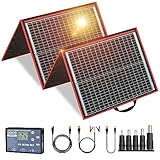
| DOKIO 150W Kit | 12V battery charging | Charge controller, 7.3 lb |
How to Choose
Start with what you are charging
Phones and small gadgets need only 20 to 30 watts. A portable power station usually takes 100 to 400 watts, but check its maximum solar input in watts and volts, because feeding it too much simply wastes the extra. A 12-volt battery needs a charge controller, either built in or added separately. Match connectors first: MC4, XT60, DC barrel or USB.
Read efficiency and weight honestly
Efficiency figures such as 23 to 25 percent describe the cell, not the finished panel in real sun. N-type cells tend to handle heat and low light a bit better than older cell types. Weight matters if you hike with the panel. Around 6 pounds for 100 watts and around 12 pounds for 200 watts is a reasonable yardstick for foldable designs, and anything far heavier deserves a second look at what you get for the extra weight.
Check the weatherproof rating
IP65 handles rain splash, IP67 survives brief submersion and IP68 is rated for longer immersion. These ratings apply to the panel face and junction box, not always to cables and connectors. ETFE and fiberglass surfaces resist scratches better than basic laminate, and kickstands should lock firmly so wind does not flip the panel.
Plan for angle and shade
A panel is rated at full sun at a perfect angle, which camp life rarely delivers. Adjustable kickstands let you tilt toward the sun, and even a partial shadow can cut output sharply. Budget panels often cut corners on cable length, so look for several feet of lead and a plan to keep your power station in the shade.
The 10 Best Options
FlexSolar 100W Foldable Solar Panel
The FlexSolar combines a 100W foldable panel with PD3.0 USB-C, QC3.0 USB-A and DC ports and an IP67 waterproof rating. It suits campers who want to charge phones directly and also feed a power station during emergencies.
- Strength: PD3.0 USB-C and QC3.0 USB-A allow direct device charging.
- Strength: IP67 protection suits damp conditions.
- Trade-off: 100 watts is slow for a large power station.
Skip it if you plan to run a big station daily. A larger panel will refill faster, and USB output ports add little for that job. It makes more sense as a backup that also keeps a phone alive during an outage.
HQST 100W Portable Solar Panel, N-Type
The HQST 100W lists N-type cells at 25 percent efficiency, an IP67 rating, a weight of just 5.91 pounds, a 3-in-1 adapter cable and adjustable kickstands. It fits weight-conscious campers feeding a small station.
- Strength: 5.91 pounds is light for a 100W foldable.
- Strength: a 3-in-1 cable helps match different station inputs.
- Trade-off: it is not a direct USB device charger.
Skip it if you need USB ports on the panel. Check your station input before relying on the included adapter. A panel this light is also easy to carry from the car to a sunny clearing.
BougeRV 100W N-Type Portable Solar Panel
BougeRV pairs a 100W N-type panel at 25 percent efficiency with a fiberglass layer and a foldable charging design. It is aimed at overlanders and RV owners who want a sturdier panel face for roads and trailheads.
- Strength: a fiberglass layer adds rigidity and durability.
- Strength: high listed efficiency suits limited folded area.
- Trade-off: the title gives no weight or connector details.
Skip it if you need verified weight or output ports. Confirm the plug type matches your power station before buying.
100W Portable Solar Panel With ETFE and Angle Guide
This unbranded 100W panel lists 24 percent efficiency, an ETFE surface, a solar angle guide, IP65 protection and a foldable design for power stations, RVs and emergencies. It fits first-time buyers who want help aiming the panel.
- Strength: an angle guide helps novices find the best tilt.
- Strength: ETFE resists scratches and fading.
- Trade-off: IP65 is a lower rating than IP67 or IP68 models.
Skip it if you camp in heavy rain or want a waterproof panel you can rinse. A higher IP model suits wet climates better.
SOKIOVOLA 200W N-Type 16BB Solar Panel
The SOKIOVOLA is a 200W foldable panel with N-type 16BB cells, 25 percent efficiency and an IP68 rating, built for stations from EcoFlow, Jackery, Bluetti and Anker. It targets owners of mid-size stations.
- Strength: 200W doubles the harvest of a 100W panel.
- Strength: IP68 is the highest weather rating in this group.
- Trade-off: the title does not list weight or connector adapters.
Skip it if you need a pocket-size panel. Compatibility claims also need checking against your station’s input limits.
CTOLITY 400W Portable Solar Panel
CTOLITY offers 400W, 23.4 percent efficiency, IP65 protection, an adjustable kickstand and 40V MC4 and XT connectors. It targets owners of larger stations who want a big input without buying several smaller panels.
- Strength: 400W can fill a big station in a day of good sun.
- Strength: MC4 and XT connectors cover common inputs.
- Trade-off: a 400W foldable is bulky and heavy to move.
Skip it if your station caps solar input below the panel’s voltage. Check the maximum volts before connecting. Plan on setting it on level ground with the kickstand locked, since a panel this large acts like a sail in gusts.
BigBlue 28W Solar Phone Charger
The BigBlue is a 28W folding panel with dual USB-C and USB-A outputs, made for camping and backpacking with phones and small devices. It is the only listing here that is truly pack-friendly.
- Strength: dual USB outputs let you charge two devices.
- Strength: a 28W size is easy to strap to a pack.
- Trade-off: it cannot meaningfully charge a power station.
Skip it if you want to run a fridge or laptop. This is a gadget charger, not a station feeder. Hikers can clip it to a pack and charge a phone while walking in open sun.
ZOUPW 450W N-Type 16BB Solar Panel
ZOUPW lists 450W, N-type 16BB cells, 25 percent efficiency, IP68 and compatibility with EcoFlow Delta, Anker C1000, Jackery and Bluetti stations. It aims at home-backup and RV owners with big batteries.
- Strength: the highest wattage here shortens charge times.
- Strength: IP68 suits long outdoor exposure.
- Trade-off: it is a large panel that needs space and a sturdy stand.
Skip it if you hike or camp light. Exceeding a station’s solar input limit will not speed things up. Choose it only when your station lists a solar input high enough to use all 450 watts.
HQST 200W N-Type Portable Solar Panel
The HQST 200W lists 25 percent efficiency, IP67 protection, a weight of 11.82 pounds, a 3-in-1 adapter cable and adjustable kickstands. It is a good fit for mid-size stations with a focus on portability.
- Strength: 11.82 pounds is reasonable for a 200W foldable.
- Strength: kickstands and a 3-in-1 cable ease setup.
- Trade-off: it lacks built-in USB outputs.
Skip it if you only charge phones. A smaller panel will be easier to carry and store. The weight is worth carrying only if you need the faster refill.
DOKIO 150W Foldable Solar Panel Kit
The DOKIO is a 150W kit with a charge controller, folding to 21 x 20 inches and weighing 7.3 pounds, with USB ports for 12V batteries and stations. It suits van and boat owners charging a battery directly.
- Strength: the included charge controller protects a 12V battery.
- Strength: the folded size and 7.3 pounds are manageable.
- Trade-off: the title lacks efficiency and weather rating details.
Skip it if you want a plug-and-play panel for a power station. A kit with a controller is meant for batteries. Check the polarity and fuse your wiring before connecting to a vehicle battery.
Which One Fits Your Situation
Backpacking with phones and a headlamp
The BigBlue 28W is the only listing sized for a pack, and its dual USB ports charge devices directly.
Weekend camping with a small power station
Two days of fridge-free camping rarely need more than a small station. The HQST 100W or the FlexSolar 100W offers a light, simple input, with the FlexSolar adding USB outputs.
RV and home backup with a large station
The ZOUPW 450W or the CTOLITY 400W will refill a big battery faster, as long as your station accepts the voltage.
Van or boat with a 12V battery
The DOKIO 150W kit includes the charge controller you need for direct battery charging.
Common Mistakes
- Buying more watts than the power station can accept.
- Ignoring connector type until the panel arrives and does not fit.
- Laying the panel flat in shade and expecting rated output.
- Skipping a charge controller for a 12-volt battery.
- Assuming IP ratings cover the cables and plugs as well as the panel.
Related guides
- How To Strip Old Varnish From Furniture Without Sanding
- Random Orbital Sanders For Furniture Refinishing
- How Long To Wait Between Coats Of Polycrylic
Frequently Asked Questions
How many watts do I need?
Phones need under 30 watts, small stations do well with 100 to 200 watts and large stations benefit from 400 watts or more. Always check the input limit, and remember that real output in the field is usually well below the rated number because of angle, haze and heat.
What does N-type mean?
N-type cells are a newer cell design that generally handle heat and low light better. The listing efficiency figures reflect the cell design.
Do I need a charge controller?
Power stations include one. A bare 12V battery needs a controller, either built into the panel or sold with a kit like the DOKIO.
Can I leave a panel out in the rain?
IP65 handles rain splash and IP67 or IP68 offer more protection, but bring the panel inside during storms and protect connectors from standing water. Dry the panel before folding it so moisture does not sit in the case.

0 Comments