What's inside
As an Amazon Associate I earn from qualifying purchases. This post may contain affiliate links at no extra cost to you.
Best High-Velocity Floor Fans: Top Picks by Workshop, Garage, and Room
The best high velocity floor fan for most workshops is a 20-inch, three-speed metal fan with roughly 3,000–4,000 CFM, while a 24-inch industrial fan makes more sense when you need maximum air movement in a large garage or open work area.
High-velocity fans are not designed to cool a room as quietly as a household pedestal fan. Their strengths are moving air across a long distance, drying finishes and floors, ventilating garages, and making hot workshop sessions more tolerable. The right choice depends on more than the largest CFM number: speed control, noise, stability, cleaning access, cord length, and how much floor space the fan consumes matter just as much.
As an Amazon Associate we earn from qualifying purchases at no extra cost to you.

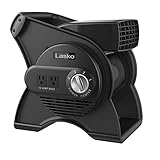

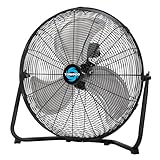
Best high-velocity floor fans at a glance
| Fan | Diameter | Airflow | Speed settings | Approx. weight | Best suited to |
|---|---|---|---|---|---|
| Lasko 2264QM | 20 in. | Up to 3,460 CFM | 3 | About 20 lb | General workshop and garage use |
| Air King 9220 | 20 in. | Up to 3,670 CFM | 3 | About 20 lb | Durable everyday circulation |
| MaxxAir BF24TF | 24 in. | Up to 5,600 CFM | 3 | About 38 lb | Large garages and high-volume airflow |
| Stanley 655704 | 20 in. | Up to approximately 4,650 CFM | 3 | About 18–20 lb | High airflow on a moderate footprint |
Published specifications can vary slightly by production version and measurement method, particularly CFM ratings. Treat the table as a practical comparison rather than a guarantee that every retailer or revision will list identical figures.
Our picks by situation
Best all-around workshop fan: Lasko 2264QM
The Lasko 2264QM is a sensible fit for a woodworking shop, basement work area, or single-car garage. Its 20-inch blade provides substantial airflow without the size and weight penalty of a 24-inch industrial fan. Three speeds let you reduce the blast when handling lightweight sanding dust collection hoses, paper plans, or freshly applied finishes.
Its metal construction, pivoting housing, carry handle, and relatively compact footprint make it practical to reposition during a project. The main compromise is noise: at maximum speed, this is a work-area fan rather than a quiet conversation fan. Use the low setting when you need circulation without the strongest draft.
Best for durability-focused buyers: Air King 9220
The Air King 9220 is built around a sturdy metal frame and a straightforward three-speed control. It is a good choice for frequent use where simple mechanical controls are preferable to a remote or electronic interface. The fan’s approximately 3,670-CFM rating places it in the same useful class as other strong 20-inch shop fans.
This model suits a permanent position near a garage door or shop wall. It is less appealing if you regularly carry equipment up stairs or need to store the fan in a narrow cupboard, because metal construction and a robust guard add weight. As with most open-blade high-velocity fans, keep it away from loose rags, long extension cords, and areas where fine debris can be pulled directly into the motor.
Best for a large garage: MaxxAir BF24TF
The MaxxAir BF24TF is the high-airflow choice in this group. Its 24-inch blade and quoted airflow of up to 5,600 CFM can move air across a larger garage, warehouse bay, or open workshop more effectively than a typical 20-inch fan.
The increased capacity comes with real ownership costs: it occupies more floor area, weighs roughly 38 pounds, and produces a more forceful stream of air. It may be excessive in a small shop, where the blast can scatter lightweight sawdust, cooling rags, or project paperwork. Choose it when the fan will usually stay in one location and maximum circulation matters more than easy portability.
Best high-airflow 20-inch option: Stanley 655704
The Stanley 655704 is worth considering when you want stronger advertised airflow without moving to a 24-inch housing. Its three-speed motor and metal construction fit garage and workshop use, while the 20-inch format remains easier to store than a larger industrial fan.
Check the exact model label before buying because Stanley has sold several similarly named fans with different specifications. Confirm the CFM rating, cord length, guard design, and whether the version available in your region has the control layout you expect.
How the important differences affect your choice
Airflow and speed
CFM describes the volume of air moved, but it does not tell you how concentrated the air stream feels. A smaller fan with a narrow guard and higher outlet velocity can feel more forceful at a nearby bench, while a larger fan can move more total air through a garage.
Three speeds are usually enough. High is useful for clearing heat from a work area or accelerating general drying. Medium is the practical setting for people working nearby. Low reduces noise and the risk of blowing loose materials across a bench. A fan with only one speed is harder to live with because its maximum output may be unnecessarily aggressive.
Noise
High-velocity fans are commonly louder than household circulation fans because they use powerful motors and fast-moving blades. Manufacturers do not always publish comparable decibel measurements, so do not treat a CFM rating as a noise rating. In a workshop, hearing protection may still be necessary because other tools often dominate the sound level. For a home office, bedroom, or conversation area, a high-velocity floor fan may be the wrong category regardless of its airflow.
Portability and footprint
A 20-inch fan generally offers the best compromise between output and storage. A 24-inch fan can deliver considerably more air but may block a walkway or interfere with a dust collector hose. Measure the complete stand or frame, not only the blade diameter. Also allow space behind the fan for intake airflow; pushing it against a wall can reduce circulation and pull more dust into the motor.
Safety features
- Choose a tightly spaced metal guard that prevents fingers and loose materials from contacting the blades.
- Look for a stable base that does not rock when the fan is switched to high.
- Use a grounded outlet and inspect the cord before every season of heavy use.
- Keep the fan away from rain, standing water, solvent vapors, and freshly sprayed combustible finishes.
- Do not use the guard as a handle unless the manufacturer specifically designed it for carrying.
- Place the fan where its exhaust cannot blow sawdust toward an open motor, heater, or ignition source.
A practical decision matrix
| Your situation | Recommended format | Why |
|---|---|---|
| Small shop with limited storage | 18–20 in., 3 speeds | Useful airflow with a manageable footprint |
| Single-car garage used several times weekly | 20 in., metal housing, 3 speeds | Balances durability, reach, and portability |
| Large garage or open work bay | 24 in., 4,500–5,600 CFM | Moves more air across distance |
| Frequent repositioning or stairs | 20 in., approximately 18–22 lb | Less tiring to carry and easier to store |
| Quiet indoor use | Low-speed circulation fan instead | High-velocity models prioritize output over silence |
Setup and maintenance that extend fan life
- Position the intake in open air. Leave several inches behind the housing and avoid placing it directly in a corner.
- Angle the fan toward an exit or high opening. In a garage, exhausting hot air toward an open door or window is often more effective than simply blowing air around.
- Inspect the guard and base. Tighten loose fasteners before vibration turns a minor rattle into a cracked bracket.
- Clean before the motor overheats. Unplug the fan, then remove accumulated dust from the guard and blades with a vacuum and soft brush. Do not spray water into the motor.
- Check for imbalance. A new vibration can indicate blade damage, a loose fastener, or debris stuck to one side of the blade. Stop using the fan until the cause is found.
- Store it covered but dry. A breathable cover helps reduce dust buildup; sealing a damp fan in plastic encourages corrosion.
In woodworking shops, the guard and blade usually need cleaning before the motor itself fails. Fine dust restricts intake airflow, adds imbalance, and can work into bearings and switches. A fan used near sanding operations deserves more frequent cleaning than one used only for summer garage ventilation.
Final verdict
Choose the Lasko 2264QM or Air King 9220 for a dependable 20-inch workshop fan with a useful balance of airflow and portability. Select the MaxxAir BF24TF when a large garage demands maximum air movement and the fan can stay mostly in one place. Consider the Stanley 655704 if its exact regional specification confirms the higher airflow you want in a 20-inch format. Whichever model you choose, prioritize a stable base, three usable speeds, accessible cleaning surfaces, and a footprint that will not create a trip hazard around your tools.
0 Comments