What's inside
As an Amazon Associate I earn from qualifying purchases. This post may contain affiliate links at no extra cost to you.
Best Graphics Cards for Crypto Mining in 2026
The best graphics cards and GPUs for crypto mining in 2026 are usually efficient mid-range models such as the AMD Radeon RX 6600, Radeon RX 6700 XT, NVIDIA GeForce RTX 4060 Ti, and GeForce RTX 4070 Super, but the right choice depends more on electricity cost, the coin’s algorithm, network difficulty, and the card’s purchase price than on raw hash rate alone.
GPU mining is no longer a simple search for the fastest graphics card. Ethereum mining ended when Ethereum moved to proof-of-stake, and many alternative coins have changing rewards, algorithms, and network conditions. A card that looks profitable today can become unprofitable after a difficulty increase or a fall in coin price. For that reason, compare efficiency in watts per unit of hash rate, not just advertised performance.
As an Amazon Associate we earn from qualifying purchases at no extra cost to you.


Quick picks by mining situation
| Situation | Best-fit GPU | Why it makes sense | Main compromise |
|---|---|---|---|
| Lowest sensible entry cost | Radeon RX 6600 | Low power draw, 8GB memory, and generally modest used-market pricing | Lower memory bandwidth and performance than larger cards |
| Balanced new build | GeForce RTX 4060 Ti 16GB | Efficient, compact versions are common, and 16GB helps with memory-heavy algorithms | Upfront cost can be high relative to its mining output |
| Strong efficiency with more headroom | GeForce RTX 4070 Super | Good performance per watt and 12GB of fast GDDR6X memory | Higher purchase price and power supply requirements |
| AMD-focused rig | Radeon RX 6700 XT | 12GB memory and strong value when purchased at a favorable price | Efficiency varies considerably by algorithm and tuning |
| Large-memory requirement | Radeon RX 6800 | 16GB VRAM provides useful capacity for demanding memory-based workloads | Older architecture and more power than the RX 6600 |
GPU comparison: efficiency, memory, and cost
The figures below are typical board specifications rather than guaranteed mining settings. Actual draw can change substantially after undervolting, and different models of the same GPU may use different coolers and BIOS limits. General street prices are broad 2026 market ranges and can vary by country, condition, and availability.
| GPU | VRAM | Rated board power | Typical tuned mining draw | Physical size tendency | General price range |
|---|---|---|---|---|---|
| Radeon RX 6600 | 8GB GDDR6 | 132W | 55–80W | 2-slot, about 200–250mm | $150–$240 used or clearance |
| GeForce RTX 4060 Ti 16GB | 16GB GDDR6 | 160W | 90–130W | 2-slot, about 240–310mm | $380–$550 |
| GeForce RTX 4070 Super | 12GB GDDR6X | 220W | 130–180W | 2–3-slot, about 240–305mm | $550–$750 |
| Radeon RX 6700 XT | 12GB GDDR6 | 230W | 100–160W | 2–2.5-slot, about 240–300mm | $220–$350 used |
| Radeon RX 6800 | 16GB GDDR6 | 250W | 130–190W | 2.5–3-slot, about 267–340mm | $300–$450 used |
| GeForce RTX 3060 12GB | 12GB GDDR6 | 170W | 90–130W | 2-slot, about 235–300mm | $170–$280 used |
How the leading choices compare
Radeon RX 6600: best for a low-power starter rig
The RX 6600 is attractive when electricity is expensive or the rig must run in a small room. Its 8GB of VRAM is enough for many current workloads, while its efficient GPU core can often be tuned well below its 132W board rating. It is also easier to cool than large triple-fan cards.
The limitation is memory bandwidth and long-term algorithm flexibility. An 8GB card may have less usable life for memory-heavy networks than a 12GB or 16GB model. Buy this card when the low purchase price and low operating cost matter more than maximum output.
GeForce RTX 4060 Ti 16GB: the practical Nvidia option
The 16GB RTX 4060 Ti is a sensible choice when software support, compact dimensions, and memory capacity are priorities. Nvidia’s ecosystem supports a wide range of mining software, although support and efficiency remain algorithm-specific. The card’s modest power draw also makes multi-GPU builds easier on the power supply and ventilation system.
Its weakness is value. A 16GB model can cost substantially more than an RX 6600 or used RTX 3060, so the extra memory must solve a real requirement rather than simply look better on a specification sheet.
GeForce RTX 4070 Super: best premium efficiency candidate
The RTX 4070 Super offers a useful balance of performance, efficiency, and manageable physical size. It can be a strong choice when electricity costs are significant and you want fewer cards in the rig. Fewer GPUs also means fewer risers, power connectors, fans, and potential failure points.
It is not automatically the fastest route to payback. Its higher upfront price means the calculation must include depreciation and resale value. A cheaper card with slightly lower output may recover its cost sooner, particularly if electricity is inexpensive.
Radeon RX 6700 XT and RX 6800: value and memory choices
The RX 6700 XT is worth considering on the used market because 12GB of VRAM offers more flexibility than entry-level 8GB cards. The RX 6800 adds 16GB and can suit algorithms that need more memory, but its larger cooler and higher power budget make airflow more important.
For either card, inspect the exact board design. Some models use robust heatsinks and quiet fans; others run hot or have compact coolers that are poorly suited to continuous load. A low purchase price is not a bargain if the card requires immediate fan replacement or thermal-pad work.
Calculate operating cost before buying
Use the wall draw of the complete rig, not only the GPU’s advertised board power. The basic electricity calculation is:
Daily electricity cost = watts at the wall ÷ 1,000 × 24 × electricity rate.
For example, a rig with three tuned RX 6600 cards drawing 70W each, plus 100W for the motherboard, CPU, storage, risers, and power-supply losses, may draw roughly 310W from the wall. At $0.15 per kilowatt-hour:
0.310 × 24 × $0.15 = approximately $1.12 per day.
That is about $34 per 30-day month before pool fees, repairs, taxes, and the value of the mined coin. If the rig earns $1.30 per day before electricity, the margin is only around $0.18 per day. A small change in network reward or coin price can eliminate it.
What to check before purchasing a used GPU
- Fan condition: Listen for bearing noise, grinding, or a fan that hesitates at startup. Fans and fan hubs often wear before the GPU core.
- Memory temperatures: A card can show an acceptable core temperature while its memory runs much hotter. Confirm that monitoring software reports memory junction temperature where supported.
- Power connectors: Check for darkened plastic, loose terminals, or melted connectors. Use separate power cables from the power supply where recommended.
- Physical damage: Inspect the PCB, heatsink fins, mounting bracket, and screw heads for corrosion or signs of repeated disassembly.
- Stability: Run a sustained workload and watch for driver resets, rejected shares, visual artifacts, or gradually rising temperatures.
- Memory capacity: Confirm the exact model. An RTX 3060 12GB and a different-memory variant should not be treated as interchangeable.
Cooling, space, and maintenance realities
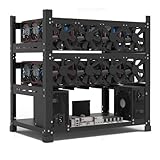
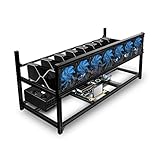
Mining loads are continuous, so case airflow matters more than short gaming benchmarks. Leave space between open-air cards, keep intake filters clean, and avoid placing a rig in a closed cabinet. A riser-based frame can improve airflow, but it also adds connectors and points of failure.
Dust removal should be performed with the system powered down and disconnected. Hold fan blades still while using compressed air, because allowing them to spin freely can damage the fan electronics. Do not assume a factory overclock is suitable for mining: lower the core voltage, reduce unnecessary core frequency, and increase memory speed gradually while checking rejected shares and temperatures.
Thermal paste, thermal pads, fans, risers, and power-supply cables are consumables or failure-prone parts in a long-running rig. Budget for them when comparing a new efficient GPU with several older used cards. A slightly lower hash rate with stable temperatures can be preferable to a faster configuration that needs constant attention.
Final buying guidance
Choose the RX 6600 when your priority is low entry cost and low power draw. Choose the RTX 4060 Ti 16GB when you want a compact Nvidia-based build with extra memory. Choose the RTX 4070 Super when higher upfront spending is acceptable and reducing watts per unit of output is important. Choose the RX 6700 XT or RX 6800 when a good used price and 12GB or 16GB of VRAM outweigh their older architecture.
Before placing an order, enter the exact GPU model, tuned wall power, electricity rate, pool fee, current coin reward, and network difficulty into a current profitability calculator. Treat the result as a snapshot rather than a promise. In 2026, the best graphics cards GPUs crypto mining buyers can choose are the ones that remain affordable, cool, repairable, and efficient under their own electricity and network conditions.
0 Comments