What's inside
- Quick comparison
- Best for the smallest footprint: a countertop horizontal rack
- Best use of vertical space: a narrow tower rack
- Best for a dining area: a ladder-style rack
- Best for changing collections: stackable cube racks
- Best for maximum storage: a compact wine cabinet
- Decision matrix: match the rack to your situation
- Fit and capacity calculations that prevent buying mistakes
- Durability, cleaning, and common mistakes
- Final recommendation
- Quick comparison
- Best for the smallest footprint: a countertop horizontal rack
- Best use of vertical space: a narrow tower rack
- Best for a dining area: a ladder-style rack
- Best for changing collections: stackable cube racks
- Best for maximum storage: a compact wine cabinet
- Decision matrix: match the rack to your situation
- Fit and capacity calculations that prevent buying mistakes
- Durability, cleaning, and common mistakes
- Final recommendation
As an Amazon Associate I earn from qualifying purchases. This post may contain affiliate links at no extra cost to you.
The best freestanding wine racks for small spaces are compact countertop racks for one to six bottles, narrow floor racks for eight to twelve, and modular cube racks when you need storage that can grow without consuming much width.
As an Amazon Associate we earn from qualifying purchases at no extra cost to you.
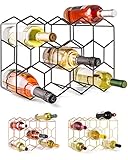


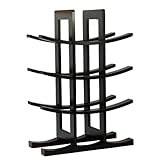
Quick comparison
| Rack type | Typical footprint | Bottle capacity | Typical materials | Assembly | Best for |
|---|---|---|---|---|---|
| Countertop horizontal rack | 12–18 in W × 6–10 in D | 4–6 bottles | Steel, wood, or bamboo | None to 15 minutes | Very small kitchens and renters |
| Vertical tower rack | 10–14 in W × 10–14 in D | 8–12 bottles | Powder-coated steel or solid wood | 15–30 minutes | Using height instead of floor area |
| Freestanding ladder rack | 16–24 in W × 10–14 in D | 8–12 bottles | Steel, wood, or mixed materials | 20–45 minutes | Dining rooms needing easy access |
| Stackable cube rack | 13–16 in W × 12–14 in D per cube | 4–6 bottles per cube | Wood, bamboo, or engineered board | Usually none | Expandable storage and uneven collections |
| Cabinet-style wine stand | 20–30 in W × 12–16 in D | 12–24 bottles | Wood or engineered wood | 30–90 minutes | Combined bottle and glass storage |
The dimensions above are useful planning ranges rather than universal specifications. Always check the assembled dimensions, not only the carton size, before ordering.
Best for the smallest footprint: a countertop horizontal rack
A countertop rack is the easiest choice when you have no spare floor space. Most hold four to six standard 750 ml bottles in two rows, with a depth of roughly 6 to 10 inches. A rack that is 15 inches wide and 8 inches deep occupies only 120 square inches, or about 0.83 square feet.
Look for bottle cradles that separate each bottle rather than a single open shelf. Individual supports prevent bottles from rolling when one is removed and reduce the chance of labels or glass rubbing together. Rubber feet are particularly valuable on polished stone, laminate, or stainless-steel counters.
The limitation is capacity. A six-bottle rack can fill quickly if you regularly buy wine by the case. It is also less suitable for oversized Champagne, sparkling-wine, or Burgundy-shaped bottles, which may be too wide for standard slots.
Choose this type if:
- You need storage for four to six bottles.
- Your available floor width is less than 12 inches.
- You want an option requiring no drilling or furniture assembly.
- You will rotate bottles frequently rather than store a large collection.
Best use of vertical space: a narrow tower rack
A vertical tower offers the strongest capacity-to-footprint ratio. A stable model approximately 12 inches wide and 12 inches deep can hold eight to twelve bottles while using less than 1 square foot of floor area. This makes it a good fit beside a refrigerator, at the end of a counter, or between a cabinet and a wall.
Stability matters more with a tall rack. Prefer a broad base, low center of gravity, and bottle slots that keep the bottles close to the frame. A tower that is 30 to 36 inches tall should either have adjustable feet or include a wall-anchoring point, especially in a home with children, pets, or uneven flooring.
Steel towers are often slimmer than wooden alternatives, but thin wire can flex under a full load. Check whether the frame is welded or held together with small screws. Welded joints generally have fewer parts to loosen, while screwed joints are easier to repair or disassemble.
Assembly and stability check
Expect 15 to 30 minutes of assembly for a basic tower. Before loading it, place it on the intended surface and press gently against the top from each side. If it rocks, adjust the feet or add a thin non-slip pad. Do not compensate for a severely uneven floor by stacking cardboard beneath one leg; a purpose-made leveling foot or rigid shim is safer.
Best for a dining area: a ladder-style rack
A ladder rack usually provides eight to twelve bottles across several horizontal rails. Its footprint is commonly wider than a tower—about 16 to 24 inches—but it can look less visually dense in a dining area. The open design also makes labels easy to read and bottles easy to remove.
Its main weakness is front-to-back stability. A ladder rack should have feet that extend beyond the rails and, ideally, a cross-brace near the back. Avoid placing it where chairs, bags, or vacuum cleaners can catch the frame. If the rack is taller than about 30 inches, an anti-tip strap is a sensible addition even when the manufacturer does not require one.
Choose a ladder design with a bottle stop or raised lip on every rail. Without one, a bottle can roll forward when the rack is nudged. Wood versions benefit from a sealed finish, while painted steel versions should be inspected for chips around screw holes, where moisture can begin corrosion.
Best for changing collections: stackable cube racks
Stackable cubes are the most flexible option for households that are unsure how much storage they need. One cube generally holds four to six bottles and measures about 13 to 16 inches wide, 12 to 14 inches deep, and 5 to 7 inches high. Two cubes can be placed side by side or stacked vertically, depending on the room.
They are particularly useful in a rental because they usually require no permanent installation. However, “stackable” does not always mean secure. Look for interlocking pins, grooves, or supplied clips. If cubes simply sit on one another, keep the stack low and avoid placing heavy objects on top.
Open cubes also make a practical temporary solution while you learn your storage habits. Start with one six-bottle unit. If you use it consistently, add another; if bottles remain untouched for months, you have not committed money or floor space to an oversized cabinet.
Best for maximum storage: a compact wine cabinet
A cabinet-style wine stand is the least space-efficient choice per bottle, but it is the best option when one piece of furniture must store bottles, glasses, corkscrews, and serving accessories. Compact versions are typically 20 to 30 inches wide, 12 to 16 inches deep, and 30 to 36 inches high, with room for 12 to 24 bottles.
Measure door swing and drawer clearance carefully. A cabinet can fit its stated width yet block a walkway when the door is open. Shelves should be removable or adjustable if you own bottles with different shapes. Avoid filling a lightweight cabinet with bottles before checking that the back panel is securely attached; the back panel often supplies much of the unit’s resistance to racking and wobbling.
Cabinets also require the most assembly, commonly 30 to 90 minutes. The extra time is worthwhile only if you need enclosed storage. For a small collection, a cabinet can make a kitchen feel more crowded than an open rack.
Decision matrix: match the rack to your situation
| Your situation | Recommended choice | Why |
|---|---|---|
| Less than 12 inches of available width | Countertop rack | Smallest footprint and minimal tip risk |
| Eight or more bottles but almost no floor area | Vertical tower | Uses height efficiently |
| Occasional wine drinker with four to six bottles | Countertop or single cube | Low cost and no unnecessary capacity |
| Growing collection | Stackable cubes | Add capacity in small increments |
| Need glassware and accessories stored together | Compact cabinet | Combines several functions in one footprint |
| Children, pets, or frequent traffic nearby | Low tower, cabinet, or anchored rack | Better resistance to accidental knocks |
Fit and capacity calculations that prevent buying mistakes
Measure the available space in three directions: width, depth, and height. Leave at least 1 inch of clearance at the sides and rear for cleaning and movement. For a rack listed as 12 inches wide, allow about 14 inches of practical space if the location has tight walls.
Also count bottle diameter rather than assuming every bottle is standard. A typical 750 ml Bordeaux bottle is around 3 inches in diameter, while some sparkling and Burgundy-style bottles approach 3.5 to 3.75 inches. Six nominal slots may therefore hold only four wide bottles if the dividers are fixed.
For example, if you drink two bottles per week and want a two-week buffer, you need storage for about four bottles. A six-bottle countertop rack provides a useful margin without taking space needed for long-term cellaring. If you buy wine monthly in quantities of 12, a 12-bottle tower or two six-bottle cubes is more practical.
Durability, cleaning, and common mistakes
- Inspect the first wear points: rubber feet dry out, screw joints loosen, and painted steel can chip at contact points. Replace worn feet rather than allowing the frame to slide.
- Keep the rack dry: wipe spills promptly, especially on unfinished wood or engineered board. Do not saturate joints while cleaning.
- Use a soft cloth: dust and grit can scratch glass bottles and finished surfaces. Mild dish soap diluted in water is usually sufficient for washable materials.
- Do not overload slots: a rack designed for 12 standard bottles may not safely hold 12 oversized bottles. Watch for bowing rails or a widening frame.
- Keep bottles horizontal when appropriate: for cork-sealed bottles intended for longer storage, horizontal positioning helps keep the cork from drying. Screw-cap bottles do not depend on this in the same way.
- Do not confuse storage with temperature control: a freestanding rack protects bottles from rolling and organizes them, but it does not provide the consistent temperature and humidity of a wine refrigerator or cellar.
Final recommendation
For the smallest kitchen, choose a four- to six-bottle countertop rack with rubber feet. For eight to twelve bottles in a narrow footprint, a well-braced vertical tower is the strongest all-around choice. Choose stackable cubes if your collection is still changing, and select a cabinet only when enclosed storage and accessory space justify its larger footprint and longer assembly.
0 Comments