What's inside
As an Amazon Associate I earn from qualifying purchases. This post may contain affiliate links at no extra cost to you.
The best wood lathe under 500 is usually the RIKON 70-105 for heavier bowl and spindle work, while the WEN 3424T offers the most capacity per dollar and the WEN 3421 is the better fit for a small shop. In the under-$500 class, the important trade-offs are not just horsepower: bed length, usable swing, low-speed control, machine weight, and how much setup work the included accessories require.
As an Amazon Associate we earn from qualifying purchases at no extra cost to you.
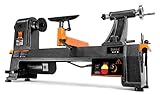


Quick comparison of budget wood lathes
| Lathe | Approx. market range | Swing over bed | Between centers | Speed range | Motor | Approx. weight |
|---|---|---|---|---|---|---|
| RIKON 70-105 | $400–$500 | 10 in. | 18 in. | 500–3,200 RPM | 1/2 HP | About 75 lb |
| WEN 3424T | $300–$450 | 12 in. | 18 in. | 520–3,400 RPM | 4.5 amp | About 70 lb |
| Shop Fox W1704 | $350–$450 | 12 in. | 18 in. | 700–3,200 RPM | 1/3 HP | About 53 lb |
| WEN 3421 | $200–$300 | 8 in. | 12 in. | 750–3,200 RPM | 3.2 amp | About 44 lb |
| Central Machinery 12 in. x 33 in. | $250–$400 | 12 in. | 33 in. | About 500–3,800 RPM | 1/2 HP | About 75–80 lb |
Specifications and package contents can change by revision, so confirm the current manual before buying. “Swing” is the largest theoretical diameter over the bed; a safe, comfortable workpiece is often smaller, especially when the blank is irregular. Likewise, the stated distance between centers includes the available bed space, not necessarily the length of a large blank after chucking.
Best picks by turning situation
| Your situation | Best fit | Why | Main compromise |
|---|---|---|---|
| First lathe for pens, handles, and small bowls | WEN 3421 | Lowest cost, compact footprint, sufficient capacity for small work | Limited 8-inch swing and 12-inch length |
| General-purpose home shop | WEN 3424T | 12-inch swing, 18-inch capacity, and useful variable-speed range | Lightweight construction can transmit vibration |
| More frequent use and better control of heavier blanks | RIKON 70-105 | Heavier build and a low 500 RPM starting speed | Only 10-inch swing and usually near the top of the budget |
| Long spindle work | Central Machinery 12 x 33 | Much more distance between centers than most competitors | Long capacity does not replace a rigid, well-supported bed |
| Occasional turning with a compact bench | Shop Fox W1704 | Small footprint and straightforward controls | Less motor reserve and a relatively high minimum speed |
Head-to-head: what each budget buys
RIKON 70-105: the stability-oriented choice
The RIKON 70-105 is appealing when the priority is controlled cutting rather than maximum stated diameter. Its approximately 75-pound mass, 1/2-horsepower motor, and 500 RPM minimum are useful for faceplate work, roughing larger bowls within its 10-inch swing, and learning to reduce an out-of-round blank without immediately running at high speed.
The 18-inch distance between centers covers typical chair spindles, tool handles, and small table legs. Its limitation is capacity: a 10-inch swing leaves less room for bowl work than a nominal 12-inch machine. It is also worth budgeting for a sturdier stand or bolting it down if you routinely turn dense hardwood or unbalanced stock.
WEN 3424T: the capacity-per-dollar pick
The WEN 3424T gives you a 12-inch swing and 18 inches between centers, making it one of the most versatile choices for a first full-size bench lathe. Its variable-speed range of roughly 520 to 3,400 RPM covers slow roughing and faster finishing, and the package commonly includes a faceplate, spur center, live center, tool rest, and knockout bar.
That accessory bundle is useful, but it does not eliminate the need for a four-jaw chuck, calipers, sharpening equipment, or better turning tools. The relatively light machine is also more sensitive to stand quality. A rigid stand with a broad footprint can improve the experience more than a small increase in advertised motor power.
Shop Fox W1704: compact, but not a heavy-duty lathe
The Shop Fox W1704 suits small projects and limited workspaces. Its 12-inch swing and 18-inch capacity look similar to the WEN 3424T on paper, but its 1/3-horsepower motor and roughly 53-pound weight place it closer to the light-duty end of the category. The speed range is convenient for small spindle work, although a 700 RPM minimum is not ideal for a large, uneven bowl blank.
Choose it for pens, bottle stoppers, small boxes, ornaments, and handles. Choose a heavier machine if your regular projects involve rough-sawn blanks, dense species, or repeated bowl turning.
WEN 3421: the sensible low-cost starting point
The WEN 3421 is a mini lathe with an 8-inch swing and 12-inch distance between centers. Its 3.2-amp motor is adequate for small, correctly secured work, and its approximately 44-pound weight makes it easier to move or store. It can be a good way to discover whether turning suits you without spending the entire budget.
Its limits arrive quickly if your plans include bowls wider than about 6 or 7 inches, long spindles, or aggressive cuts. It is also easier to move during a catch, so secure it to a bench and keep the workpiece conservative until you understand its behavior.
Central Machinery 12 x 33: long capacity at the expense of refinement
The Central Machinery 12-inch by 33-inch lathe is attractive for long spindles and oversized hobby projects because its between-centers capacity is dramatically greater than the 12- to 18-inch norm. The approximately 1/2-horsepower motor and low-speed capability are useful, but the long bed does not automatically mean the machine is ideal for large bowls.
Expect more setup attention: check alignment, clean shipping residue from the ways, inspect belt tension, and verify that the tool rest and tailstock lock firmly. It is a value-oriented option for a careful owner, not a substitute for a heavier production lathe.
Speed and motor performance: the numbers that matter
For roughing an irregular blank, lower speed is safer and easier to control. A lathe that starts around 500 RPM gives you more room than one that starts at 700 or 750 RPM. Once a blank is round and balanced, speed can increase for smoother cuts, but the correct setting depends on diameter, balance, chuck security, tool presentation, and the wood.
A useful rule for comparing motor claims is to treat amp ratings and horsepower as rough indicators, not direct equivalents. A lighter lathe may have a respectable advertised motor but still slow noticeably when the tool takes a deep cut. Heavier mass, a rigid stand, a sharp tool, and a correctly adjusted belt often matter just as much as the headline rating.
Accessories: what is included and what you will still need
Most of these lathes include a spur center for spindle work, a live center for the tailstock, a basic tool rest, a faceplate, and a knockout bar. These parts let you begin, but the included faceplate is generally more useful for simple projects than for a broad bowl that will be remounted repeatedly.
- Essential next purchase: a reliable four-jaw chuck with jaws suited to the work you plan to turn.
- Essential safety equipment: a full-face shield, hearing protection, dust protection, and sturdy footwear.
- Useful measuring tools: outside calipers, a parting gauge, and a ruler or story stick.
- Often overlooked: a sharpening system or grinder with a suitable wheel and a repeatable sharpening jig.
Setup and ownership realities
Before turning, clean protective oil and shipping debris from the bed, mount the lathe to a rigid stand, check that the headstock and tailstock centers align, and confirm that the tool rest locks without movement. Place the machine so that the workpiece cannot strike a wall, nearby tools, or the operator if it comes loose.
The parts that commonly need attention first are drive belts, belt tension, locking handles, center points, and the tool-rest surface. Keep the bed free of chips before sliding the tailstock; trapped debris can affect alignment. Do not use compressed air near bearings or electrical openings unless the manufacturer permits it, because it can drive dust deeper into the machine.
Budget for consumables as well as the lathe. A simple first-year calculation illustrates the real cost: a $350 machine, $100 chuck, $70 in basic sharpening supplies, and $40 for safety equipment totals about $560 before buying better gouges. If you turn twice a month for two years, that is roughly 48 sessions, or about $11.67 per session before wood and replacement abrasives. Buying the cheapest lathe can therefore be sensible only when its capacity matches your projects and you will not need to replace it immediately.
Final recommendation
For the broadest range of hobby projects, choose the WEN 3424T if you want 12-inch swing and a useful accessory package under a moderate budget. Choose the RIKON 70-105 if lower-speed control, greater mass, and more frequent use matter more than maximum swing. Choose the WEN 3421 for small work and minimum cost, the Shop Fox W1704 for compact light-duty turning, and the Central Machinery 12 x 33 only when long spindle capacity is the deciding requirement.
0 Comments