What's inside
As an Amazon Associate I earn from qualifying purchases. This post may contain affiliate links at no extra cost to you.
Best Variable Speed Wood Lathes for Smooth, Controlled Turning
The best variable speed wood lathe for most small-shop turners is a midi model with roughly 12 inches of swing, at least 16 inches between centers, electronic variable speed, and a belt range that keeps useful torque at low RPM. For bowls, prioritize low-speed performance and capacity; for spindles, prioritize between-centers length and a smooth speed range. The picks below reflect those tradeoffs rather than treating one lathe as right for every job.
Quick picks by turning job
- Best all-around midi: Rikon 70-150VSR, with 12 inches of swing, 16 inches between centers, and a ½ hp motor.
- Best for a longer spindle: Jet JWL-1221VS, with 12 inches of swing, 21 inches between centers, and a 1 hp motor.
- Best for larger bowls: Laguna Revo 18|36, with 18 inches of swing, 36 inches between centers, and a 2 hp motor.
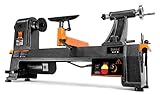
- Best compact option: WEN 3421, with 8 inches of swing, 12 inches between centers, and a 3.2-amp motor.
Variable-speed lathe comparison
Specifications below are manufacturer-published figures; verify the current configuration before buying, since details can vary by model revision and market. A lathe’s maximum swing is not a recommended bowl size: clearance, blank shape, mounting, and machine stability all matter.
As an Amazon Associate we earn from qualifying purchases at no extra cost to you.



| Model | Swing / between centers | Published speed range | Motor | Best fit |
|---|---|---|---|---|
| WEN 3421 | 8 in / 12 in | 750–3,200 RPM | 3.2 A | Small spindles, pens, and limited shop space |
| Rikon 70-150VSR | 12 in / 16 in | 250–3,200 RPM | ½ hp | General midi turning and smaller bowls |
| Jet JWL-1221VS | 12 in / 21 in | 60–3,600 RPM | 1 hp | Longer spindles and flexible speed control |
| Laguna Revo 18|36 | 18 in / 36 in | 50–3,500 RPM | 2 hp | Larger bowls and more demanding work |
Which model fits your work?
Rikon 70-150VSR: a balanced first midi lathe
The Rikon’s 12-inch swing handles a useful range of small bowls and spindle work, while its 250–3,200 RPM range gives room for both cautious roughing and finishing. Its ½ hp motor is appropriate for moderate cuts, not forcing a large, unbalanced blank through a heavy cut. Choose it if your work is varied but mostly modest in size and you want electronic speed adjustment without stepping up to a full-size machine.
Its limitation is capacity: 16 inches between centers can be restrictive for longer projects, and a 12-inch swing does not mean every 12-inch blank is a sensible starting point. Leave clearance for irregular edges and tool movement.
Jet JWL-1221VS: the spindle-friendly choice
The Jet combines a 12-inch swing with 21 inches between centers, making it a stronger fit for chair parts, table legs, and other longer spindle work than many compact midi lathes. Its published 60–3,600 RPM range is broad, and the 1 hp motor offers more headroom than a half-horsepower class machine.
That extra power does not eliminate the need to reduce speed for an unbalanced blank. Nor does it make the lathe a large-bowl machine: the 12-inch swing remains the physical limit, with practical working size lower when a blank is rough or irregular.
Laguna Revo 18|36: for larger work and regular use
With 18 inches of swing, 36 inches between centers, and a 2 hp motor, the Revo 18|36 is the clear choice here for turners who expect to make larger bowls or longer pieces frequently. Its 50–3,500 RPM range includes a very low setting for cautious startup, but low RPM alone does not guarantee strong torque. The drive system and selected belt range also determine how effectively the motor turns a heavy blank slowly.
This is a substantial investment in space as well as money. Check the machine’s footprint, weight, electrical requirements, and whether your floor and bench arrangement can support the setup. It is poor value if your projects rarely exceed midi-lathe capacity.
WEN 3421: compact and budget-conscious
The WEN is suited to small projects and shops where footprint and initial cost matter more than capacity. Its 8-inch swing and 12-inch bed limit bowl and spindle size, and its 750 RPM minimum is higher than the other models in this comparison. That makes it less forgiving for starting larger or noticeably unbalanced blanks.
Consider it for small, relatively balanced work and occasional use. If you expect to turn bowls, grow into longer spindles, or work with rough blanks, a machine with more swing and a lower speed floor is the better long-term choice.
How to choose by situation
| Your situation | Better fit | Why |
|---|---|---|
| Beginner, small shop, mostly small projects | WEN 3421 | Small footprint and capacity match compact work; accept its higher minimum speed. |
| Beginner or intermediate, mixed work, moderate budget | Rikon 70-150VSR | Useful midi capacity and electronic speed control for varied projects. |
| Frequent long spindle work | Jet JWL-1221VS | Its 21-inch between-centers capacity is the key advantage. |
| Frequent large bowls or heavier work | Laguna Revo 18|36 | More swing, bed length, and motor power, provided your space and budget allow. |
Speed control and low-speed torque: what the numbers don’t tell you
Electronic variable speed changes RPM with a dial or control panel, so you can adjust speed without stopping to move a belt. Many lathes still use stepped pulleys and a belt-range change to cover the full speed span. The electronic control is convenient, but the pulley position matters: a low-speed belt range generally gives more useful torque at the spindle than running a high range at its lowest electronic setting.
For a rough, uneven blank, start at the lowest suitable belt range and a conservative speed. Secure the work, stand out of the line of fire during startup, and increase RPM only after the piece runs without excessive vibration. The correct speed depends on blank diameter, balance, mounting, and cut—not just the lathe’s maximum RPM. Follow the manufacturer’s guidance, and do not exceed the rated speed of a chuck, faceplate, or other accessory.
Ownership details worth checking
- Readouts and controls: A digital RPM readout helps repeat settings, but it does not compensate for a wrong belt range or an unstable blank.
- Stand and mounting: A light lathe can vibrate during roughing. A rigid stand, secure anchoring where appropriate, and careful blank balancing improve control.
- Belts and dust: Belts are wear items. Keep dust out of vents and controls, and inspect belt condition and tension according to the manual.
- Capacity upgrades: Bed extensions may add spindle length but do not increase swing. Confirm compatibility and remember that an extension may need its own support.
- Electrical fit: Check voltage, amperage, plug, and circuit requirements before purchase, especially for a larger motor.
Bottom line
For a versatile midi lathe, the Rikon 70-150VSR is the balanced pick. Choose the Jet JWL-1221VS when longer spindles matter more than bowl capacity, the Laguna Revo 18|36 for regular larger work, and the WEN 3421 for small projects in a compact shop. In every case, prioritize a suitably low speed, stable mounting, and useful torque in the chosen belt range over the headline maximum RPM.
0 Comments