What's inside
- Best Wood Lathe Chisels: Top Picks for Every Turning Style
- Top picks by turning style
- Steel, size, and handle: what changes the buying decision?
- Choose by experience, workspace, and sharpening habits
- Grind options: buy for the cuts you want to make
- Sharpening and durability: the costs beyond the set
- Bottom line
- Best Wood Lathe Chisels: Top Picks for Every Turning Style
- Top picks by turning style
- Steel, size, and handle: what changes the buying decision?
- Choose by experience, workspace, and sharpening habits
- Grind options: buy for the cuts you want to make
- Sharpening and durability: the costs beyond the set
- Bottom line
As an Amazon Associate I earn from qualifying purchases. This post may contain affiliate links at no extra cost to you.
Best Wood Lathe Chisels: Top Picks for Every Turning Style
The best wood lathe chisels for most turners are a small, well-made high-speed steel (HSS) set with a spindle roughing gouge, spindle gouge, bowl gouge, scraper, and parting tool; choose individual tools instead if you know your preferred turning style or grind. HSS holds an edge longer than traditional carbon steel and tolerates heat better, while handle length, tool size, and grind determine how comfortably and safely each chisel cuts.
Top picks by turning style
- Best general-purpose set: A five- or six-piece HSS starter set from a recognized turning-tool maker, such as Robert Sorby or Crown Hand Tools. Look for clearly labeled HSS blades, full-size handles, and useful core profiles rather than a large assortment of duplicate scrapers.
- Best for bowl turning: A 3/8-inch or 1/2-inch bowl gouge, selected by flute width and grind. A swept-back grind is versatile for shaping and finishing; a more traditional grind may suit turners who prefer controlled, supported cuts.
- Best for spindle work: A 3/8-inch or 1/2-inch spindle gouge plus a roughing gouge, skew, and parting tool. These cover beads, coves, tapers, and sizing cuts. Do not use a spindle roughing gouge on a bowl: its tang and construction are not designed for that job.
- Best value for occasional use: A compact HSS set or a few individual HSS tools. Spending on the profiles you will use is usually more useful than buying a large entry-level set with tools you rarely touch.
- Best for a confident sharpener: Individual HSS tools with the preferred grind—or powdered-metallurgy steel if available within budget. Premium steel can reduce sharpening frequency, but it cannot compensate for an unsuitable profile or poor sharpening technique.
Steel, size, and handle: what changes the buying decision?
| Tool or feature | Common size or length | Best suited to | Ownership trade-off |
|---|---|---|---|
| HSS turning tool | About 1/4–1/2 in. (6–13 mm) across common gouge sizes | Frequent sharpening, varied projects, general workshop use | Costs more than basic carbon steel but usually needs sharpening less often |
| Carbon-steel turning tool | Often sold in similar nominal sizes to HSS | Budget-conscious or occasional turning with ready sharpening access | Typically loses its edge sooner and is more sensitive to overheating |
| Short-handled tool | Roughly 10–14 in. (25–36 cm) overall | Small lathes, close work, limited storage | Less reach and leverage; may feel cramped on larger work |
| Full-size handled tool | Roughly 16–24 in. (41–61 cm) overall | Bench and floor lathes, larger work, two-handed control | Needs more storage, but offers reach and leverage at the tool rest |
| 3/8-in. bowl gouge | Common flute width; actual bar diameter varies by maker | Small and medium bowls, lighter cuts | Less mass than a larger gouge; may chatter more on heavy cuts |
| 1/2-in. bowl gouge | Common flute width; actual bar diameter varies by maker | Medium and larger bowls, more substantial cuts | More robust, but needs a compatible grinder setup and comfortable handling |
Sizes in this table are common examples, not universal standards: makers may label gouges by flute width, bar diameter, or both. Check the manufacturer’s dimensions before buying. Overall handle lengths also vary by model.
As an Amazon Associate we earn from qualifying purchases at no extra cost to you.


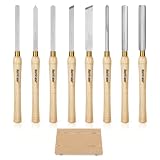
HSS is the practical starting point for most people because it combines decent edge life with forgiving sharpening. Traditional carbon steel can be cheaper and sharpens readily, but frequent users may spend more time at the grinder. Powdered-metallurgy steels can hold an edge longer still, often at a higher price. Their advantage matters most when sharpening interruptions are costly; for a new turner still learning tool presentation, a sound HSS tool is usually the better investment.
Handles are part of the control system, not an afterthought. A short handle can work well on a compact lathe, but a longer handle gives more leverage and helps keep hands farther from the work. Choose a length that lets you brace the tool against your body or hip while keeping the bevel supported on the tool rest. Handle comfort and balance are individual, so a set with replaceable or standard-sized handles can be useful.
Choose by experience, workspace, and sharpening habits
| Your situation | Good starting choice | Why it fits |
|---|---|---|
| New to turning; unsure what you will make | Five- or six-piece HSS set with full-size handles | Covers core spindle and bowl profiles without committing to specialty tools |
| Mostly pens, handles, or other spindle work | Spindle gouge, roughing gouge, skew, and parting tool | Prioritizes the shapes and cuts used on work held between centers |
| Mostly bowls | One suitable bowl gouge first, then add a second grind or size | Builds skill with a useful profile instead of paying for unused spindle tools |
| Small lathe or limited storage | Shorter handles and modest tool sizes matched to the lathe | Improves maneuverability and reduces storage demands |
| Turns often and dislikes frequent sharpening | HSS or premium steel individual tools in the most-used profiles | Longer edge life can reduce interruptions; choose premium steel only where use justifies it |
| Still learning to sharpen | HSS tools with a consistent, commonly supported grind | More forgiving than a collection of specialty grinds that require different setups |
For a first purchase, a smaller, balanced best wood lathe chisel set is often more useful than a 10- or 12-piece bundle. A sensible core might include a bowl gouge, spindle gouge, roughing gouge, skew, scraper, and parting tool. If you only turn spindles, swap the bowl-focused choices for the profiles you will actually use.
Grind options: buy for the cuts you want to make
Grind describes the cutting edge’s shape and the bevel behind it. It affects access, control, and which parts of the tool can make a clean cut. A traditional bowl-gouge grind is a good starting point for learning supported cuts. A swept-back or “Irish” grind exposes longer wings for shaping and finishing, but those wings need careful control. A fingernail grind on a spindle gouge helps reach coves and beads. A skew’s straight or slightly rounded edge is suited to clean spindle cuts, but it rewards practice and a stable presentation.
Sets sometimes arrive with factory grinds that differ from the profile shown in a sharpening jig’s instructions. Before buying, check whether the tools are supplied ground and whether the maker lists a recommended profile. Pick one grind, learn to reproduce it consistently, and alter it only when a specific cut calls for the change. Constantly changing the profile makes sharpening less repeatable.
Sharpening and durability: the costs beyond the set
A turning chisel is only as useful as its edge. Plan for a bench grinder or sharpening system, a wheel or abrasive suitable for tool steel, and a repeatable way to hold the tool. Many turners use a jig for bowl-gouge profiles because it helps reproduce the same wing shape. A jig is not essential, but it can reduce guesswork while learning.
- Sharpen little and often: A quick touch-up usually removes less steel than waiting for a visibly dull edge and grinding heavily.
- Manage heat: Avoid pressing hard or holding the edge in one spot. If the tool becomes too hot to handle comfortably, pause and cool it; overheating can damage the cutting edge, especially on carbon steel.
- Keep the edge clean: Wipe off resin and dust after use, and store tools so edges do not strike one another. A light protective coating can help in a damp shop, but remove residue before turning.
- Expect gradual wear: The cutting edge needs regular sharpening; over time, repeated grinding shortens the tool. Handles can loosen, and wooden handles may crack after impacts or poor storage. These are more typical ownership concerns than a sudden failure of sound HSS steel.
- Avoid common misuse: Do not use a spindle roughing gouge on bowl blanks, and do not let a tool hang unsupported far beyond the tool rest. Match tool size to the lathe and workpiece.
When comparing prices, include sharpening equipment and replacement abrasives in the budget. A low-cost set paired with no safe way to maintain its edges can be a worse buy than a few HSS tools and a basic, repeatable sharpening setup.
Bottom line
For an all-around first purchase, choose a compact HSS set with full-size handles and the core profiles for your intended work. For bowl turning, prioritize a comfortable bowl gouge and learn one grind before adding alternatives; for spindle work, build around a spindle gouge, skew, and parting tool. Buy premium steel or extra profiles when your turning frequency and sharpening routine make the difference worthwhile—not simply because a set contains more tools.
0 Comments