What's inside
- Choose the spindle motor that matches your cuts—not the biggest number
- Compare common spindle sizes and cooling options
- Choose by your work and workshop
- Match RPM to the cutter and material
- Check electrical and mechanical compatibility before buying
- Cooling: simpler setup versus quieter operation
- Budget for the setup, not just the motor
- A practical decision rule
- Choose the spindle motor that matches your cuts—not the biggest number
- Compare common spindle sizes and cooling options
- Choose by your work and workshop
- Match RPM to the cutter and material
- Check electrical and mechanical compatibility before buying
- Cooling: simpler setup versus quieter operation
- Budget for the setup, not just the motor
- A practical decision rule
As an Amazon Associate I earn from qualifying purchases. This post may contain affiliate links at no extra cost to you.
Choose the spindle motor that matches your cuts—not the biggest number
For most woodworkers cutting with a desktop or mid-size CNC router, a 1.5–2.2 kW spindle with a speed range around 6,000–24,000 RPM, an ER20 collet, and cooling suited to the machine’s duty cycle is a versatile starting point. Choose a smaller air-cooled unit for light, intermittent work and simple installation; consider a larger water-cooled spindle when you need sustained cutting, lower noise, or more torque at moderate speeds. Before buying, confirm that the spindle, inverter, electrical supply, mount, and collets all fit your machine.
The right spindle motor CNC setup depends on the cutter and cut as much as the material. A small end mill needs a stable, appropriately low speed and low runout; a large surfacing bit needs enough power and machine rigidity. More spindle power cannot compensate for a flexible frame, dull cutter, or poor chip evacuation.
As an Amazon Associate we earn from qualifying purchases at no extra cost to you.
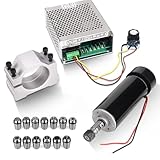


Compare common spindle sizes and cooling options
These figures are representative ranges, not guarantees for every model. Check the manufacturer’s rated speed, power, current, dimensions, and collet compatibility before ordering. A spindle’s stated power may be electrical input rather than usable output.
| Spindle type | Typical power | Typical speed range | Common collet | Cooling and best fit |
|---|---|---|---|---|
| Compact trim-router spindle | 0.8–1.5 kW | 8,000–24,000 RPM | ER11 or ER16 | Usually air-cooled; small machines, engraving, and light cuts |
| Mid-size router spindle | 1.5–2.2 kW | 6,000–24,000 RPM | ER16 or ER20 | Air- or water-cooled; general-purpose woodworking |
| Heavy router spindle | 3.0–4.5 kW | 6,000–18,000 RPM | ER20 or ER25 | Often water-cooled; larger machines and sustained heavier cuts |
| Low-speed, high-torque spindle | 2.2–4.5 kW | About 3,000–12,000 RPM | ER20 or ER25 | Typically water-cooled; larger cutters and work that benefits from lower RPM |
Collet capacity is not the same as recommended cutter size. ER20 tooling can accept shanks up to 13 mm in some setups, but the exact supported range depends on the collet and spindle. Use the correct collet for each shank diameter—never clamp a smaller shank in an oversized collet—and avoid pushing a large cutter beyond the CNC’s rigidity or spindle limits.
Choose by your work and workshop
- Occasional carving, signs, and small cutters: A compact air-cooled spindle can keep the system simple. Prioritize low runout, reliable speed control, and an ER collet system with the sizes your cutters use.
- Regular work in hardwood or sheet goods: A 1.5–2.2 kW spindle is a practical middle ground for many machines. An ER20 collet offers more flexibility for common router-bit shanks, provided the machine can carry the spindle’s weight.
- Long jobs or noise-sensitive space: A water-cooled spindle is often quieter because it does not rely on a high-speed cooling fan. It adds a pump, reservoir, hoses, coolant, and leak checks, so plan for the extra maintenance and space.
- Large cutters or production duty: Look at 3 kW and above only if the CNC frame, Z-axis, electrical supply, and workholding can support the added load. A spindle with a lower speed rating may suit larger tooling better, but confirm its torque curve and minimum operating speed.
- Limited electrical capacity or a small machine: Stay within the machine’s documented current and voltage limits. A smaller spindle that runs reliably is more useful than a high-powered unit that requires a supply or inverter your setup cannot support.
Match RPM to the cutter and material
Many woodworking operations use small cutters at high RPM, but running every tool at maximum speed is not a safe default. Large-diameter cutters have a higher edge speed at the same RPM; they may need a slower setting, and some tooling is not approved for CNC use. Follow the cutter manufacturer’s speed limit and use feeds and depths appropriate to the bit, material, and machine.
For example, a 6 mm end mill may be used at a higher RPM than a 25 mm surfacing cutter, but the exact setting depends on cutter geometry and feed rate. If chips turn to fine dust, the tool may be rubbing rather than cutting. If the machine chatters, burns the wood, or loses steps, stop and reassess the feed, RPM, depth of cut, sharpness, and rigidity instead of simply increasing spindle power.
Check electrical and mechanical compatibility before buying
A CNC spindle motor usually runs from a variable-frequency drive (VFD), which controls speed and requires correct configuration. Confirm that the VFD input matches your available supply, its output matches the spindle’s voltage and phase, and its current rating is suitable. A spindle labeled for three-phase output does not necessarily require a three-phase household supply; some VFDs accept single-phase input and produce three-phase output, but the specific VFD must be rated for that arrangement.
- Supply and wiring: Check voltage, phase, rated current, grounding, cable type, and circuit capacity against the spindle and VFD manuals. Have a qualified electrician handle wiring if you are unsure.
- Control and speed: Confirm the VFD accepts the CNC controller’s speed-control signal and that minimum and maximum frequencies are set to the spindle’s limits.
- Physical fit: Measure the spindle body and mount diameter, tool clearance, collet access, and Z-axis capacity. Compare spindle weight with the machine’s specifications.
- Safety: Use a properly grounded installation, suitable emergency-stop and interlock arrangements, and eye and hearing protection. Keep the spindle from starting unexpectedly during setup or tool changes.
Cooling: simpler setup versus quieter operation
Air cooling is easier to install and avoids a coolant loop. Its fan adds noise and can draw dust toward the spindle, so keep the air passages clear and position dust collection thoughtfully. Do not assume an air-cooled spindle can run continuously at full load; use its duty-cycle rating.
Water cooling can reduce operating noise and support sustained use, but it is not maintenance-free. Use the coolant type and flow rate specified by the manufacturer, secure the hoses, and verify circulation before starting the spindle. Check the reservoir and connections regularly; a pump failure or leak can damage equipment. In cold spaces, protect the loop from freezing.
Budget for the setup, not just the motor
General market prices vary by power, quality, and included accessories: compact spindle-and-drive packages are often in the low hundreds of dollars, while higher-power or better-supported systems can cost several hundred dollars or more. Budget separately for a compatible VFD, mount, correctly sized collets, wiring, cooling hardware if needed, and installation. The lowest purchase price can become poor value if replacement collets are hard to source or the drive lacks support for your controller.
Collets and bearings are ownership items to monitor. Keep collets and their nuts clean, avoid tightening a dirty or damaged assembly, and replace collets that show wear or fail to hold cutters securely. Dust buildup can obstruct air cooling, while coolant systems need periodic checks. Poorly balanced tooling, overtightening, and running a cutter with excessive stick-out can accelerate wear or cause vibration.
A practical decision rule
Start with the largest cutter and hardest material you expect to use regularly, then check the machine manufacturer’s limits for spindle weight, power, and cutting load. Choose an RPM range that suits those tools, a collet system that fits their shanks, and a cooling method you can maintain. For a typical hobby CNC used on wood a few hours at a time, a compatible 1.5–2.2 kW spindle with ER20 collets is often a sensible balance. Step down for light work or limited power; step up only when the machine and electrical setup are built to take advantage of it.
0 Comments