What's inside
As an Amazon Associate I earn from qualifying purchases. This post may contain affiliate links at no extra cost to you.
Best Benchtop CNC Mills for a Home Shop or Small Workshop
For most home shops, the best benchtop CNC mill is a compact, rigid machine with enough travel for the parts you actually make—not the largest advertised work area you can squeeze onto a bench. Choose a lighter desktop mill for plastics, wood, and occasional aluminum; step up to a heavier machine if you plan regular metal cutting and have a sturdy stand, room for enclosure and chip control, and time for careful setup.
Compact CNC mills compared
Specifications vary by configuration, and usable cutting area is smaller than axis travel once you account for the tool, workholding, and safe clearances. The figures below are representative published specifications; verify the exact configuration before buying, especially if a machine has optional extensions or different spindle packages.
As an Amazon Associate we earn from qualifying purchases at no extra cost to you.
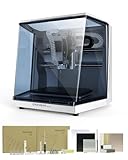

| Machine | Approx. X/Y/Z travel | Approx. machine weight | Practical fit | Setup consideration |
|---|---|---|---|---|
| Carbide 3D Nomad 3 | 8 × 8 × 3 in | About 65 lb | Small parts in wood, plastics, wax, and light aluminum work | Enclosed desktop format; confirm workholding and tool reach for your part |
| Carbide 3D Shapeoko 5 Pro, 2 × 2 ft configuration | About 23.5 × 23.5 × 4.5 in | About 100 lb, configuration dependent | Larger wood, plastic, and light nonferrous-metal projects | Router-style platform needs a rigid base, dust management, and room beyond the cutting area |
| Sherline 5400 CNC-ready mill | About 6 × 2.5 × 6.25 in | About 30–40 lb, configuration dependent | Small, precise parts; light cuts in aluminum and other machinable metals | “CNC-ready” means drives and control may need to be purchased or configured separately |
| Tormach PCNC 440 | 10 × 6.25 × 10 in | About 600 lb | More demanding metalworking in a compact industrial-style mill | Requires substantial floor support, power planning, coolant/chip strategy, and delivery access |
These examples span very different meanings of “benchtop.” A Nomad is a self-contained desktop machine; a Shapeoko is a larger gantry CNC often used for wood and plastics; Sherline’s small mill is a conventional mill platform that can be CNC-equipped; and the PCNC 440 is a heavy compact machining center rather than a machine to casually place on a household bench. Compare actual configurations and manufacturer documentation, not just model-family names.
Choose by the work, not the travel number
For engraving and small, occasional parts
A compact enclosed mill such as the Nomad 3 makes sense when parts fit within its limited envelope and convenience matters more than throughput. Its enclosure helps contain chips, but it does not eliminate cleanup, tool changes, workholding decisions, or the need to learn feeds and speeds. For a small shop making instrument parts, fixtures, or prototypes, a smaller machine can be more useful than an oversized one that is difficult to set up.
For larger wood and plastic projects
A Shapeoko 5 Pro offers much more XY reach than a small desktop mill, making it a better match for panels, signs, templates, and broad workpieces. It is a gantry router-style CNC, not a rigid knee mill: plan on conservative cuts in metal, particularly steel. Aluminum may be possible with appropriate tooling, feeds, workholding, and shallow passes, but cut quality and reliability depend heavily on machine rigidity and setup. Allow clear space around the frame for loading stock and servicing the machine.
For small metal parts
A Sherline CNC-ready mill is a better starting point when compact metalworking and a conventional milling layout matter more than a large work envelope. Check what “CNC-ready” includes: the mill may require stepper motors, a motion controller, wiring, and control software before it can cut under computer control. Its small size limits part dimensions and often means taking light cuts, but it is easier to support and accommodate than a several-hundred-pound machine.
For frequent, more serious metal cutting
The Tormach PCNC 440 is in another weight and ownership class. Its mass and machine-tool format are advantages for rigidity, but they create real installation demands: a suitable stand or foundation, safe unloading, electrical compatibility, and a plan for chips and coolant. If your shop cannot accommodate those needs, buying a lighter mill is not a compromise—it may be the more practical choice.
Check fit and setup before ordering
- Measure the part envelope: Include clamps, vise jaws, tool length, and clearance for the spindle. A 6-inch travel axis does not guarantee a 6-inch-wide part can be machined in one setup.
- Measure the whole installation: Allow access to doors, controls, cable chains, and enclosure panels, as well as room to load stock. A frame’s footprint is not the same as its operating footprint.
- Check bench or floor capacity: Add the machine, stand, vise, stock, and accessories. A heavy mill on a flexible bench can vibrate, affect cut quality, and make leveling harder.
- Budget for the complete system: The machine price may not include a vise, cutters, probing, workholding, computer, software, dust collection, enclosure, or electrical work. General market prices range from a few thousand dollars for compact desktop and hobby systems to well into five figures for heavier machine tools, depending on configuration and accessories.
- Plan for noise and debris: Router-based machines can be loud and produce substantial dust or chips. Metal-cutting setups need chip management and, where appropriate, coolant containment. Check ventilation and nearby electronics before choosing a location.
A practical decision matrix
| Your situation | Likely direction | Why |
|---|---|---|
| Very limited space; small parts; beginner | Enclosed desktop mill | Lower weight and a contained footprint simplify placement, though the work envelope is small. |
| Room for a frame; mostly wood, plastic, or sheet goods | Gantry CNC such as a Shapeoko configuration | More XY coverage suits large projects, with less emphasis on heavy metal cuts. |
| Small parts and regular light metal cuts | Compact conventional mill, such as a CNC-equipped Sherline | Mill-style workholding and a compact footprint suit smaller metal components. |
| Frequent metal production; room and installation budget available | Heavy compact machine tool | Greater mass and capability can support more demanding work, but require serious setup planning. |
Ownership realities that affect the choice
On any CNC benchtop mill, cutters and workholding are recurring costs. Small end mills can chip or dull quickly when feeds, spindle speed, tool stickout, or material holding are wrong. Loose work is especially dangerous: secure the stock before a job, use a toolpath suited to the cutter, and start unfamiliar cuts conservatively. Keep ways, rails, screws, and the work area clear of chips; follow the manufacturer’s lubrication and maintenance schedule. Dust from wood and abrasive debris can also reach bearings or electronics if the machine is not protected.
Setup effort differs as much as cutting ability. A ready-to-run desktop system may still need calibration, a flat and stable surface, and software learning. A CNC-ready mill adds motor and control integration. A heavy mill may arrive in sections or require professional delivery and installation. Ask what is included, what power is required, and whether the machine can be moved through your doorway before committing.
Bottom line
Match the machine to your most common material and largest realistic part. Pick a compact enclosed mill for small, tidy jobs; a gantry CNC for larger wood and plastic work; a small conventional mill for modest metal parts; and a heavy machine tool only when your workload and shop can support its weight and setup. For any benchtop CNC mill, usable travel, rigidity, and installation space matter more than a headline axis number.
0 Comments